Why choose HSO for Microsoft Foundry consulting
HSO combines Microsoft platform depth, a data-first delivery approach, and specialist AI deployed engineering, so your Foundry investment reaches production instead of stalling at proof of concept.

Microsoft Foundry Consulting (Formerly Azure AI Foundry)
Design, build, and govern custom AI agents and apps on Microsoft Foundry.





Move Microsoft Foundry prototypes into production AI
A working AI prototype can take days. Getting it into production as a governed, audited agent that runs inside your core systems can take months, and that gap is where most enterprise AI programs stall. Microsoft Foundry is built to close it.
Microsoft Foundry (formerly Azure AI Foundry) is Microsoft's unified platform for building, deploying, and governing custom AI apps and agents. It brings more than 11,000 models, a managed agent runtime, enterprise knowledge retrieval, and fleet-wide security controls into a single Azure environment.
HSO's Microsoft Foundry consulting services take your use case from idea to a production agent that is grounded in your data, integrated with Dynamics 365 and the systems you already run, and governed from day one.
11,000+
Foundation, open, reasoning, multimodal, and industry models in the Foundry catalog
80%
Of Fortune 500 companies use Foundry, across 80,000+ enterprises and digital natives
327%
Three-year ROI for a composite enterprise using Foundry
6 months
Payback period reported by teams using Foundry to build AI apps and agents
*Source: Microsoft/Forrester
End-to-End Microsoft AI Expertise
Microsoft Foundry consulting services
HSO delivers Microsoft Foundry consulting across the full AI lifecycle: strategy, architecture, build, integration, governance, and ongoing operations. Every engagement starts with the KPI the solution needs to move, then works backward to the right model, agent design, and data foundation. Foundry work sits within HSO's wider AI consulting services, alongside its other Microsoft AI solutions.
Use case workshops that test each idea against the right Microsoft tool, so Foundry is reserved for work that needs code-first control and simpler needs go to Microsoft 365 Copilot or Copilot Studio.
Value case and KPI baseline definition tied to outcomes such as cost per transaction, cycle time, or forecast accuracy, not model accuracy alone.
Consumption forecasting across model tokens, agent runtime, knowledge retrieval, and observability, so cost is modeled before the first build sprint.
A sequenced Foundry roadmap that moves from one proven use case to the next, rather than a portfolio of disconnected pilots.
Responsible AI impact assessment aligned to Microsoft's Responsible AI Standard before design begins.

Why choose HSO for Microsoft Foundry consulting
HSO has spent 22 consecutive years in Microsoft's Inner Circle, which recognizes fewer than 1% of partners worldwide. In June 2026, HSO also earned the Microsoft Frontier Partner Badge for moving customers from AI pilots into governed production.
HSO's AI engineers bring close to a decade of production machine learning and generative AI work on Microsoft's platform, with dozens of solutions taken from prototype to production.
HSO starts with the ERP, CRM, and operational data an agent has to act on, backed by 30+ years of Dynamics 365 delivery. HSO also runs its own production agents, so integration patterns are proven, not theoretical.
HSO designs identity, guardrails, Purview policies, and evaluation into every agent from the start, not after launch. Each agent is tied to a KPI baseline, so every result makes the case for the next use case.
Our Microsoft AI technology stack
HSO leverages the full Microsoft ecosystem to deliver Copilot solutions that are secure, scalable, and grounded in your organizational data.

Microsoft Foundry (Formerly Azure AI Foundry)

Microsoft Copilot

Copilot Cowork


Microsoft Graph

Microsoft Entra
"When an organization wants to build an agent that will be used across the business, or externally, at large scale, that's where Copilot Studio or Microsoft Foundry come in. That's where we create specialist agents to do specific things. M365 Copilot is more about personal productivity: interactive reviews, summaries, and content creation."

Our customers
See how organizations across industries are transforming their operations with HSO's AI services.
Common Microsoft Foundry challenges and solutions
Foundry gives developers more control than any other Microsoft AI solution. That control is also where most implementations get stuck.
Challenge: Teams build a convincing prototype in days, then spend months on identity, security, deployment, and monitoring for every new use case. Each project restarts from zero, and leadership loses patience before anything ships.
Solution: HSO sets up a reusable Foundry foundation once, covering the landing zone, identity, guardrails, CI/CD, and evaluation, then builds each new agent on it. The second use case ships faster than the first, and the third faster again.
Challenge: With more than 11,000 models and several deployment options, teams default to the largest model for every task. Token spend climbs, latency suffers, and nobody can say what a single transaction costs.
Solution: HSO benchmarks candidate models against your real tasks, configures Model Router to match each request to the right model, and sets per-agent cost monitoring so spend stays predictable as usage scales.
Challenge: Poorly structured knowledge sources, stale indexes, and weak retrieval design produce answers that sound confident but are wrong. One bad answer in front of a customer or auditor can end a program.
Solution: HSO designs the knowledge architecture before the agent, using Foundry IQ and Azure AI Search for grounded retrieval, then runs groundedness and task adherence evaluations before launch and continuously in production.
Challenge: Autonomous agents call tools, touch sensitive data, and act on behalf of users. Without central control, organizations end up with dozens of agents with unknown owners, broad permissions, and no audit trail.
Solution: HSO deploys Foundry Control Plane, Entra Agent ID, and runtime guardrails from the first agent, so every agent has a verified identity, a defined owner, least-privilege access, and logged activity that holds up to GDPR and internal audit.
View HSO's AI compliance services
Challenge: A standalone AI app that employees have to open separately rarely gets used. Value comes when AI acts inside the ERP, CRM, and workflows that run the business.
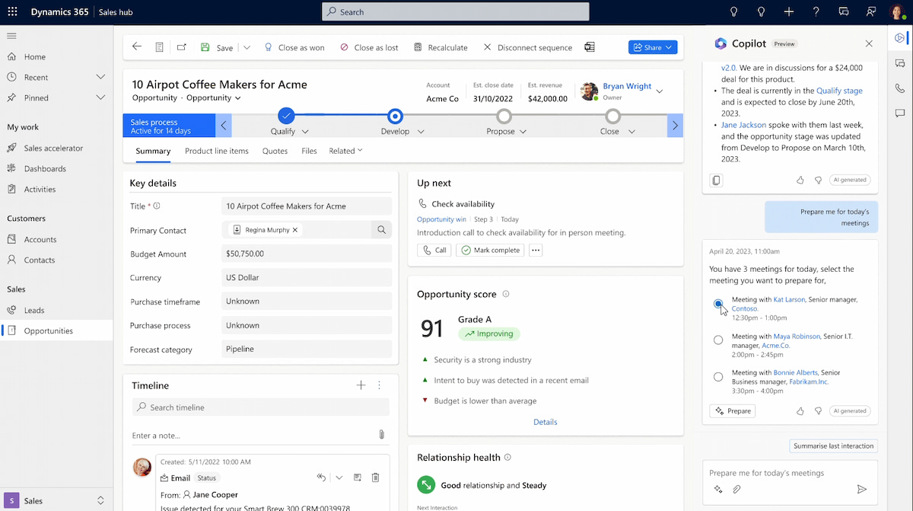
Solution: HSO integrates Foundry agents with Dynamics 365 and line-of-business systems, applies existing business rules, and publishes agents into Microsoft 365 Copilot and Teams so they show up where work already happens.
Challenge: Many early adopters built on hub-based Azure AI Foundry projects, Prompt Flow, or standalone Azure OpenAI resources. Hub-based projects do not receive new agent and model features, and Prompt Flow must be migrated by April 2027.
Solution: HSO assesses your current Azure AI estate, plans a phased move to Foundry projects and Microsoft Agent Framework workflows, and regression-tests each workload so nothing breaks in the move.
What's new in Microsoft Foundry
Foundry has moved quickly from model playground to full agent platform. Recent releases that shape how HSO designs solutions include:
Foundry Agent Service reached general availability in March 2026, with private networking and expanded MCP authentication.
Microsoft Agent Framework 1.0, the unified multi-agent SDK for .NET and Python, reached general availability in April 2026.
Foundry agents can now publish directly into Microsoft 365 Copilot and Teams, generally available since June 2026.
Routines, Tool Search, and Agent-to-Agent connections became generally available in September 2026.
Autopilot agents, now in public preview, give an agent its own Entra identity, mailbox, calendar, and Teams presence so it can work alongside teams in group chats.
HSO's Frontier Partner status means consultants work with these capabilities early, so your architecture is designed for where the platform is heading.
Ready to take a Foundry prototype into production, or not sure where to start? HSO's Microsoft Foundry consultants will help you scope the right first use case.
Related resources
Learn how we're empowering Microsoft AI adoption

