Real-World Applications
Non-Profit Success Stories

Microsoft Dynamics 365 for Non-Profits
A connected. agentic business platform that helps non-profit organizations modernize and grow by implementing the solutions they need today and expanding as their mission evolves.

What Is Microsoft Dynamics 365 for Non-Profits?
Microsoft Dynamics 365 is a suite of connected business applications that non-profits can use to manage functions such as constituent relationships, fundraising and engagement, finance, operations, customer service, and other organizational needs. Organizations can implement the Dynamics 365 applications that fit their priorities today and add additional capabilities as their needs evolve.
Microsoft Dynamics 365 applications work together with supporting Microsoft technologies—including Microsoft Power Platform, Microsoft 365, Dataverse, Fabric, Azure, and AI—to connect data and processes across the organization. As Microsoft continues to evolve Dynamics 365 toward more agentic business applications, organizations can increasingly use Copilot and AI agents alongside their business data and workflows to help automate work, surface insights, and support better decisions.
This gives non-profits the flexibility to modernize a single business function or create a broader connected platform while integrating with many of the systems they already use, helping protect existing technology investments and reduce disconnected data and manual processes.

Non-Profit Success: How Children International is Advancing Its Mission to Eliminate Generational Poverty
Children International partnered with HSO to replace siloed legacy systems with Microsoft, creating a more connected, data-driven foundation to support its global mission and the communities it serves.
Choosing the Right Microsoft Technology for Your Organization
Every non-profit has different priorities, existing technologies, and transformation goals. Microsoft gives you the flexibility to implement the applications you need today, integrate with the systems you already rely on, and expand your solution as your organization evolves. You also get a foundation for Copilot and agentic experiences that connect AI with your data, applications, and processes.
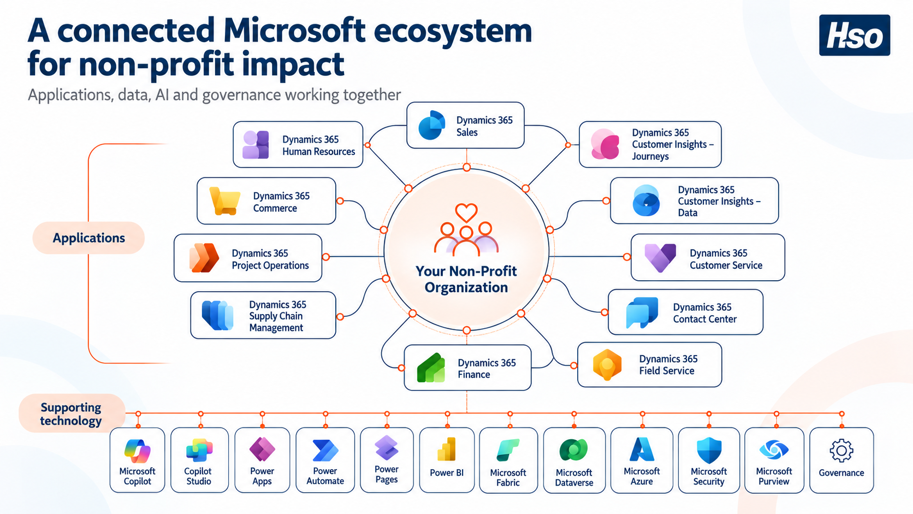
Microsoft Dynamics 365 Sales: Manage donors, members, sponsors, volunteers, and constituent relationships — Centralizes constituent information, tracks interactions, manages fundraising pipelines, and helps build stronger relationships.
Microsoft Dynamics 365 Customer Insights–Journeys: Create personalized fundraising campaigns and constituent journeys — Automates personalized email journeys, event communications, donor engagement, and ongoing constituent outreach.
Microsoft Dynamics 365 Customer Insights – Data: Create unified constituent profiles — Brings together data from multiple sources to create a more complete view of donors, members, volunteers, beneficiaries, and other constituents for segmentation, personalization, analytics, and AI.
Microsoft Dynamics 365 Customer Service: Deliver responsive constituent and program support — Helps teams manage inquiries, cases, knowledge, service requests, and interactions so donors, members, beneficiaries, and other constituents receive more consistent support.

Microsoft Dynamics 365 Contact Center: Manage service and support across channels — Provides a connected environment for handling voice, digital, and other constituent interactions while improving service coordination, responsiveness, and visibility across channels.
Microsoft Dynamics 365 Field Service: Coordinate people, resources, and work in the field — Helps organizations manage scheduling, work orders, mobile teams, equipment, and field activities for programs and services delivered outside the office.
Microsoft Dynamics 365 Finance: Manage finances, budgeting, grants, and accounting — Improves financial visibility, budgeting, grant and fund accounting, compliance, reporting, and stewardship.
Microsoft Dynamics 365 Supply Chain Management: Manage procurement, inventory, and physical resources — Streamlines purchasing, inventory, warehousing, vendor management, and distribution of donated goods, humanitarian aid, or program supplies.
Microsoft Dynamics 365 Project Operations: Manage projects, resources, budgets, and delivery — Connects project planning, staffing, budgeting, expenses, billing, and delivery to help organizations manage complex initiatives and programs more effectively.
Microsoft Dynamics 365 Commerce: Manage commerce and transactional experiences across channels — Supports digital and in-person commerce, order management, product catalogs, payments, and customer experiences for non-profits that sell merchandise, operate stores, or manage other commerce activities.
Microsoft Dynamics 365 Human Resources: Manage and support your workforce — Helps organizations manage recruiting, onboarding, employee information, workforce processes, and employee experiences within a connected Microsoft environment.
Microsoft Copilot, Copilot Studio, and AI Agents: Increase productivity with AI — Help staff summarize information, automate routine work, identify trends, and make faster, more informed decisions.
Microsoft Power Platform - Power Apps: Build applications tailored to your organization's unique processes -Enables low-code applications for volunteer management, inspections, grant tracking, case management, and other unique operational needs.
Microsoft Power Platform - Power Automate: Automate repetitive business processes — Reduces manual work by automating approvals, notifications, document routing, donor acknowledgments, and countless other workflows.
Microsoft Power Platform - Power Pages: Create secure online portals for donors, volunteers, grant applicants, and partners — Delivers self-service experiences that improve engagement while reducing administrative effort.
Microsoft Platform - Power BI: Analyze organizational performance and measure impact — Helps create interactive dashboards and reports that give leaders real-time visibility into fundraising, programs, finance, operations, and organizational performance—helping measure outcomes and make more informed decisions.
Microsoft Fabric: Build a connected, AI-ready data foundation — Helps unify data from across your organization into a single, governed platform that powers advanced analytics, AI, reporting, and data-driven decision-making across your Microsoft ecosystem.
Microsoft Dataverse: Create a unified foundation for organizational data — Securely stores and manages business data used by applications, enabling organizations to build apps and processes against their core business data without creating separate systems or duplicate records.
Microsoft Azure: Secure, integrate, and scale your Microsoft environment — Provides the secure cloud infrastructure, integration services, AI capabilities, and scalability that support Microsoft's business applications ecosystem.
Microsoft Security, Purview, and Governance: Protect your data, strengthen compliance, and enable trusted AI — Help safeguard sensitive constituent, donor, financial, and organizational information while establishing the governance foundation required for responsible AI adoption.
Build a Secure Foundation for AI
AI and digital transformation depend on trusted data, secure cloud infrastructure, and strong governance. HSO helps non-profits build the foundation needed to securely adopt AI.
AI Data Governance Advisory: Establish the governance, policies, and data foundation needed to adopt AI with confidence while managing risk and supporting responsible AI across the Microsoft platform.
Cloud Infrastructure & Security: Strengthen security, governance, identity, and Azure infrastructure to protect sensitive information, improve compliance, and provide a secure foundation for business applications and AI.

Key Features, Capabilities, and Benefits of Microsoft Dynamics 365 and Supporting Microsoft Technology
Whether your organization is modernizing fundraising, finance, operations, or multiple business functions, Connected Dynamics 365 applications and supporting Microsoft technologies, work together—and with many existing systems—to create a flexible platform that grows with your organization.
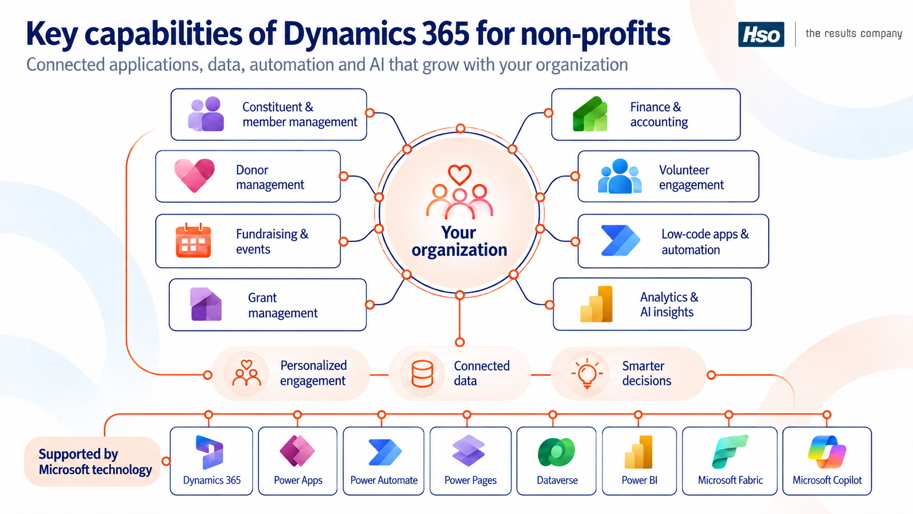
Constituent and Member Management (360° View): Know every relationship—not just every donor - Supporters rarely fit into a single category. A donor may also volunteer, serve on your board, attend events, or receive services. Dynamics 365 creates a complete, 360-degree view of every constituent, giving your team the context they need to personalize engagement, strengthen relationships, and deliver more meaningful experiences. Built-in AI can also help staff identify engagement patterns and surface opportunities to strengthen constituent relationships.
Donor Management and Donation Tracking: Turn every donation into a stronger relationship -Track one-time and recurring donations, pledges, giving history, donor interactions, and engagement in one place. With a complete view of each donor relationship, your team can drive all facets of donor engagement—stewardship, personalized communications, strengthened donor retention, and the ability to identify opportunities to deepen support. AI can also help identify giving trends, predict donor interests, and recommend personalized engagement opportunities.
Fundraising, Campaign and Event Management: Spend less time managing campaigns and more time engaging supporters - Dynamics 365 helps you plan fundraising campaigns, manage events, track responses, automate routine activities, and measure results from a single platform. It helps your team stay organized, automate routine tasks, and gain real-time visibility into campaign performance so you can focus on building lasting donor relationships. AI can also help teams analyze campaign performance, identify emerging opportunities, and personalize donor outreach at scale.
Grant and Award Management: Keep every grant on track—from application to reporting -Manage grant opportunities, applications, award lifecycles, funding requirements, compliance obligations, and reporting from one connected system. Better visibility helps reduce administrative effort while improving accountability throughout the grant lifecycle.
Financial Management and Accounting: Gain complete visibility into your organization's finances - Non-profits that need modernize financial management can extend their Microsoft solution with Microsoft Dynamics 365 Finance—improving financial agility, control, and insight. Finance teams can manage all areas in one connected system, connected with fundraising, grants, and operations for greater visibility into financial performance while improving stewardship and accountability. AI-assisted analysis helps finance teams identify trends, improve forecasting, and spend more time on strategic planning instead of manual analysis.
Supply Chain Management and Procurement: Manage resources responsibly and efficiently -Non-profits that manage inventory, humanitarian aid, donated goods, medical supplies, or other physical resources can extend their Microsoft solution with Microsoft Dynamics 365 Supply Chain Management, helping streamline procurement, purchasing, inventory management, warehouse operations, vendor relationships, and order fulfillment. Connected operational and financial data helps organizations improve accountability, control costs, and ensure critical resources reach the people and communities they serve.
Volunteer Management and Engagement: Strengthen every volunteer relationship - Track volunteer interests, availability, skills, scheduling, participation, and communications while giving coordinators a complete view of every interaction. AI can help coordinators identify participation trends and improve volunteer engagement over time. Better engagement helps strengthen volunteer relationships and encourage long-term involvement.
Flexible Apps and Automation with Microsoft Power Platform: Adapt technology to the way your organization works - Not every nonprofit process fits neatly into an out-of-the-box application. Microsoft Power Platform allows organizations to extend Dynamics 365 with low-code applications, automated workflows, and other capabilities tailored to their unique requirements. For example, Power Apps can support processes such as volunteer onboarding, case management, and program delivery. Power Automate can reduce repetitive work by automating approvals, document routing, and other everyday processes. Because these capabilities work with Dynamics 365 and other Microsoft and third-party systems, organizations can adapt and expand their environment without relying on extensive custom development.
Self-Service Portals with Power Pages: Connect with your community anytime, anywhere - Using Microsoft Power Pages, part of the Power Platform toolbox, non-profits can create secure online portals where donors, volunteers, members, and partners can register for events, submit information, update their profiles, or access resources—reducing administrative work while improving the overall experience.
Connected Data and a Unified Organizational View: See the complete picture—not just pieces of it - Microsoft Dataverse helps create a secure, connected foundation for information across fundraising, finance, grants, volunteers, programs, operations, procurement, and constituent engagement. Instead of maintaining duplicate records across disconnected systems, teams can work from more consistent information. That improves collaboration, reporting, automation, and decision-making across departments while providing a stronger data foundation for analytics and AI.
Dashboards, Reporting, Analytics, and AI: Turn information into insight - Transform information from across your organization into interactive dashboards, AI-powered insights, and intelligent actions. Microsoft Fabric provides the connected data foundation, while Power BI transforms that data into meaningful dashboards and real-time insights across fundraising performance, financial health, grant utilization, program outcomes, operational performance, and organizational impact. Combined with AI agents, organizations can automatically identify trends, surface risks, answer questions, and help staff take action instead of simply reporting on what happened.
Modernize at Your Own Pace: Transform Without Replacing Everything
Every organization has different priorities, budgets, and existing technology investments. Microsoft Dynamics 365 and supporting Microsoft technologies allow you to modernize one function, one process, or multiple areas of the organization while integrating with many of the systems you already use. That flexibility makes it possible to address immediate priorities first and expand over time rather than undertaking an all-or-nothing transformation.
Agentic AI and Microsoft Dynamics 365 for Non-Profits
AI should strengthen human relationships, not replace them.
Microsoft’s 2026 Work Trend Index found that 58% of AI users are producing work they couldn't have accomplished a year earlier, demonstrating how AI expands what people can do—not by replacing human expertise, but by giving them more time to guide their work, make better decisions, and focus on higher-value work that advances their mission.
When AI is built into everyday work, it becomes less about automating tasks and more about helping people make better decisions. Microsoft Copilot, AI agents, and built-in intelligence work across Microsoft Dynamics 365 and the broader Microsoft ecosystem to help people find information, reduce routine work, identify what needs attention, and take action more efficiently.
For non-profits, that creates opportunities to use AI across fundraising, constituent engagement, finance, programs, operations, and service. But AI delivers the greatest value when it is grounded in connected, trusted information. Microsoft technologies such as Microsoft Dynamics 365, Dataverse, Fabric, Power Platform, Microsoft 365, and Azure provide the data, application, automation, and governance foundation needed to support reliable AI and agentic experiences.
Dynamics 365 is evolving into an agentic business platform that combines Copilot experiences with AI agents that can assist with—and in some cases autonomously execute—business processes. Depending on the application and use case, agents can monitor information, surface opportunities or risks, recommend next steps, and automate multi-step work while keeping people involved where judgment or approval is required.
Microsoft Copilot helps staff complete everyday work more efficiently by summarizing constituent interactions before meetings, drafting donor and grant communications, preparing board reports, answering questions about financial and operational data, finding information across Microsoft Dynamics 365 and Microsoft 365, and reducing the time spent on routine administrative tasks. Rather than replacing human expertise, Copilot helps your team accomplish more with the resources you already have.
View Microsoft Copilot Services
AI can analyze information across fundraising, finance, grants, programs, procurement, operations, and constituent engagement to identify trends, highlight opportunities, and surface potential risks. Whether recognizing changes in donor engagement, monitoring financial performance, identifying funding opportunities, or uncovering operational efficiencies, AI-powered insights help leaders make faster, more informed decisions using the information they already have.
Most AI tools answer questions or generate content when prompted. AI agents (sometimes referred to as agentic AI) go a step further by continuously monitoring information, identifying opportunities or risks, recommending next steps, and automating routine work based on the goals you define.
Built on Microsoft technologies such as Dynamics 365, Fabric, Dataverse, and Azure, Microsoft AI agents can help non-profits proactively support fundraising, finance, operations, and constituent engagement—allowing staff to focus more time on advancing their mission.
Microsoft Copilot Studio enables non-profits to create AI assistants that answer common questions, guide users through routine processes, and provide self-service support for donors, volunteers, employees, grant applicants, and community members. From helping volunteers find opportunities to answering HR questions or assisting finance teams with routine requests, AI assistants can improve responsiveness while freeing your staff to focus on the work that only people can do.
Cost-Effectiveness and Discounted Non-Profit Licensing: Maximize every technology dollar
Microsoft offers discounted licensing and grant programs for Azure, Dynamics 365, Microsoft 365, and Power Platform and grant programs to eligible non-profits, helping make enterprise technology more accessible. Microsoft eligibility is based on organization type, recognized legal status, not-for-profit operation, and mission criteria.

Real-World Applications
Non-Profit Success Stories
The partnership with HSO is the biggest thing. It's not a vendor, it's a partner. Leveraging Microsoft, working with HSO, it allows us to align very well together to achieve our goal, which is ending poverty for good.

How HSO Helps Non-Profits Succeed with Microsoft
Every non-profit organization has unique goals, funding models, stakeholders, and operational challenges. We begin by understanding your mission, strategic priorities, and business processes before recommending technology that supports your long-term vision—not a one-size-fits-all solution.
Technology decisions are long-term investments. As one of Microsoft's leading business transformation partners, HSO brings deep expertise across Microsoft Dynamics 365, Microsoft Azure, Microsoft Power Platform, Microsoft Fabric, Microsoft 365, data, analytics, and AI to help organizations build connected solutions that continue delivering value as their needs evolve.
From fundraising and constituent engagement to finance, grants, procurement, volunteers, reporting, and operations, HSO helps non-profits take full advantage of Microsoft technologies while tailoring solutions to their unique operating models, compliance requirements, and strategic priorities.
Technology delivers the greatest value when it works together. HSO helps organizations connect CRM, ERP, collaboration, analytics, automation, AI, and cloud technologies into one integrated Microsoft ecosystem, eliminating data silos and creating a connected foundation for better decision-making.
Technology—and the needs of non-profits—continues to evolve. Our relationship doesn't end at go-live. HSO continues to help organizations optimize, innovate, and adapt as Microsoft technologies, organizational priorities, and community needs change over time.
Helpful Links
Learn More About HSO's Non-Profit Expertise


Commit Partnership transformed their database with the help of Microsoft, HSO, and DataKind

Discover how Commit Partnership collaborates with HSO, Microsoft, and DataKind to leverage vital, data-driven insights that influence legislation and funding decisions.


Support a client-first focus to advance your mission

A coalition of more than 200 partners, Commit Partnership is a Dallas, TX community navigator and connector that works collaboratively to help solve the region’s biggest systemic challenges, including improving early childhood education, preparing and retaining effective educators, and increasing post-secondary completion rates.


Ensure accountability and compliance with standards without compromising on service levels

Ensure accountability and compliance with standards without compromising on service levels


LifeWorks Austin selected Microsoft and HSO to implement a transformative case management solution

Advance your mission by supporting the entire case/client life cycle


A story of how modernizing technology kept critical processes flowing—starting with donations


Engage with industry experts to shape an AI journey that will bring your mission into focus


Join us for an on-demand, inspiring conversation on how Children International is leveraging Microsoft technology and AI to empower change and optimize their mission-driven work

In these Microsoft-produced demos, see how Copilot for Microsoft 365 and Copilot in Bing can significantly and securely enhance operational efficiency for non-profits

Unlock new possibilities for your non-profit with the power of technology

Identify challenges, align budgets with benefits, and create a strategic solution blueprint for improved impact


Modernize and streamline donor and constituent engagement to increase mission impact

Whether you're evaluating Microsoft Dynamics 365 for the first time or looking to get more value from your existing Microsoft investment, HSO can help you build a connected platform that supports your mission today and grows with your organization tomorrow. Let's advance your mission together.