
Dive deep into our knowledge

Why you need an Enterprise Data Management Strategy
19 Aug, 2026
Data is no longer just a byproduct of doing business. It’s an asset you must come to use to support and to make the insight-driven decisions that enable your organisation to compete, grow, and succeed. And yet, if you’re like most organisations, your data is still scattered across systems. This makes it inconsistent and difficult to trust. Decision-making becomes sluggish, compliance becomes a headache, and you spend so much time manually curating your data that you miss vital opportunities.
Enterprise Data Management (EDM) helps you change that. With a strategic approach, you can turn disconnected data into a reliable, governed asset that supports every part of your organisation.
What is Enterprise Data Management?
Enterprise Data Management (EDM) is the practice of collecting and managing data. It lays the foundation for how you collect data and where you store it, to how you govern it and integrate it into your organisation. The desired outcome is data that is accurate and accessible and fit for purpose.
At its core, EDM helps you create a single, trusted view of your data across systems and teams.
With enterprise data management, you bring together:
Data governance frameworks so you know who owns and controls your data
Data integration processes to connect your systems
Data quality management to ensure your data is accurate and consistent
Metadata management to give your data meaning and context
Data security and compliance to protect sensitive information
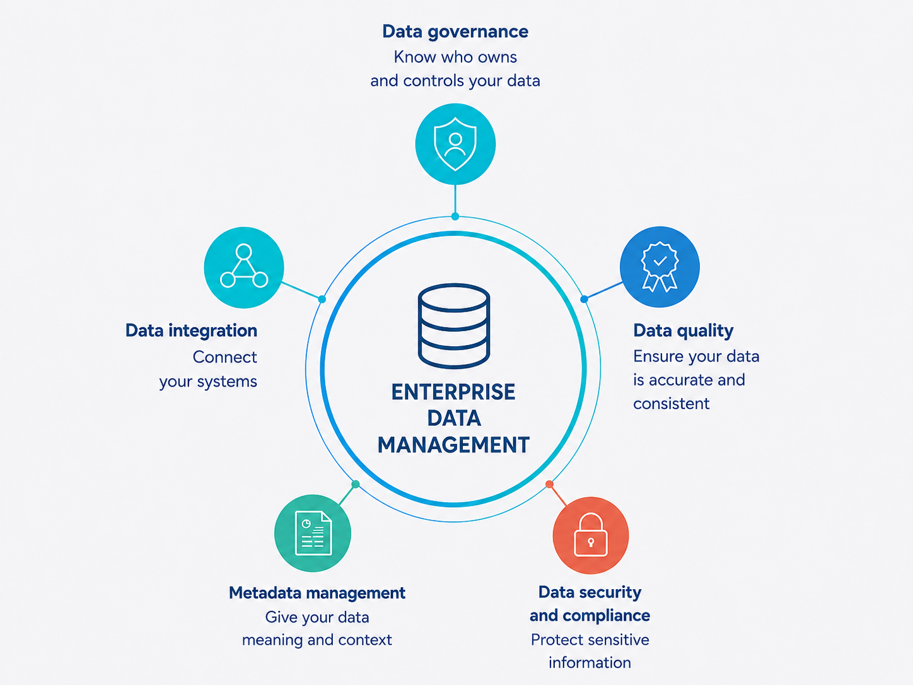
Instead of managing data in silos, you align your people, processes, and technology around a shared data strategy.
Why Enterprise Data Management is important
You are likely generating more data than ever from customer interactions to operational systems. Without a structured approach, this enterprise data can quickly overwhelm existing processes, leading to new manual and costly sub-processes.
An effective enterprise data management approach allows you to:
Make faster, more confident decisions using trusted data
Reduce inefficiencies caused by duplicated or inconsistent data
Stay compliant with regulations through better control and visibility
Deliver better customer experiences with unified data views
Scale your operations as your data grows
Ultimately, EDM helps turn your data into something you can use, not just store for those rare ‘just in case’ moments...
Dynamics Matters Podcast: Ep 20 - The Importance Of Data ManagementListen to this episode with Doug McConchie, HSO, on the importance of data management. |
Key components of an Enterprise Data Management strategy
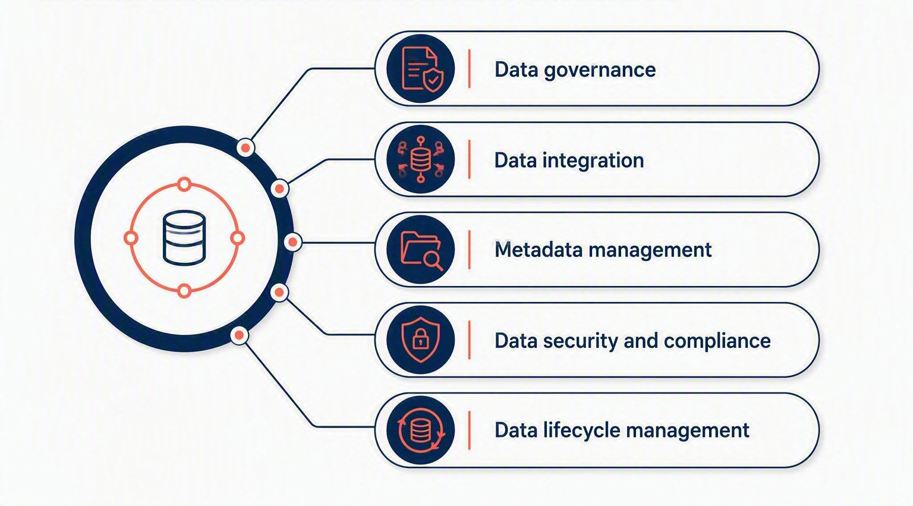
Data governance: Data governance defines how you manage ownership, access, and accountability for your data. When you establish governance, you create clear rules so everyone in your organisation understands how data should be used.
Data integration: Data integration allows you to connect your systems, such as ERP, CRM, and cloud platforms, so your data flows seamlessly across the organisation. This helps you eliminate silos and ensures you work from consistent, up-to-date information.
Metadata management: Metadata gives your data meaning. It tells you what the data represents, where it came from, and how it should be used. With strong metadata management, you can improve data discovery, trace data lineage, and build trust across your organisation.
Data security and compliance: You need to ensure your data is protected and handled responsibly, especially with regulations like GDPR.
This means implementing:
Access controls
Encryption
Data masking
Audit trails
Data Lifecycle Management: Your data isn’t static. It moves through a lifecycle from creation to storage to deletion. By managing this lifecycle effectively, you ensure your data remains relevant, compliant, and cost-efficient.
What does Enterprise Data Management architecture look like
Your enterprise data management architecture is the technical foundation that supports your strategy.
A modern architecture typically includes:
Data sources (your applications, systems, and external data)
Ingestion layer (how you collect and move data)
Storage layer (data lakes, warehouses, or lakehouses)
Processing layer (where your data is transformed and analysed)
Governance layer (tools that manage quality, lineage, and policies)
Access layer (dashboards, APIs, and reporting tools)
Today, many organisations are moving toward cloud-based and modular architectures so you can scale faster and adapt more easily.
A step-by-step approach to building an Enterprise Data Management strategy
Your Enterprise Data Management strategy can follow a structured approach: Step 1: Assess your current data landscape
Start by understanding your current environment.
Ask yourself:
Where does your data live?
Which systems are critical?
Where are your biggest data quality issues?
Who depends on your data the most?
The answer to these will give you a clear place to start from.

Step 2: Define governance policies and data ownership
Next, you must define how your data will be managed.
You should:
Assign data owners and stewards
Define data standards and quality rules
Set policies for access and usage
Without this level of governance and control, your strategy won’t hold together. Or worse, you’re left in a worse place than when you started.

Step 3: Choose the right technology platform
Finally, you need to select tools that support your goals.
When choosing technology, consider:
How easily it integrates with your existing systems
Whether it can scale with your organisation
Its governance and security capabilities
How easy it is for your teams to use
The key is to choose tools that support your strategy and provide a platform to build on. Technology changes, as do the needs of staff and your customers. So you need flexible tools that can bend and shape to evolving environmental changes.

Having data in a central place gives us more accurate and better reporting, better data governance, and master data management

Why HSO's DnA Accelerator is the right approach to Enterprise Data Management
If you want to accelerate your enterprise data management journey, HSO’s Data & AI (DnA) Accelerator provides a structured starting point.
With it, you can:
Speed up your implementation
Apply proven governance and architecture frameworks
Reduce risk with best practices
Start delivering value from your data faster
Instead of building everything from scratch, start on a foundation built fit for purpose to the needs of large enterprise organisations

Frequently Asked Questions
Final Thoughts
You cannot ignore Enterprise data management. And you shouldn’t wish to. Because
when you align your strategy, governance, and architecture around it, you unlock the ability to operate with great clarity and foresight. The essential traits of organisations able to deliver on the needs of their staff and customers.