
Discover More
Industry Resources
Continue exploring how modern law firms are rethinking client engagement, AI, and growth strategy.

The Law Firm Revenue Engine: A Case for a Client Engagement Platform

Law firms today face a familiar challenge: they have tremendous client data, but they struggle to turn it into meaningful growth. Contacts, matters, financials, feedback, marketing activity — all exist somewhere in the ecosystem. Yet when this information lives in silos, the firm never gets the full picture.
That’s why CRM alone no longer drives the outcomes modern firms require. CRM was never designed to orchestrate growth. It was built to record it. To track it. To store it. That’s valuable, but it isn’t the same as driving strategy.
Modern growth demands something different — a client engagement platform that unifies every element of the client lifecycle, so firms can make better decisions, faster.
Why Traditional CRM Falls Short
Think about how your firm evaluates client relationships today. Is it primarily through activity logs, manual reports, or partners’ personal insight? Does your marketing team know how their campaigns tie to revenue outcomes? Does business development clearly see where white space lives with key clients? Are client sentiments consistently measured and connected to existing financial data?
If the answer isn’t a confident “yes,” your firm is operating with blind spots.
CRM captures data at the point of entry, but it doesn’t always surface insight at the point of decision. It doesn’t bring your business development strategy into harmony with your client experience. It doesn’t tie intake, compliance, and client feedback back to the opportunities that matter. And it rarely answers the questions fee earners and leaders actually ask when preparing for client engagements.
That’s the problem a unified platform solves.
The Anatomy of a Client Engagement Platform
A client engagement platform doesn’t replace CRM. It expands it, connects it, and infuses it with purpose. It aligns the data you already have across teams and turns it into usable insight.
At the heart of this model are eight connected pillars. Together, they form the engine that drives client understanding, business development effectiveness, and revenue growth.
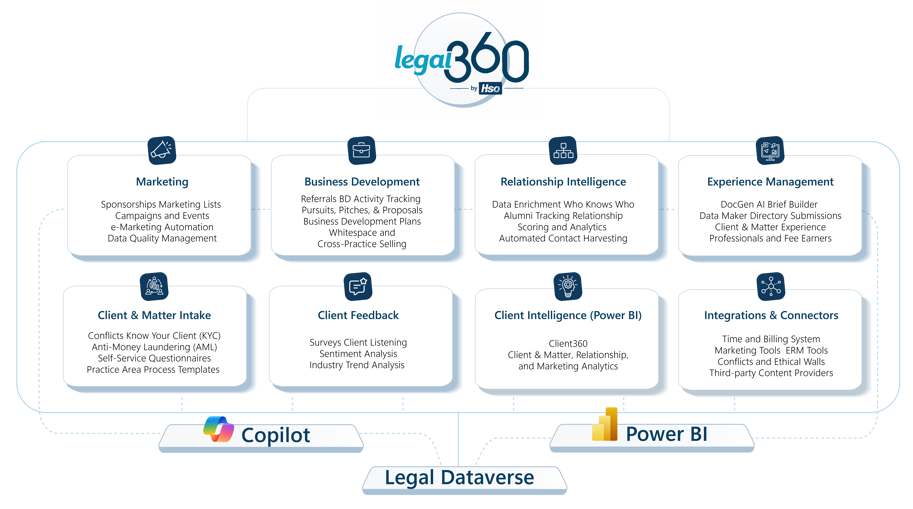
Marketing in this context isn’t a separate function with its own data set. Campaigns, sponsorships, and email outreach are all tied back to revenue outcomes, relationships, and pursuit activity. Marketing doesn’t broadcast — it contributes measurable engagement that feeds directly into how the firm grows.
Business development becomes strategic when it sees everything through a revenue lens. Referrals, pursuits, pitches — all are tracked in context with client experience and relationship strength. White space isn’t a concept; it’s a view you can act on.
Not all relationships are equal. Some are deep, others are shallow, and many go unnoticed until it’s too late. Automated enrichment and scoring give a sense of who knows whom and how strong that connection is. It turns relationship management from guesswork into clarity.
Experience isn’t just a matter record. It’s a searchable, structured history that helps lawyers quickly identify relevant expertise for the engagement at hand. It makes it easier to assemble teams, craft pitches, and win work.
Risk reduction and operational efficiency go hand in hand. By unifying conflict checks, know your client (KYC), anti-money laundering (AML), and structured workflows into the same platform that houses client data, firms reduce friction and expedite matter setup. Intake no longer feels like a compliance burden — it becomes a foundation for strategic growth.
Clients tell you what they value every day. But unless feedback is structured and tied to the rest of your data, much of it is lost or under-leveraged. Surveys, sentiment tracking, and executive interviews become part of the client narrative instead of scattered notes.
This is where everything comes together. Executive dashboards draw from all eight pillars to surface trends, risks, opportunities, and performance indicators. Leadership can see patterns over time, not just snapshots in isolation. Decisions are rooted in insight, not inference.
A client engagement platform must play well with others. Time and billing systems, ERM tools, marketing platforms, conflicts databases, third-party data sources — they all feed the engine. Integration doesn’t just reduce duplicate entries; it ensures the platform reflects the firm’s true operational landscape.
The Value of Unification
When these eight pillars function together, the impact is real and measurable.
Firms gain clarity on where revenue is growing and where it’s stagnating. Business development gains a unified strategy rooted in data, not guesswork. Fee earners have the context they need to engage clients confidently and proactively. Marketing investments become traceable to business outcomes. Leadership stops reacting to what happened and starts steering toward what will happen.
This is not an incremental improvement. It’s a shift in how growth is managed.
Built for the Modern Firm
A platform of this nature must be grounded in a solid data architecture. Legal360 leverages Microsoft Dataverse as its foundation, with embedded Copilot for AI-assisted insight and Power BI for analytics that inform strategy. That technical backbone is not an accessory — it is the reason firms can finally move beyond isolated systems and toward an orchestrated, actionable engagement environment.
It ensures:
The Revenue Engine Is Already Within Reach
Your firm already has the talent, relationships, and experience to win. What’s missing is the connected view that turns those strengths into a strategic advantage.
A client engagement platform does exactly that — it replaces silos with clarity, activity with insight, and data with strategy.
Law firms have always been relationship businesses. Now they have the tools to make those relationships measurable, manageable, and most importantly, growth-driving.
When engagement becomes the operating model, revenue becomes the outcome.

See the Platform in Action
If the idea of a unified client engagement platform resonates, watch our on-demand webinar - Beyond CRM: Client Engagement as the Engine of Law Firm Success.
In the session, we walk through the full model — from relationship intelligence and experience management to intake, feedback, analytics, and AI — and show how modern law firms are connecting it all in one Microsoft-powered foundation.
Discover More
Industry Resources
Continue exploring how modern law firms are rethinking client engagement, AI, and growth strategy.
If you're exploring how to unify client insight and turn engagement into measurable growth, we’d welcome the conversation.