
Why traditional CRM falls short in AEC
Four problems show up in almost every firm, regardless of size or which platform they're on:

The AEC Marketer's Guide to Headless CRM
How AI and automation can help firms capture better data, reduce seller-doer friction, and make CRM more useful for marketing and business development.

AEC marketers are expected to build sharper proposals, stronger interview and client presentation materials, and better pursuit strategies from incomplete, outdated, or hard-to-trust CRM data. This isn't a reflection of anyone's effort. It's that seller-doers' time is already spoken for. Their time is best spent on winning and delivering work and managing clients, not documenting their every move.
That friction adds up. You shouldn't have to babysit your CRM system in order for it to deliver meaningful information, but for most AEC firms, that's exactly what's happening.
Why traditional CRM falls short in AEC
Their effort is best spent on winning and delivering the work, not documenting it.
Every contact, meeting, and opportunity update is a small interruption to real work.
When people skip entering data, what's left in the system no longer reflects reality.
Once the data can't be trusted, go/no-go calls, relationship insights, and pursuit strategy all fall back on gut feel instead of fact.
One AEC firm summed it up well: "If it's not in CRM, it never happened." Without a complete picture in one place, marketing and BD can't see what's actually happening across the pipeline, relationships, and project performance.
This isn't a fringe problem. In a live poll during HSO's SMPS Learning Lab webinar (June 2, 2026), roughly 60% (out of 175 participants) said CRM adoption is a constant battle at their firm.
How headless CRM works
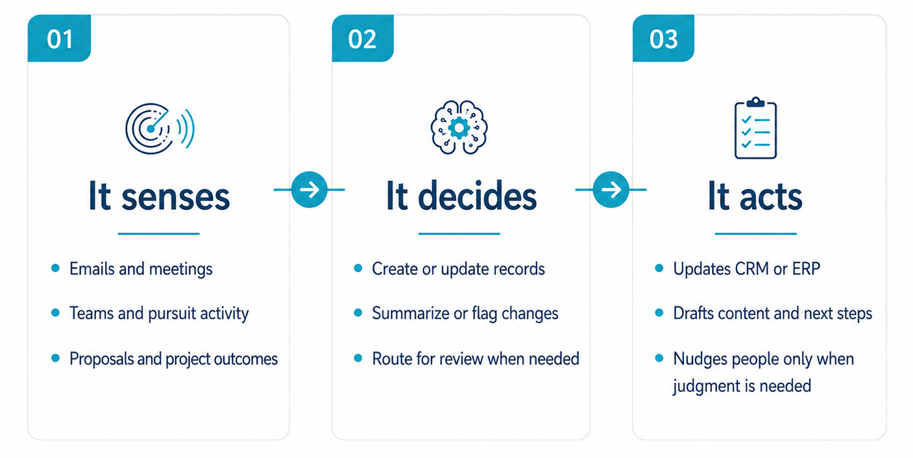
The mechanics break down into three steps: sense, decide, act.
It senses. The system recognizes signals from everyday work: an email containing a new contact, a meeting that creates a client touchpoint, a Teams conversation referencing pursuit activity, a proposal containing reusable project experience, a completed project with outcomes worth capturing.
It decides. Based on what it senses, it determines whether something should be created, updated, summarized, or flagged for a person to review.
It acts. It updates records, drafts content, recommends next steps, or nudges a person when human judgment is genuinely needed.
A real example shows all three steps in sequence: in one case, an AI tool read through an ongoing email thread about a potential project and recognized that the client's latest message pointed to a new contract finalization date. Rather than silently changing anything, it flagged the opportunity's close date and asked whether it should be updated, letting the BD person confirm and even adjust the timing before anything changed in CRM. That's the model: headless CRM doesn't remove people from the process. It lets people contribute their judgment only when it's actually needed, instead of on every single update.
Why this matters for AEC marketing and business development
The benefits aren't abstract, they show up in specific, measurable ways:
Subject matter experts get hours back. At one firm, AI-driven CRM processes cut SME involvement in proposal preparation from roughly 8 hours down to 2 hours per proposal – time that goes back into serving clients and developing solutions instead of writing from scratch.
Relationship intelligence becomes real, not anecdotal. In one example, an automated white-space analysis flagged that a client was missing four service lines that the firm could be cross-selling. The tool then identified the client's VP of Facilities as a strong-fit contact, scoring an 80 out of 100 on relationship strength, and surfaced two internal team members with full, 100% relationship scores to that same contact. That's a targeted BD plan built with zero manual research.
Marketing content stops depending on chasing people down. In another case, AI auto-drafted a project narrative for a proposal by pulling from a team member's time entries, project scope narrative, and email communication. The marketing team's job shifted from writing the first draft to editing and approving it, a meaningfully different (and faster) workflow.
Pipeline questions get answered in plain English. Instead of hunting through CRM screens and reports, marketers can simply ask their CRM a question the way they'd ask a colleague and get a direct, complete answer, including related opportunities, project history, and financials, without ever opening a CRM screen.
Go/no-go decisions get backed by data, not gut feel. Rather than filling out a manual go/no-go form, AI models can surface win-rate trends, competitive performance, and risk indicators automatically, giving teams a starting score and rationale before anyone has to fill in a single field.
Where to start
Before jumping into AI tools or new platforms, take stock of what's actually happening today:
Where does CRM adoption break down, and for whom?
Which data do marketing and BD teams need most, but struggle to get?
Which manual tasks happen repeatedly, week after week?
Which systems (CRM, ERP, Outlook, Teams, SharePoint) already contain useful signals that aren't being captured?
Which use case would create the fastest, most visible value for your team?
That assessment is the foundation of a prioritized roadmap: a clear, sequenced plan for which automations to deploy first based on where the impact will be greatest for your firm.
This is exactly the kind of assessment HSO helps AEC firms work through every day – looking at your current marketing and BD tools and processes, identifying where the highest-impact use cases are, and turning that into a roadmap you can actually act on. If any of this sounds familiar, a quick call is the easiest way to find out where to start.

Looking for a deeper dive?
The theme across every example above is the same: when your CRM works for you instead of the other way around, better data becomes a byproduct of doing your job, not a separate task competing for your time.
Want to see what headless CRM could look like for your firm? Watch the SMPS Learning Lab webinar or schedule a roadmap conversation with HSO to map out where AI and automation could reduce CRM friction across your marketing and BD workflows.

Whether you want to talk about headless CRM, ERP, data, or AI our team is here to help you solve your challenges