

Microsoft Dynamics vs Salesforce: Full CRM Comparison

The Microsoft Dynamics vs Salesforce decision is rarely about which CRM has more features. Both have plenty.
The real question is which platform fits your stack, your budget model, and the way your teams already work. Here is how the two compare on features, AI, pricing, integration, total cost of ownership, and how to tell which one fits.
Microsoft Dynamics vs Salesforce Overview
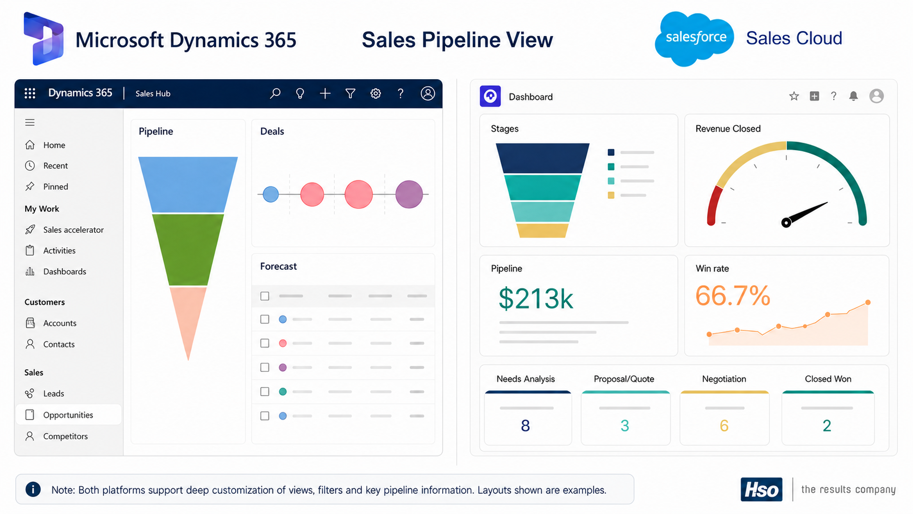
Microsoft Dynamics 365 and Salesforce are both enterprise-grade CRM leaders. The right choice depends on your architecture, your existing technology stack, and your total cost of ownership, not on raw feature count.
Dynamics 365 is a broad business-applications suite spanning CRM, contact center, ERP, and low-code on one Microsoft stack. Salesforce is the most CRM-centric portfolio, with deep breadth across sales, service, marketing, commerce, data, and analytics, plus the largest partner ecosystem in the category.
Both sit in the top analyst tier. Each was named a Leader in the 2025 Gartner Magic Quadrant for Sales Force Automation and among the Leaders in Forrester's 2025 CRM evaluation. So the comparison is not about which one is enterprise-ready. It is about which architecture, operating model, and commercial structure fits your environment.
Decision rule: Choose Dynamics 365 for tight Microsoft 365, Teams, Power Platform, Azure, and ERP alignment, plus hybrid or on-premises flexibility where you need it. Choose Salesforce for the deepest CRM-first ecosystem, the most mature marketplace, and a fully cloud-native operating model.
The pattern HSO sees across engagements: Microsoft wins where CRM is only one part of the transformation. Dynamics 365, Microsoft 365, Power Platform, Dataverse, Azure, Fabric, and Copilot form one connected ecosystem, which gives organizations a clearer path to unify CRM, ERP, data, automation, and AI across the business. The advantage is a connected business platform, not just a sales platform.
Product Families: What Each Suite Includes
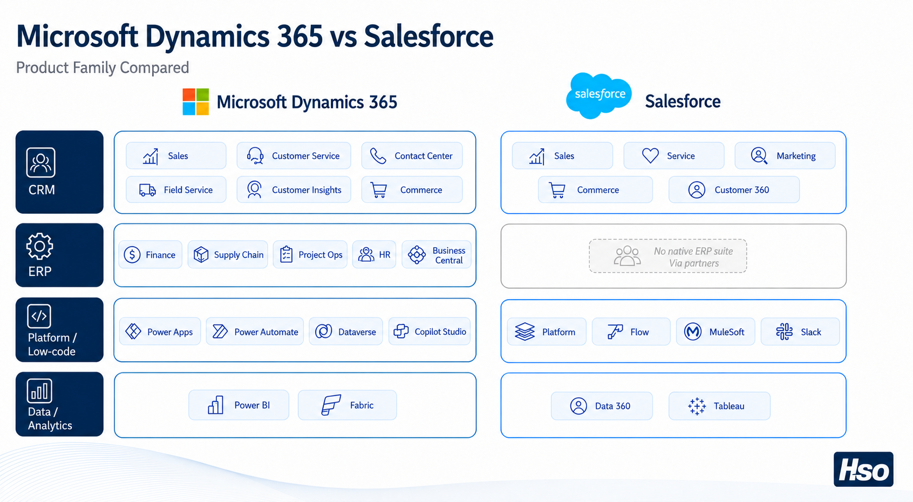
Dynamics is CRM plus ERP plus low-code. Salesforce is CRM plus data plus platform plus ecosystem.
The Dynamics 365 family covers Sales, Customer Service, Contact Center, Field Service, Customer Insights (Journeys + Data), Commerce, Finance, Supply Chain Management, Project Operations, Human Resources, and Business Central. Microsoft frames it as a combined CRM, contact center, and ERP suite.
The Salesforce portfolio centers on Customer 360, spanning Sales, Service, Marketing, and Commerce, plus Data 360, Tableau, Slack, MuleSoft, the Salesforce Platform, and a long list of industry clouds. Salesforce now separates Customer 360, the CRM layer, from the broader Agentforce 360 portfolio.
Naming note: Microsoft's former "Marketing" product is now Customer Insights (Journeys + Data), licensed per tenant; the old outbound marketing module was retired in May 2026. On the Salesforce side, Sales and Service pricing pages now lead with Agentforce tiers, and AppExchange has been rebranded AgentExchange. Keep both in mind when comparing older material.
Feature Comparison
On core CRM the two are close. The differences show up with productivity workflow for Microsoft, marketplace and multi-cloud depth for Salesforce.
Area | Microsoft Dynamics 365 | Salesforce | Where it matters |
|---|---|---|---|
Sales | Sales Professional, Enterprise, and Premium, plus LinkedIn-based Relationship Sales. Copilot built into Sales Enterprise. | Starter, Pro, Enterprise, Unlimited, Agentforce 1 Sales. Deal insights and conversation intelligence from Enterprise. | Salesforce for CRM-first breadth and marketplace; Microsoft for productivity-workflow adjacency. |
Service | Customer Service Professional, Enterprise, and Premium. Premium bundles contact center and generative AI. A separate Contact Center family can sit beside another CRM. | Starter, Pro, Enterprise, Unlimited, Agentforce 1 Service. | Salesforce has long service maturity; Microsoft's Contact Center can bolt onto an existing CRM. |
Marketing | Customer Insights (Journeys + Data), one per-tenant package. | Split across Agentforce Marketing, Marketing Cloud (Account Engagement, Growth, Engagement), and Data 360. | Microsoft simpler at base; Salesforce broader but more fragmented. |
Field service | Dynamics 365 Field Service: scheduling, remote assist, Guides. | Role-based licensing: Contractor, Dispatcher, Technician, Field Service Plus. | Microsoft strong when tied to ERP and Teams; Salesforce flexible role config for large service orgs. |
Commerce | Dynamics 365 Commerce: omnichannel retail, B2B, headless. | Commerce Cloud: B2B and composable storefronts. | Microsoft for retail and ERP consistency; Salesforce for cloud-native digital commerce. |
Low-code | Power Apps, Power Automate, Dataverse, Power Pages, Copilot Studio, Power BI. | Salesforce Platform, Flow, LWC, Apex, Prompt Builder, Data 360. | Microsoft if you already standardize on Microsoft low-code; Salesforce for an all-in-one CRM-platform model. |
The split runs through the whole table. Neither platform loses on core CRM capability. The gap opens in what surrounds the CRM: Microsoft wins on productivity and ERP adjacency, Salesforce wins on marketplace depth and CRM-first specialization.
One practical nuance on the marketplace. Salesforce's depth there is a real strength, but projects can become dependent on AppExchange (now AgentExchange) third-party products to fill gaps. Microsoft customers often find more of what they need natively across the stack, from Power BI to Fabric to Copilot, under one vendor's roadmap and licensing.
User Experience and Interface
Both platforms are modern and configurable, but Dynamics feels familiar from day one to anyone working in Outlook, Teams, and Excel, and that familiarity shows up in adoption rates.
Dynamics 365 uses the Microsoft look and feel. Users move between CRM, Outlook, Teams, and Excel without switching mental models, which lowers the training burden and reduces adoption resistance. Sales activity can be captured automatically through Outlook and Exchange integration rather than typed in by hand.
Salesforce Lightning is a mature, polished, CRM-native interface with strong configurability. Admins and users with Salesforce experience are widely available, which matters when you are staffing a CRM-first program.
The honest caveat: user reviews report a learning curve for advanced configuration on both platforms. UX quality ultimately comes down to implementation discipline.
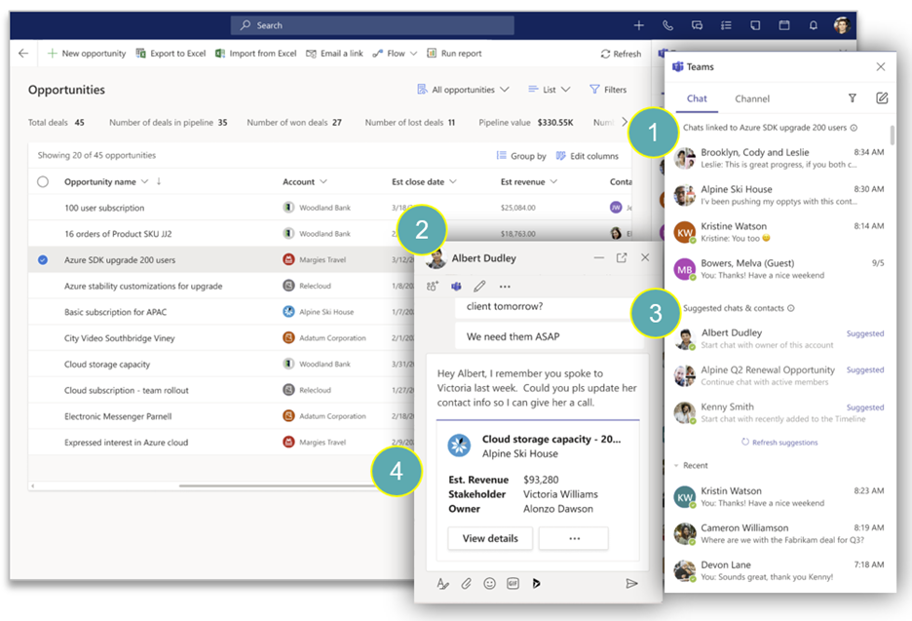
HSO sees the adoption difference play out in practice. Research Affiliates found Salesforce rigid and poorly adopted, and after moving to Dynamics 365 designed a cleaner interface consistent with the firm's business processes and with a Microsoft look and feel. canfitpro shortlisted both platforms and chose Dynamics 365 specifically for its user experience and native integration with the Microsoft 365 and Azure services the team already used.
Dynamics 365 can be intimidating to some, but it's very user-friendly. HSO has done a great job, too, and everything we've gone through with all of our customizations.
AI Capabilities: Copilot vs Agentforce
AI is now central to how both platforms position themselves. Microsoft has Copilot and Copilot Studio running through Dynamics 365 and the Power Platform. Salesforce has Agentforce, underpinned by Data 360.
Microsoft: Copilot and Copilot Studio
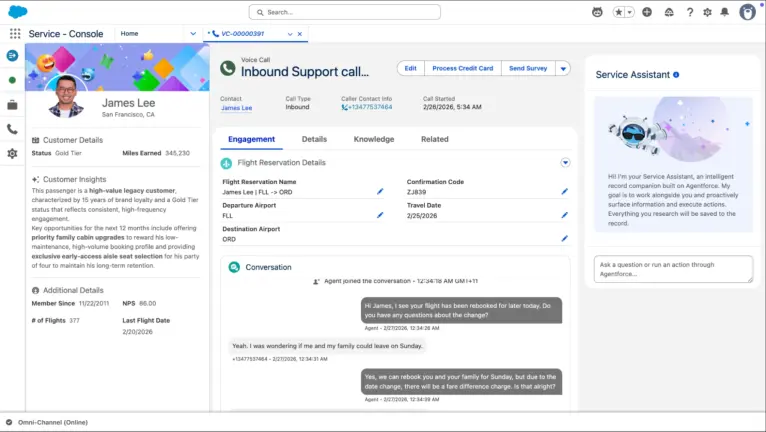
Copilot is embedded directly in Dynamics 365 apps such as Sales Enterprise and Customer Service Premium. It summarizes opportunities, drafts customer emails, preps meetings, and condenses long case histories into a few sentences.
Copilot Studio extends this with custom agents that automate workflows across Dynamics 365, Microsoft 365, and external systems. Microsoft's 2026 release waves push agentic capabilities deeper into Sales, Customer Service, Contact Center, and the Power Platform, and Model Context Protocol style integration means Dynamics data increasingly surfaces inside Microsoft 365 Copilot rather than forcing users into the CRM interface at all.
The practical advantage: AI works where your people already work, in Teams, Outlook, and Excel - under one governance and licensing model across the stack.
Salesforce: Agentforce and Data 360
Agentforce is Salesforce's umbrella AI agent platform, and it has matured quickly. Prompt Builder grounds and reuses prompts across the platform, and Data 360 acts as the real-time data engine feeding the agents, with zero-copy integration reaching data in external platforms without duplicating it.
Salesforce is investing aggressively here: the AgentExchange marketplace, the Informatica acquisition, and the announced Fin acquisition. For CRM-first organizations running large service or digital-engagement programs, Agentforce is a genuinely strong platform.
The commercial models differ. Microsoft prices AI through per-user Copilot inclusion plus Copilot Studio credit packs. Salesforce blends per-user Agentforce 1 bundling with per-action Flex Credit consumption, which needs careful usage modeling before you can predict cost at scale.
What This Means for Buyers
AI value depends on grounding. Copilot draws on Microsoft Graph, Dataverse, and increasingly the wider data estate in Microsoft Fabric; Agentforce draws on Data 360. In practice, the AI decision largely follows the data-platform decision you have already made.
Both platforms are strong on AI. Microsoft's edge is that it spans everyday productivity and business processes together: the same Copilot works across CRM, ERP, Teams, Outlook, and Excel, so intelligence follows the work.
And neither delivers value on messy data. AI readiness starts with data quality and governance regardless of vendor. HSO's Agentic AI Consulting Service helps organizations turn high-value use cases into production-grade agents, securely and at scale.
Platform and Integration
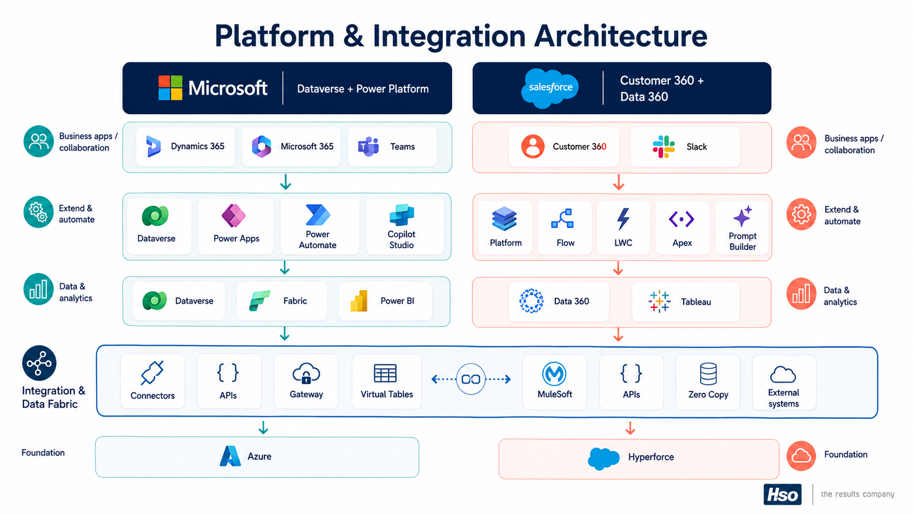
The cleanest way to frame the platform choice is Dataverse plus Power Platform versus Customer 360 plus Data 360 on Hyperforce.
Microsoft's customization model is built on Dataverse, Power Apps, Power Automate, custom APIs, and connectors, with optional Azure services behind it. Dataverse exposes a RESTful Web API based on OData 4.0, the on-premises data gateway handles secure hybrid data movement, and Microsoft Fabric and Power BI extend the same data estate into analytics without a separate integration project.
Salesforce is built on its multi-tenant platform: standard and custom objects, Flow, Lightning Web Components, Apex, and Data 360, with REST, SOAP, Bulk, and Pub/Sub APIs. Salesforce Connect reaches external data, and MuleSoft is the strategic layer for enterprise and on-premises integration.
Both support low-code plus pro-code. The deciding factor is which cloud you already run.
HSO angle: Dynamics 365 is engineered as an add-on to Microsoft 365, with native Outlook, Teams, Excel, and Copilot integration out of the box. In one HSO engagement, a professional services firm found Salesforce lacked the native integrations to talk to its other systems, so work done in Salesforce had to be redone by hand in the ERP. That integration gap is a recurring reason HSO clients move to Dynamics.
Pricing and Total Cost of Ownership
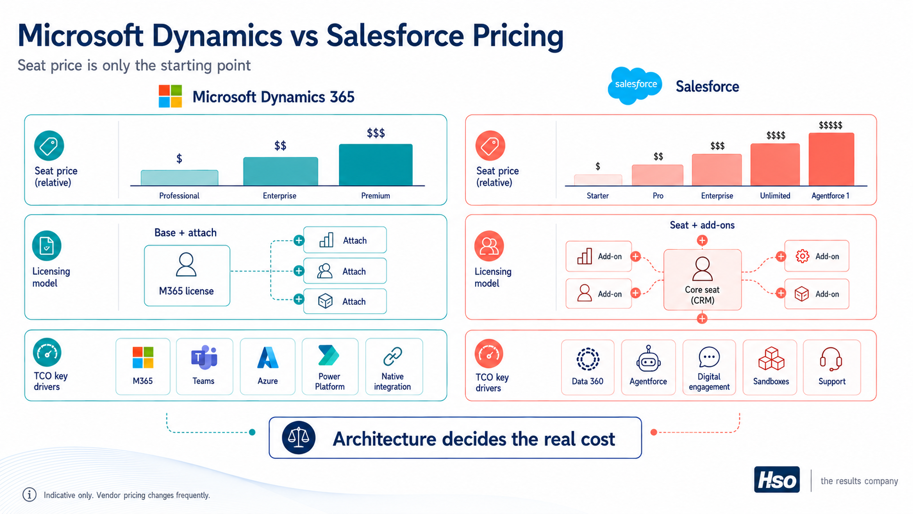
Microsoft usually looks cheaper at the seat level. Salesforce packs more into its upper tiers. Real cost is decided by architecture, not list price.
At the core CRM seat level, Dynamics 365 Sales runs from $65 to $150 per user per month across the Professional, Enterprise, and Premium tiers. Salesforce Sales tiers run from $25 to $350 per user per month, with Agentforce 1 Sales at $550 per user per month. For full, current pricing across every product, check the official Microsoft Dynamics 365 pricing page and each vendor's published price lists.
The licensing models matter more than the list prices:
Microsoft = base + attach. Your first Dynamics app is the base license; additional apps attach at lower cost. Attractive for multi-app deployments, though it adds procurement complexity.
Salesforce = simpler headline seat, but cost climbs with Data 360, Agentforce consumption, digital engagement, sandboxes, partner portals, and premium support.
TCO reality: Microsoft often lowers cost for organizations already paying for Microsoft 365, Teams, Azure, and the Power Platform, because the integration points are already native. Salesforce can lower delivery friction for CRM-centric programs because so much talent and tooling is standardized around it. HSO clients repeatedly cite Salesforce licensing becoming "too expensive to support" as a switch trigger.
Vendor-sponsored Forrester TEI studies exist on both sides; Microsoft cites a 215% ROI over three years for Dynamics 365 Sales in a commissioned Forrester Consulting study from March 2022. Treat these figures as directionally.
Deployment and Security
Salesforce core CRM is cloud-only. Microsoft still supports meaningful on-premises and hybrid scenarios in parts of its portfolio.
Dimension | Microsoft Dynamics 365 | Salesforce |
|---|---|---|
Core cloud model | Cloud-first SaaS across Dynamics 365 and Power Platform. | Cloud-only CRM on Hyperforce, Salesforce's public-cloud architecture. |
On-premises | Finance + Operations on-premises, Business Central on-premises, and Customer Engagement on-premises v9.x supported to January 12, 2027 for mainstream support and January 9, 2029 for extended support. | No equivalent on-premises CRM deployment model. |
Hybrid pattern | Dual-use rights, on-premises data gateway, and mixed cloud/on-premises ERP scenarios. | Cloud CRM plus external or on-premises data via MuleSoft or Salesforce Connect. |
Best fit | Regulated, legacy-heavy, or Microsoft-standardized estates that still need local control in some domains. | Organizations comfortable with a cloud-native operating model, integrating everything else around Salesforce. |
On security and residency, both vendors are credible. Salesforce's Einstein Trust Layer includes grounding, data masking for supported generative AI features, and zero-data-retention commitments with external model providers. Hyperforce is built for global scale and local data residency where supported services are available in a Hyperforce country, with Salesforce reported to have reached 17 global Hyperforce locations when Israel launched as a local platform region.
Microsoft's distinct advantage is ownership of the underlying cloud: Dynamics 365, the Power Platform, and Fabric all run on Azure, so security, compliance, and Purview governance apply consistently from CRM through ERP to analytics.
When to Choose Dynamics 365 vs Salesforce
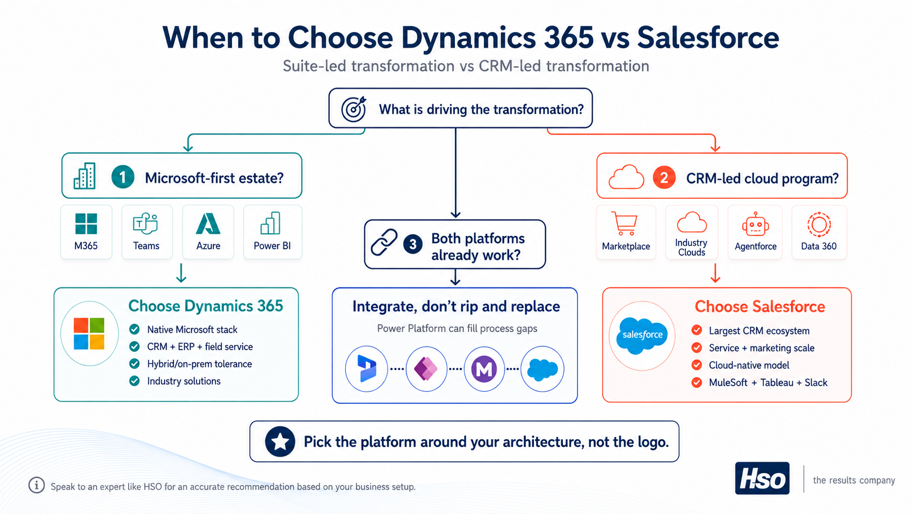
The split is less enterprise-versus-SMB and more suite-led transformation versus CRM-led transformation.
Choose Dynamics 365 when
You already run Microsoft 365, Teams, Azure, and Power BI, and want CRM to extend that stack.
CRM must connect tightly to ERP, retail, or field service processes.
You need hybrid or on-premises tolerance in some domains.
Lower core-seat pricing and native Microsoft productivity integration matter.
End-to-end industry transformation is the goal, connecting CRM, ERP, finance, supply chain, service, and reporting, often through partner industry solutions like HSO's aec360 and legal360.
Choose Salesforce when
You want the largest CRM-focused partner network and marketplace.
You need very broad industry-cloud packages out of the box, with industry data models and AI capabilities of their own.
Large service, marketing, or digital-engagement programs are the priority, including Agentforce, Data 360, Tableau, Slack and MuleSoft.
Decision Framework
Scenario | Recommended |
|---|---|
Organization standardized on Microsoft 365, Teams, and Azure | Dynamics 365 |
CRM must sit next to Dynamics or another ERP | Dynamics 365 |
Regulated estate needing some on-premises control | Dynamics 365 |
Field service tied tightly to ERP and Teams | Dynamics 365 |
Largest CRM marketplace and partner talent pool is a priority | Salesforce |
Broad industry-cloud packaging out of the box | Salesforce |
Cloud-native, CRM-led transformation with heavy service or marketing | Salesforce |
Multi-cloud digital commerce with composable storefronts | Salesforce |
Or Take the Best of Both Worlds
You do not always have to rip and replace. Some organizations keep Salesforce where it is working and integrate Dynamics 365 and the Power Platform around it.
In one engagement, HSO used the Power Platform to design and roll out a Client Engagement Hub with Salesforce Einstein Next Best Action, integrated with Dynamics 365 and Marketo, in just three months. The existing systems stayed; the gaps got filled.
Real-World Switches: Why HSO Clients Moved from Salesforce to Dynamics
These HSO client stories show organizations switching from Salesforce, shortlisting Salesforce, or choosing Dynamics 365 after comparing the options.
A multi-national professional services firm experienced low Salesforce adoption because of manual data entry, limited integration, and poor visibility across projects and client relationships. The firm moved to Dynamics 365 and HSO's projects360, creating a centralized repository for project history, employee experience, and client touchpoints. Outlook and Exchange integration also helped automate contact, activity, and lead data capture.
Research Affiliates replaced Salesforce with Dynamics 365 Sales after finding Salesforce too rigid, adopted by too few people, and increasingly expensive to support. Dynamics 365 lowered costs, improved usability, and gave the firm a cleaner interface aligned with its business processes.
"Our migration from Salesforce to Microsoft Dynamics CRM remains the only consultant-led project that finished on time and on budget."
Brent Leadbetter, VP of Client Strategies, Research Affiliates
iNRCORE was using Salesforce as a costly holdover from an earlier business structure. Its sales pipeline was housed in Salesforce but managed in Excel, and the platform was too inflexible to meet current forecasting needs. Ahead of a Salesforce renewal deadline, iNRCORE moved to Dynamics 365 in an approximately three-week minimum-viable implementation.
"It's been a game-changer for everyone."
Sarah Harris, CEO, iNRCORE
canfitpro narrowed its CRM decision to Dynamics 365 or Salesforce and chose Dynamics 365 for its user experience, integration with existing Microsoft services, including M365 and Azure, and overall robustness.
A global investment management authority considered whether to stay on Dynamics, migrate to the cloud, or replace Dynamics with Salesforce. It selected Dynamics 365 over Salesforce because of performance, scalability, user adoption with familiar Microsoft tools, and total cost of ownership.
A leading AM Law 200 firm selected Dynamics 365 and HSO's legal360 after evaluating legal CRM options including Salesforce, Peppermint, and IntApp. The firm chose the Microsoft and legal360 combination for legal-specific functionality, Microsoft integration, relationship intelligence, and a stronger foundation for AI and automation.
To be clear: none of this means Salesforce is a bad platform. It remains a powerful CRM and agentic AI platform, and for CRM-first, cloud-native organizations running large service or digital-engagement programs, it can be the right answer. The common thread in these stories is narrower: when organizations need Microsoft integration, lower operational friction, industry-specific functionality, or closer alignment between CRM and the wider business platform, Dynamics 365 often becomes the stronger fit.
Frequently Asked Questions
Talk to HSO About Your CRM Decision
HSO implements Dynamics 365 work daily and migrates organizations from Salesforce regularly. That experience cuts both ways: HSO can tell you honestly which platform fits your environment.
Explore HSO's Dynamics 365 Sales services or the broader business applications capabilities, or get in touch to talk through your shortlist.