
News
Basildon Council launches trailblazing AI initiative as part of its Resident, Digital, and Transformation strategy
Basildon Council - Customer Service Agent

Agentic AI Examples: 6 Enterprise Use Cases That Deliver ROI

Most organizations have read enough about what agentic AI can do. The question they're actually asking is: what does it look like running, inside a real business, on a real process?
85% of organizations increased their AI investment last year. Only 6% saw measurable returns within 12 months. The gap between those two numbers is not a technology problem, it is a deployment problem.
These are six enterprise use cases where agentic AI is operating in production today, what each agent does, what it connects to, and what it returns.
A note on the examples below: Not every example here is fully agentic in the strictest technical sense. What they share is the architecture and level of agentic autonomy closest to what most real-life enterprises can realistically deploy right now.
Finance and Accounts Payable
Finance teams run some of the highest-volume, most rules-governed processes in the enterprise, conditions that make them ideal starting points for agentic AI, and where measurable ROI can surface fastest.
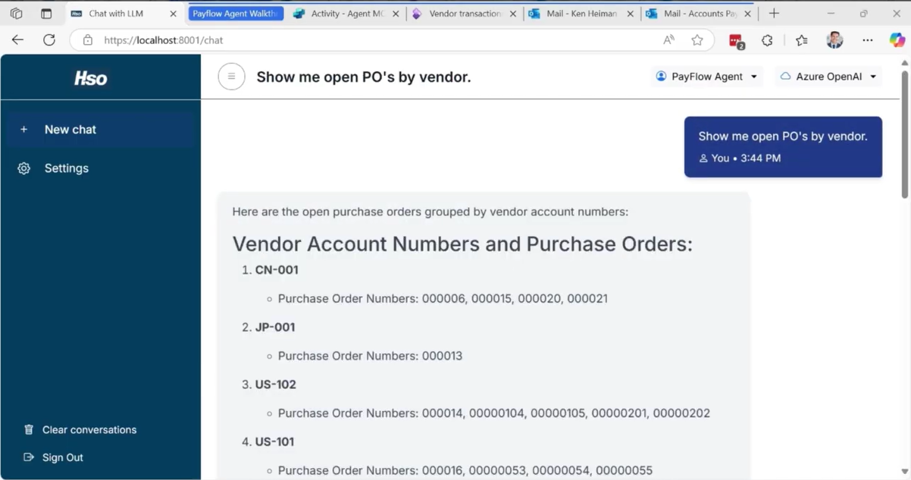
The HSO PayFlow Agent handles supplier payment inquiries end-to-end, with no manual lookup and no human required for routine queries.
The problem: AP teams receive a high volume of supplier emails asking when invoices will be paid. Each one requires a staff member to log into the ERP, find the correct invoice, check payment status, and draft a response. High volume, low complexity, entirely repetitive.
The agent: The HSO PayFlow Agent, built on Microsoft Copilot Studio and integrated with Dynamics 365 Finance via the Model Context Protocol (MCP). The agent monitors the supplier mailbox, reads the incoming message in natural language, retrieves real-time payment data from Dynamics 365, and sends an accurate response automatically.
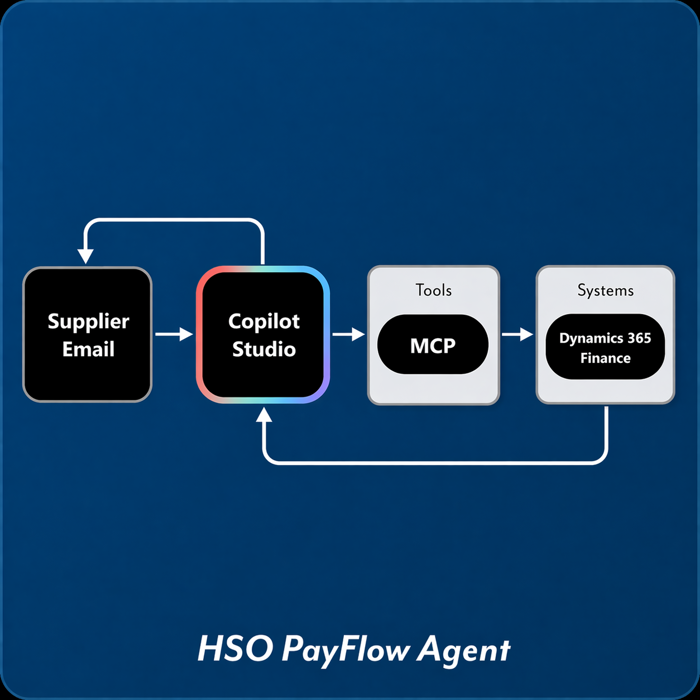
The result: AP staff move from handling repetitive status updates to managing genuine exceptions and strategic supplier relationships.
AI Automated vendor tax form processing, reducing cycle time from 1–2 days to 3 hours, saving thousands of staff hours annually. This solution was the Winner of the 2024 Federal Tax Administration Award for Innovation and Excellence.
Knowledge Work and Expense Management
The fastest-adopted agents in most organizations are the ones that remove tasks employees actively dislike, and expense entry consistently tops that list.
One sentence framing why adoption velocity matters for this category: agents that eliminate manual overhead people already resent face the least resistance and produce the fastest compliance improvement.
The HSO Expense Entry Agent processes expense submissions accurately from within Microsoft Teams, no manual data entry, no separate system login, no paper receipts.
The problem: Expense reporting compliance degrades when staff treat it as administrative overhead. Receipts pile up, entries arrive late or incomplete, and finance teams spend time chasing, correcting, and reprocessing.
The agent: The HSO Expense Entry Agent, built on Copilot Studio and surfaced directly in Microsoft Teams, extracts data from receipt photos submitted by the employee, matches them to the correct expense categories and project codes, and auto-populates the relevant fields in Dynamics 365.
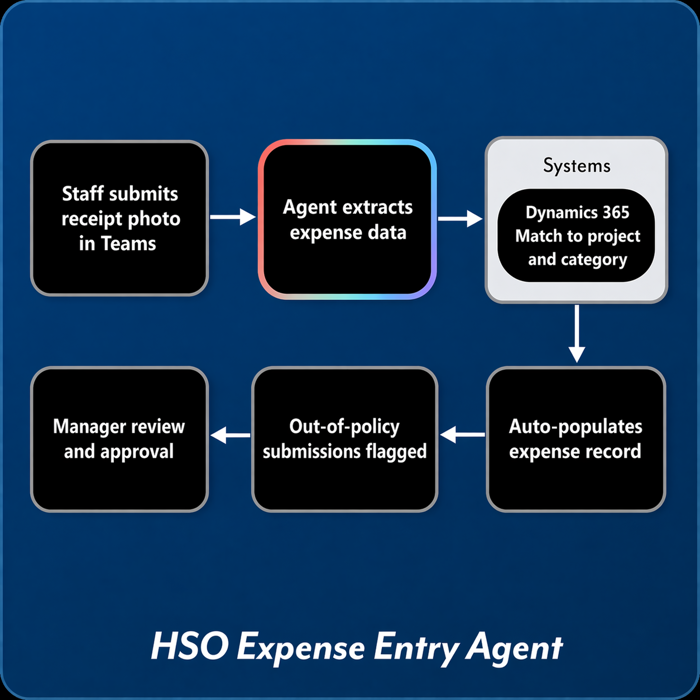
The result: Compliance rates increase as friction decreases. Staff redirect time to billable and client-facing work with expense entry time cut by up to 50%. Governance monitoring, built in from deployment, tracks mis categorizations, and surfaces accuracy degradation.
I used to block out at least an hour after every work trip just to process expenses. Now I just snap a photo on the spot, spend two minutes in Teams, and move on. No stress, and no pile of receipts I’m stressed about losing at the airport.
Operations and Supply Chain
Operations is where the volume is highest and the tolerance for manual error is lowest, which is why agents embedded inside operations workflows can tend to return value in weeks rather than quarters.
The HSO Order Management Agent reads incoming purchase orders in any format and creates the ERP record automatically, without manual data entry for clean orders.
The problem: Purchase orders arrive from customers in multiple formats, email body, PDF attachment, WhatsApp message, each requiring a staff member to extract the data, check it against pricing and current inventory, and manually enter the order into the ERP.
Errors at this stage delay fulfillment and create downstream issues that are expensive to correct.
The agent: The HSO Order Management Agent reads incoming order communications regardless of format, extracts structured order data using generative AI, validates it against Dynamics 365 pricing and inventory in real time, and creates the sales order in the ERP automatically. Orders that meet all validation criteria complete without human input.
Orders that fail validation, wrong pricing, stock unavailable, missing information, route to a human worker with the relevant context already surfaced.
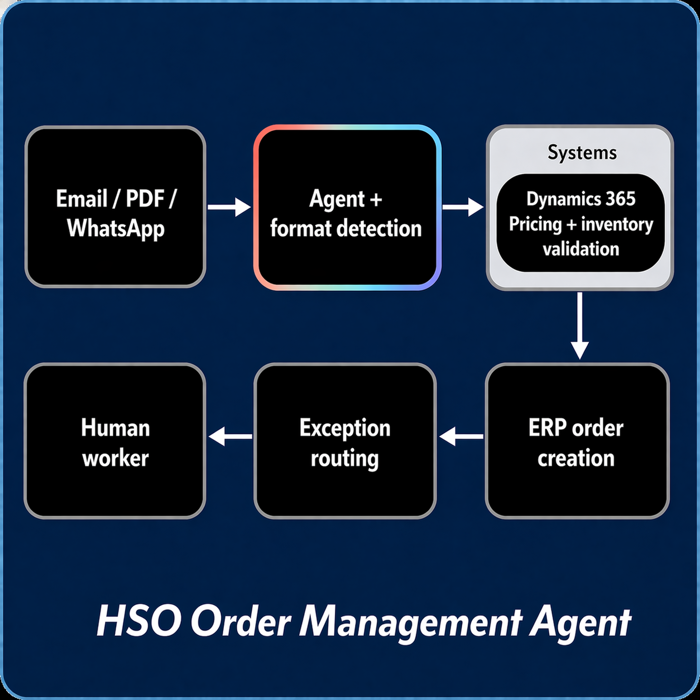
The result: Non-billable order-processing overhead is reduced. Human effort is reserved for genuine exceptions, not routine entry.
“HSO's sweet spot is optimizing business processes with fully integrated ERP, CRM and Analytics —making use of AI for those processes to become more autonomous, smarter, faster, and with less human effort.”

Customer Service and Support
Customer service were some of the first enterprise functions to deploy AI agents at scale, and the distance between a static chatbot and an agent that can reason, retrieve, and route is now where the commercial outcomes diverge.
Chatbots answer FAQs from a fixed decision tree; agentic agents read context, pull live data, apply business logic, and determine the right action.
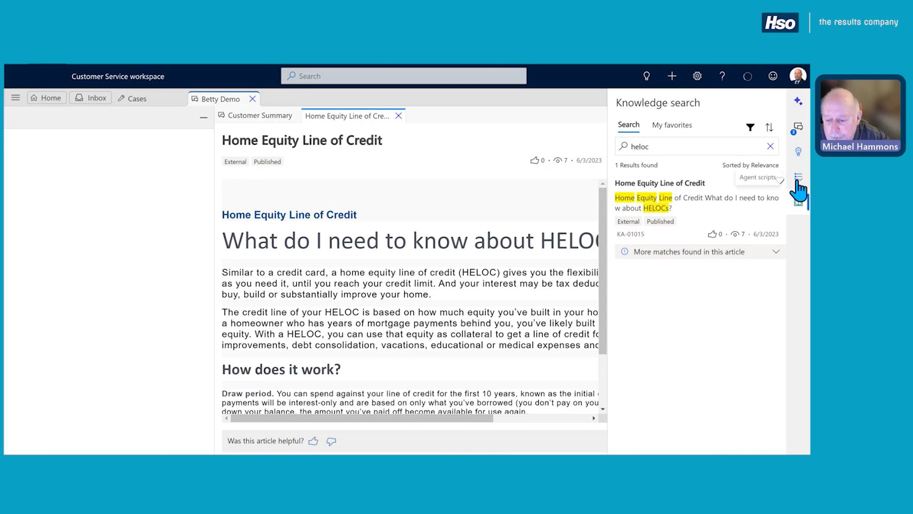
The HSO Customer Service Agent routes, categorizes, and progresses support cases using live CRM context, applying consistent logic to every case, regardless of who picks it up.
The problem: Support cases arrive across multiple channels. Routing decisions depend on whoever picks up the ticket. Categorization is inconsistent. Priority cases get delayed behind routine ones. High-complexity queries and simple inquiries consume the same human effort.
The agent: The HSO Customer Service Agent reads incoming cases using natural language understanding, retrieves the relevant customer and case context from Dynamics 365, and applies defined routing, categorization, and progression logic automatically. Routine queries, status checks, standard information requests, known issue resolution—complete without human involvement. Cases that exceed defined scope, risk thresholds, or complexity criteria escalate to a human worker with full context already compiled.
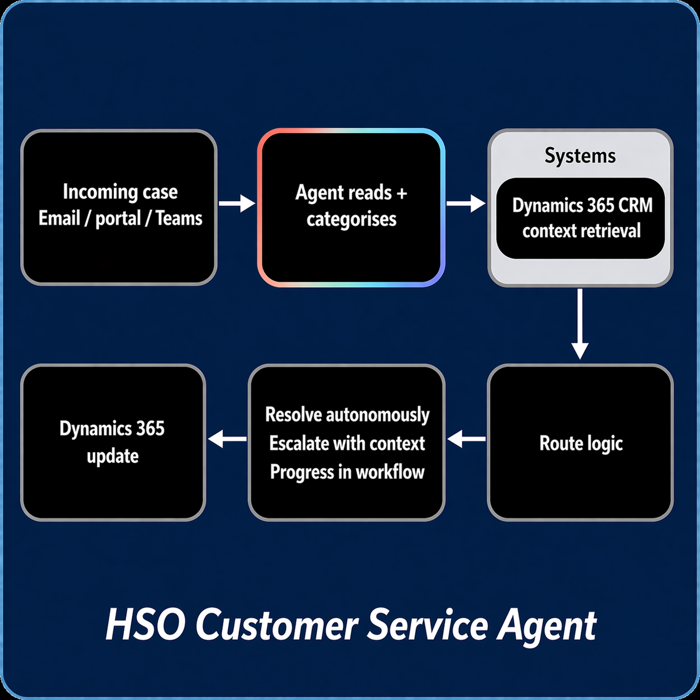
The result: Consistent case handling across the team. Faster resolution on routine queries. Human effort directed to cases that genuinely require judgment.
Legal and Professional Services
Legal and professional services firms carry some of the highest manual processing loads in any sector—document-heavy, time-sensitive, and governed by strict accountability requirements that make AI governance-first agent design non-negotiable.
An LLM-driven contract review agent can reduce document review costs by 20% and and 19-month payback—directing legal professionals to interpretation and advisory work rather than first-pass reading.
The problem: Legal and compliance teams must review high volumes of contracts for risk exposure, regulatory alignment, and non-standard clauses. Manual first-pass review at scale is slow, expensive, and subject to inconsistency. Missing a non-standard clause in a high-value contract has direct commercial and legal consequences.
The agent: An LLM-driven agent reads contracts using natural language processing, cross-references them against a defined knowledge base of standard terms, risk indicators, and regulatory requirements, and flags deviations with supporting context. The agent presents its findings to the lawyer, who retains the decision at every consequential step. Human oversight is built into the workflow by design, not bolted on afterward.
The result: 20% cost reduction and 19-month payback. Legal professionals redirect effort from first-pass reading to interpretation, negotiation, and client counsel.
Gowling WLG applies Azure OpenAI and legal360 to automate legal operations, cutting administrative effort by 35%.
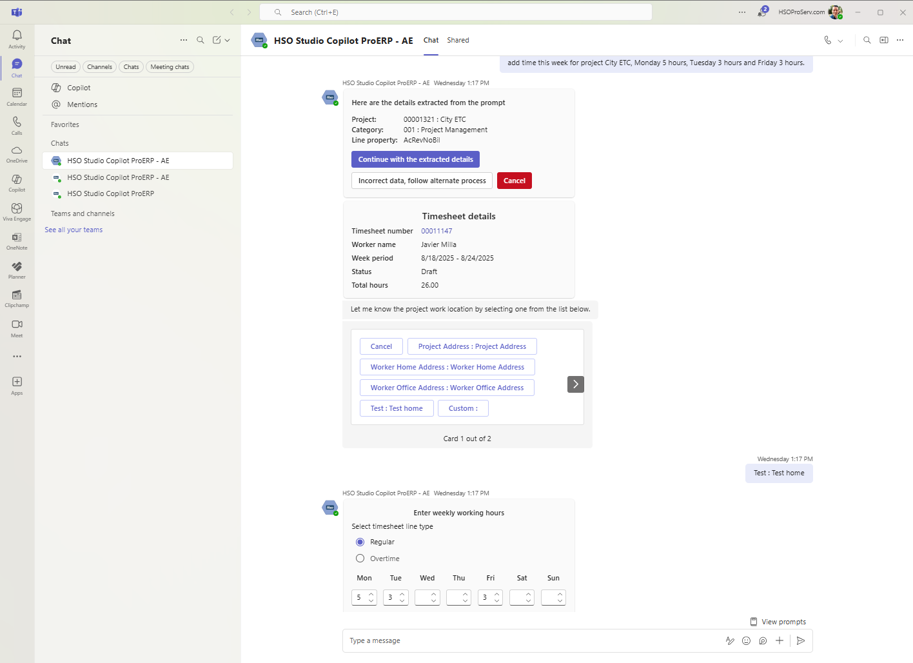
The HSO Time Entry Agent prompts, populates, and validates billable time entries from inside Microsoft Teams, reducing the time that costs professional services firms revenue and accuracy every billing cycle.
The problem: In professional services, late or inaccurate time entries directly affect billing accuracy, revenue recognition, and project profitability reporting. Compliance suffers when staff treat time entry as administrative overhead, especially across complex project portfolios with multiple clients, overlapping deadlines, and varied billing arrangements.
The agent: The HSO Time Entry Agent, built on Copilot Studio and used from Microsoft Teams, uses project assignment and calendar context from Dynamics 365 Finance and Operations to prompt users at natural points in their day. It auto-populates time entry lines based on scheduled project activity, alerts users when entries are missing or incomplete, and escalates persistent gaps to the project manager. No separate system login is required. The agent works within the tools employees are already using.
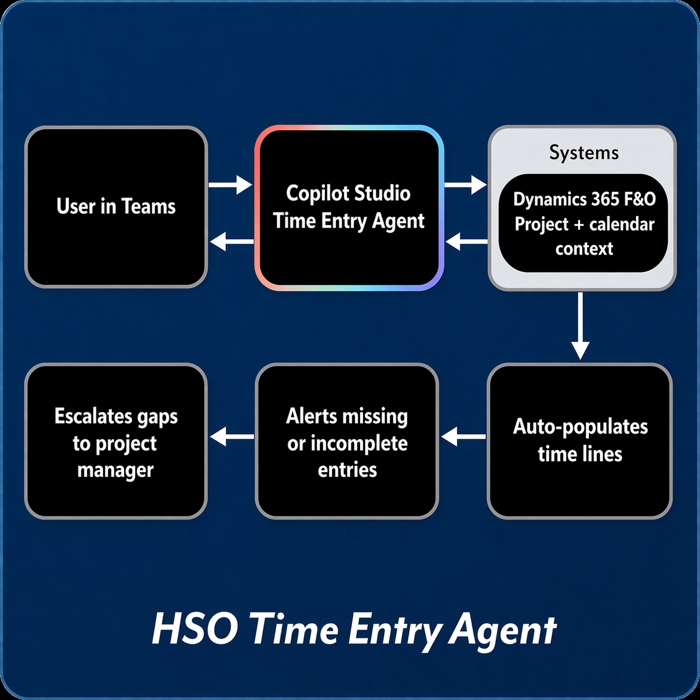
The result: Time entry compliance rates increase as the friction of submission decreases. Billing accuracy improves. Staff redirect attention to client-facing, billable work.
How HSO Approaches Agentic AI Implementations
HSO follows a prove-then-scale model: start with a defined, measurable process, demonstrate value quickly, then build the broader transformation on that foundation.
Forrester's Total Economic Impact study of Microsoft's agentic AI solutions found that organizations deploying on a properly built foundation realized $44.5 million in benefits over three years against $20.2 million in costs, an ROI of approximately 120%. That is what structured deployment on the right platform produces. It is also why most organizations are not seeing those numbers yet.
The above agentic AI examples did not happen because the technology is impressive. They happened because someone asked the right questions before building anything.
“You don't go and hire an employee thinking let's hire them and then we will define what they will do. No. Digital coworkers (AI agents) are the same.”

Before any agent is scoped, HSO starts with outcomes—not technology. Define outcomes before building. What is the expected output? What does success look like at 30 days and 90 days? What is the break-even point between what this costs to build, run, and maintain, and what it measurably returns? Define the outcome first. HSO AI Strategy Services.
Choose the right starting point. High-volume, repetitive, measurable processes first. The first agent should produce a visible result in weeks, not a roadmap entry for next year.
Build on a data foundation. HSO integrates agent delivery with data platform readiness, not as a separate workstream, but as a prerequisite. No reliable agnetic workflow operates on unreliable data. HSO DnA Accelerator.
Design AI governance in from day one. Audit trails, escalation paths, and human accountability structures are part of the initial build. Governance added after deployment has consequences. Governance built in from the start reduces them. AI Governance Consulting Services.
Manage agents for the long term. Agents are operational workloads. They need the same lifecycle management, performance monitoring, security review, and continuous improvement discipline as any other business-critical system. HSO AI Managed Services.
Across recent projects, clients have achieved an estimated 3-year ROI ranging from 100% for Finance & Operations to 300% for Customer Engagement, driven by efficiency gains, automation, and new revenue streams.