industry expertise, technology & knowledge
Explore Resources


94,526 FOI requests. The challenge isn't responding. It's finding the information.
During 2025, monitored public bodies received 94,526 Freedom of Information requests, the highest annual volume recorded since monitoring began in 2005.
That's an increase of 14% in a single year, with more than 11,000 additional requests submitted compared to 2024.
On the surface, those figures point to growing demand. But for information governance teams across local government, the bigger challenge isn't the number of requests arriving.
It's what happens after they arrive.
Every FOI or Subject Access Request (SAR) sets off a process that most councils know all too well. Information must be located, reviewed, validated and brought together before a response can be issued. As demand increases, that process becomes harder to manage efficiently, particularly when information is spread across multiple systems, teams and repositories.
The challenge facing local government
The increase in request volumes is only part of the story.
Many councils are also seeing requests become more detailed, more specific and more complex than they were a few years ago.
The rise of publicly available AI tools is changing the way residents interact with organisations. It is now possible for someone to ask ChatGPT, Copilot or Gemini to draft a detailed FOI request covering multiple topics, departments, date ranges and document types in a matter of seconds.

This creates an interesting paradox.
Artificial intelligence has enormous potential to help councils manage information more efficiently. Yet it may also be contributing to the growing complexity of the requests they receive.
The latest FOI statistics provide another indication of this challenge. Of the requests withheld in full or in part during 2025, 26.6% were withheld because the cost of responding exceeded the statutory limit.
That doesn't necessarily mean organisations are unwilling to provide information. It highlights the practical reality that locating, reviewing and collating information is a significant exercise in its own right.
As requests become broader and more sophisticated, the effort required to respond can quickly increase.
The challenge is greater when the information needed to respond is spread across many systems, departments and repositories. Before a response can be drafted, someone must understand what information exists, where it is held and whether it can be trusted.
Finding the information is only part of the challenge. Teams must then review records for personal, sensitive or exempt information before disclosure, making redaction another time-consuming step in an increasingly complex process.
What good looks like
While every council's approach is different, the organisations making progress in this area focus on a common objective: making information easier to find, manage and govern.
Rather than expecting staff to move between many systems, inboxes and repositories to build a response, information is brought together in a way that makes it easier to access and manage.
This is a challenge Oldham Council recently explored as part of a webinar hosted with HSO. In the session, the council shared its journey towards creating a joined-up view of the resident, bringing together interactions, documents, service history and supporting information in one place to help staff respond more quickly, coordinate more effectively and make better-informed decisions.
What's particularly interesting is that this approach doesn't start with FOIs or SARs.
It starts with improving access to information.
On-Demand | Oldham Council Modernises Resident Services with Gov360See how to create a single, connected view of the resident |
What councils tell us
The challenges with FOIs and SARs are not happening in isolation
This reflects feedback in our recent research with Socitm.
When senior local government Digital, Data and Technology leaders were asked about the challenges their organisations face, the discussion quickly moved beyond technology itself. Budget pressures, growing demand, skills shortages, information quality and data maturity all featured prominently.
While technology has a role to play, councils are increasingly looking for solutions that can be implemented quickly, align to existing Microsoft investments and deliver tangible operational benefits without lengthy transformation programmes.
That's particularly important at a time when teams are being asked to improve services while managing increasing demand. Organisations need solutions that address today's operational challenges while also creating a foundation for future innovation and AI adoption.
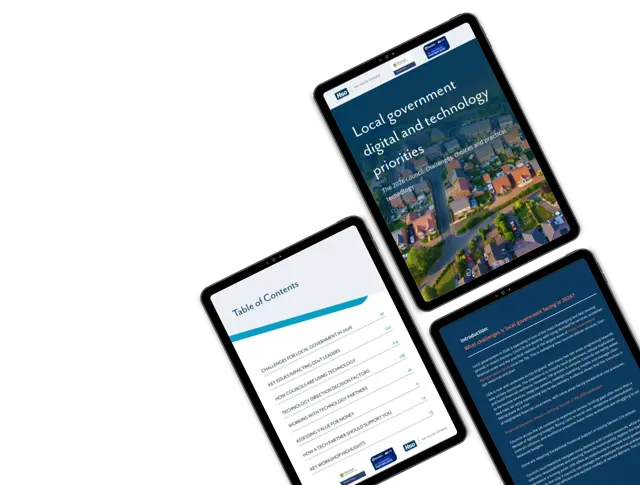
Report by Socitm and HSO | How local authorities can make better decisions under pressure
What leading councils are doing differently in 2026. And what you can learn from them
A different approach to managing FOIS and SARS
This is the challenge HSO Information Accelerator was designed to address.
Information Accelerator is one of the modules within HSO Gov360, our local government solution built on Microsoft technology. Rather than starting from scratch, Gov360 provides councils with pre-configured solutions designed around common local authority processes, helping organisations implement more quickly and realise value sooner.
For information governance teams, Information Accelerator brings FOIs, SARs, complaints, member enquiries and related processes together within a single platform, providing a unified view of requests, workflows, deadlines and resident interactions.
The objective isn't simply to process requests faster.
It's to make information easier to find, easier to govern and easier to use.
When teams spend less time searching for information, they can focus more time on delivering accurate, timely and consistent responses.
Because ultimately, responding to an FOI or SAR isn't usually the difficult part.
Finding the information is.
Book a demonstration of HSO Information Accelerator.industry expertise, technology & knowledge
Explore Resources