Why Choose HSO for MLOps Consulting
Why Choose HSO for MLOps Consulting
HSO combines deep Microsoft expertise with a practical, data-first approach to MLOps that gets models into production and keeps them performing.




From Experimentation to Production
Most ML models never make it past the proof-of-concept stage.
Without standardized pipelines, monitoring, and governance, promising models stall in notebooks—consuming budget without delivering business value. HSO's MLOps consulting services help you build the infrastructure, automation, and AI governance services needed to turn ML experiments into measurable business outcomes—all with Microsoft AI tools.
What We Deliver
Our MLOps Services
HSO delivers end-to-end MLOps consulting services across the full machine learning lifecycle, from infrastructure design to continuous model monitoring.
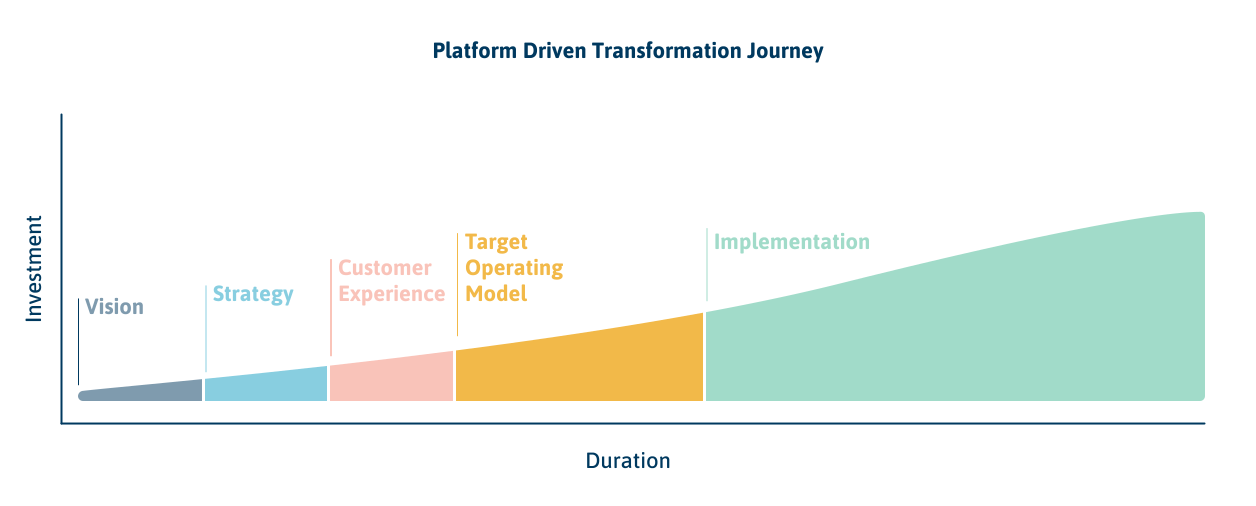
Azure Machine Learning can deliver 189% to 335% three-year ROI with a 25% increase in data science productivity and a 40% improvement in data engineering efficiency. HSO's consulting approach is built around realizing these outcomes, with clear success metrics defined at the start of every engagement and tracked through delivery.

Azure Machine Learning
Azure Synapse Analytics
Azure AI Foundry

Microsoft Purview

Azure Databricks

Dynamics 365
“Our experience with HSO has been highly collaborative. Their team gave us technical capabilities we hadn’t seen elsewhere and helped shape the architecture that underpins the model’s performance.”
Our customers
MLOps in Practice
See how HSO has helped organizations operationalize machine learning at scale.
Moving from ML experimentation to production is hard. These are the obstacles HSO's MLOps consulting services are designed to overcome.
Challenge: Many organizations invest heavily in data science talent and tooling but struggle to move models beyond notebooks and proof-of-concept stages. Without standardized deployment pipelines, governance frameworks, and production infrastructure, promising models stall—consuming budget without delivering business value.
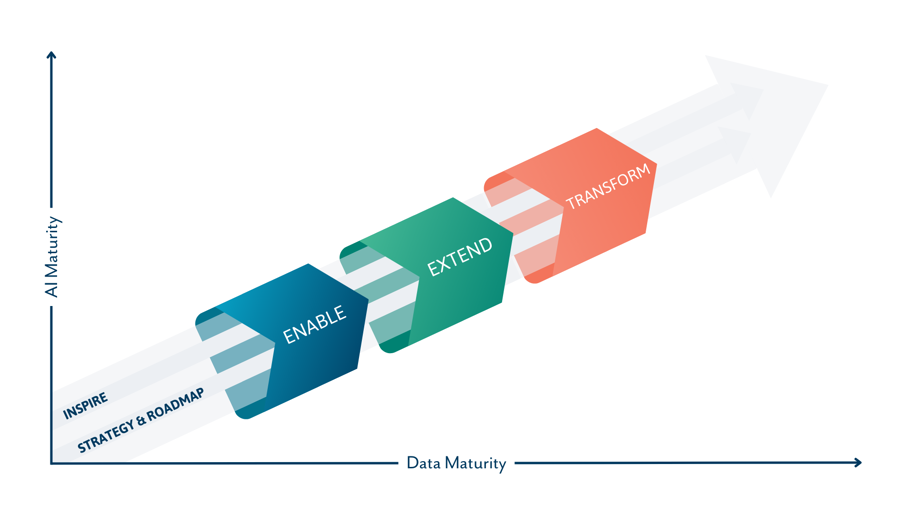
Solution: HSO structures every MLOps consulting engagement around production readiness from day one. Rather than treating deployment as an afterthought, HSO builds automated CI/CD pipelines, standardized environments, and approval workflows into the platform from the first sprint. This approach compresses the model-to-value timeline and breaks the cycle of perpetual piloting.
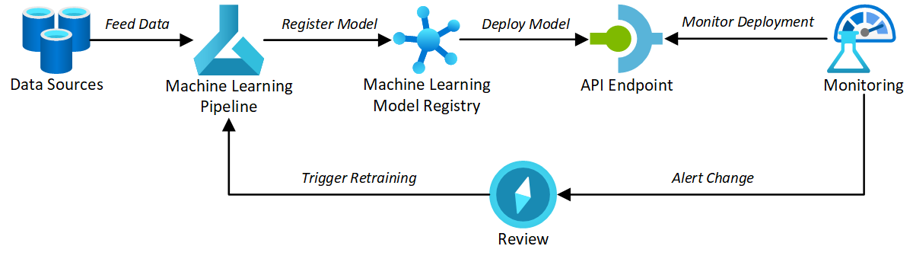
Challenge: Models that perform well at launch often degrade over time as the underlying data distribution shifts. Without continuous monitoring, organizations make business decisions based on stale or inaccurate predictions, sometimes without realizing the model has deteriorated. Data drift and concept drift are among the most common and costly production ML failures.
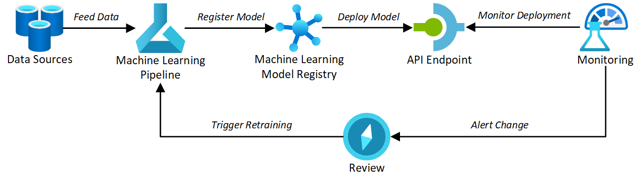
Solution: HSO implements continuous monitoring for data drift, concept drift, and prediction quality using Azure Machine Learning's built-in capabilities. Automated alerts notify teams when performance drops below defined thresholds, and automated retraining pipelines can retrain and redeploy models without manual intervention, keeping predictions accurate and trustworthy.
Challenge: When training and serving environments use different data pipelines, feature definitions, or processing logic, the result is training-serving skew, a silent source of prediction errors in production. Fragmented data across silos compounds the problem, making it difficult to ensure models are trained on complete, representative datasets.
Solution: HSO's data-first approach ensures a unified data foundation using Microsoft Fabric and Azure Synapse before building ML pipelines on top. Feature stores and shared data preparation logic eliminate skew between training and serving environments. This architecture guarantees that the data your model sees in production matches what it learned from during training.
Challenge: With the EU AI Act enforcement beginning in August 2026 and increasing regulatory scrutiny worldwide, organizations face growing AI compliance requirements for their ML systems. Many lack the model versioning, lineage tracking, bias auditing, and documentation practices needed to demonstrate responsible and compliant AI operations.
Solution: HSO builds AI governance into the MLOps platform from the start—not as a retrofit. This includes model registries with full version history, automated Responsible AI checks (bias detection, fairness assessment, explainability), and audit-ready documentation. HSO aligns governance practices with the Microsoft Responsible AI Standard, the NIST AI Risk Management Framework, and emerging regulations like the EU AI Act.
Challenge: A single successful ML model does not mean an organization is ready to scale. Without a platform approach, each new model requires its own infrastructure, deployment process, and monitoring setup, creating operational complexity that grows linearly with every additional use case.
Solution: HSO designs ML platforms, not one-off model deployments. Using Azure Machine Learning and Infrastructure as Code, HSO builds reusable templates, shared compute resources, and standardized pipelines that new teams and use cases can adopt without starting from scratch. This platform approach means the cost and effort of deploying the tenth model is a fraction of the first.
Challenge: Many organizations have strong data science talent but lack the engineering and operational expertise needed to manage production ML systems. Without a clear path to internal capability—or a reliable partner to handle operations, models stall between experimentation and sustained production use.
Solution: HSO builds internal capability through structured knowledge transfer, hands-on training, and operational runbooks at every stage. For organizations that prefer to focus their teams on model development rather than platform operations, HSO's AI managed consulting services provide continuous MLOps support, including monitoring, retraining, and governance—as an ongoing service.