


















Common processes and reliable data can power growth and AI initiatives. Venchi has been able to:
AI for Retail: Optimize inventory, Delight customers, strengthen customer loyalty
Discover how retailers can turn fragmented data, inventory uncertainty, and rising customer expectations into practical AI applications that improve availability, personalize every interaction, and speed up service across channels.

Retailers are under pressure to improve both their profitability and the customer experience, with AI often framed as the answer. But scaling beyond pilots remains challenging.
Balancing Operational Pressure with Expectations for AI
Retail operations are under intense strain. Customer expectations are rising, as shoppers want seamless omnichannel journeys, personalized experiences, and faster fulfillment.
Without an effective response, brands face a future of lower customer lifetime value, eroding margins, and rising acquisition costs.
So, it’s no wonder that retailers are grasping for answers—and AI is seen as a magical fix for homeware chains, DIY outlets, garden stores, and a host of other businesses. In fact, 90% of retailers will increase AI budgets in 2026, says NVIDIA in analysis of its State of AI in Retail and CPG report.
What happens next?
Expectations escalate and the task of turning AI into measurable retail value falls heavily on retail operations leaders, CIOs, CTOs, and digital transformation functions. Suddenly, they need to reduce operational complexity and protect margins while supporting growth and consistent experiences across channels and markets.
Pilots can falter or fail to scale
Organizations embark on AI projects with high hopes. But what’s the reality? While 75% of executives call AI a top strategic priority, only 16.5% can quantify a return, according to the State of AI in retail and CPG from Deloitte in 2026.
Meanwhile, 71% of merchants said AI merchandising tools have had limited or zero effect on their business so far when asked by McKinsey in a survey explored by its insightful 2026 article, Merchants unleashed: How agentic AI transforms retail merchandising.
Let’s explore five areas where challenges becomes visible—and find solutions
Five Retail Processes Where Isolated AI Pilots Fall Short
Standalone AI projects target important goals. For example, retail leaders may want to improve stock availability, boost fulfillment, raise productivity, or increase customer satisfaction without extra manual resources. But what’s causing pilots to fail? Let’s take a closer look across the retail industry.
Pressures on retail: Inventory is spread across stores, warehouses, marketplaces, and fulfillment partners with different systems show varying product levels. Stockouts, overselling, and split shipments are impacting revenue and customer trust.
Why isolated AI pilots won't fix it: AI needs visibility across locations and channels, with access to trustworthy data. But outdated inventory information produces inaccurate AI recommendations. Getting the wrong information faster doesn’t help anyone.

The Common Problem: Retail Processes Break at the Handoff
Retail CIOs, COOs, and transformation leaders under pressure to prove AI ROI at scale. But turning scattered AI experiments into measurable business impact is a major challenge with a strong likelihood of cost overruns, stalled adoption, or governance risk.
The reason? Typically, AI pilots focus on one retail task rather than the wider process.
AI pilots can break at the handoff, such as:
Between merchandising and commerce
Between commerce and fulfillment
Between fulfillment and customer service
Between local and global teams
Between systems managing critical data
Customer outcomes depend on coordination across the entire process. Everything needs to click into place, so logistics happen as anticipated and retail brands keep their promise to the customer. So, let’s explore where AI creates measurable operational value when these foundations are in place.
See Operational AI in Action
Order management is a strong candidate for operational AI in practice. With the right approach, you can accelerate beyond a fragmented landscape of PDF email attachments, Excel lists, EDI glitches, and form clicks. The outcome? Greater accuracy, speed, and customer satisfaction.
Watch this demo and see how to save time, boost accuracy, and enable faster fulfillment.

Where Processed-Focused AI Creates Value in Retail
Successful retail AI initiatives start with business outcomes, not technology. The framework below shows how common retail objectives connect to operational challenges, the data and decision logic AI requires, and the business value that can be measured through clear operational KPIs.
Retail goal | Challenge | Data & Decision Logic | Business Value & KPIs |
|---|---|---|---|
Increase product availability and fulfillment reliability |
|
| Capture more sales at full margin and reduce fulfillment costs. |
Protect margin and reduce post-purchase costs |
|
| Reduce service and returns costs while improving margin recovery. |
Scale consistent operations across markets |
|
| Accelerate rollout of new initiatives while maintaining operational consistency across markets. |
The retailers seeing the greatest value from AI connect data, decision logic, and business processes across functions. This enables AI and agents to improve decisions at scale while delivering measurable business outcomes.
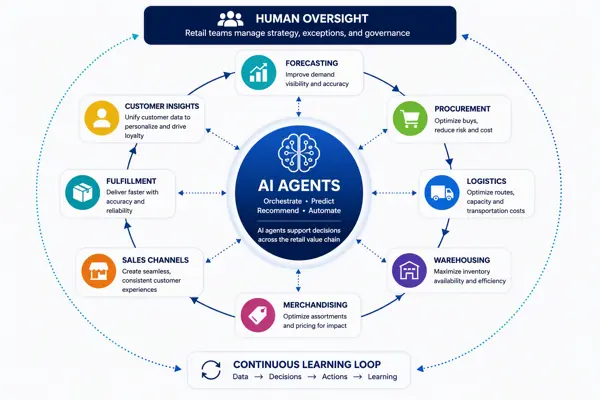
Connected AI Across the Retail Value Chain
AI creates greater value by transforming connections between retail processes and coordinating decisions across the value chain. By using real-time data across processes, AI can optimize operations workflows continuously.
How HSO helps retailers scale AI with confidence
HSO has experience delivering AI solutions to dozens of leading companies and decades of experience with retail and trade-led organisations around the world. From that experience, we have developed a structured approach that overcomes these roadblocks, considers industry-specific challenges, and helps your organisation adopt AI confidently across critical business processes.
By partnering with HSO, your retail organisation can:

Venchi Builds a Consistent Platform for Growth
Premium chocolate and gelato brand Venchi leveraged HSO’s AI expertise to optimize millions of customer experiences each year in a business that has 180 boutiques across over 70 countries.
HSO began supporting Venchi with its core business applications, including Dynamics 365. But experts soon surfaced some exciting opportunities to drive innovation with AI.
The retailer made a critical decision to standardize and unify every endpoint and data source.
This opened the way to faster, more scalable innovation. Now the company is reaping the rewards across its sophisticated, multi-channel ecosystem, which spans wholesale, retail boutiques, and digital commerce.
The Rresult
15000
hours saved yearly by automating fulfilment
2%
reduction in cost of goods sold year-over-year
800000
customers to the loyalty program
4.9
out of 5 customer satisfaction contributed
How to Transform Order Management in Retail
Order management is one of the most time-consuming manual processes in retail supply chain operations. Teams spend hours processing, validating, and entering orders into ERP systems. Delays and mistakes impact customers and revenue.
Transformation brings significant benefits, so this makes order management a prime candidate for AI-enabled automation. It’s an environment where AI can thrive, getting to work with high volumes of structured and unstructured documents.

Further Read
Learn how we're helping retail businesses with the latest cloud and AI technologies
Get a personalised view of your retail AI readiness
At HSO, we help retailers identify top opportunities where AI can create value for your teams, your customers, and your bottom line. Fill in the form to get personalized recommendations from our retail experts.