Security Under Control
Although the project is still in full swing, the first results are already noticeable.

Technische Unie builds an AI-driven future with Azure
How do you ensure that your integration infrastructure runs reliably today and is ready for tomorrow’s technology? For Technische Unie, it starts with a clear choice: working with leading, proven technology. That’s why the company switched from BizTalk 2013 to Azure Integration Services. The result? Better interfaces and a solid foundation for innovations such as AI.

Ronald Blankestijn is responsible for data integration at Technische Unie (a Sonepar company) and discusses the migration from BizTalk to Azure at Technische Unie. The transition began in mid-2024 and is expected to last until mid-2026.
Innovating with Azure
“We were being left behind,” says Ronald. “Originally, the plan was to upgrade the outdated BizTalk 2013 environment to BizTalk 2020, but since BizTalk is being phased out by 2028, that turned out to be a stopgap solution with no future.”
For Ronald, Azure is also a logical step in his organization’s IT strategy. “With Azure, we’re truly taking our integration architecture to the next level. At TU, we deliberately work only with leading and proven applications and are constantly looking for ways to continue guaranteeing our quality, stability, flexibility, and scalability. Azure fits perfectly into that. The platform supports the latest standards and protocols and aligns well with our innovation strategy—think AI analysis and AI development.”
“With Azure, we’re really taking our integration architecture to the next level.”

International alignment
The transition to Azure aligns with the strategy of the parent company, Sonepar, and other international branches. HSO has set up the Cloud Foundation at both Sonepar and Technische Unie. This serves as the foundation for the Integration Landing Zone, on which various solutions—including integration—run.
"Our systems are now perfectly aligned. We sought alignment in advance on both the HSO side and the Sonepar side. I wanted to make sure our foundation was solid, so that we could work effectively with landing zones and ensure that the entire infrastructure was truly well organized."
This decision ensures standardization in both infrastructure and integration systems. “We were already moving toward Azure. Fortunately, we stuck with that decision, because ultimately, the parent company made the switch as well. Moreover, more and more countries are following suit, such as Norway, the United States, and France.”

About Technische Unie & Sonepar
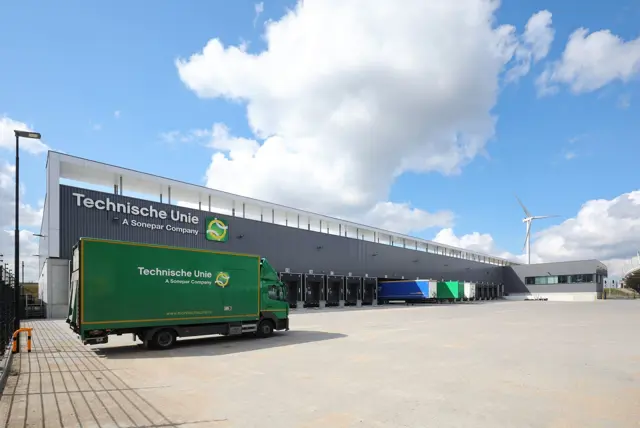
Technische Unie is part of the global Sonepar family, a wholesaler of technical solutions for installation.
"Best practice" interfaces
Azure Integration Services not only addressed the continuity risk associated with BizTalk 2013, but also introduced a completely new way of working. Instead of a server-based, outdated system, Azure offers a flexible, scalable, and microservice-based iPaaS environment in which interfaces can be easily customized and managed. “With Azure, we can now implement standardization that was previously impossible,” explains Blankestijn. “All new interfaces are designed from the start according to the latest best practices.”
Importantly, Azure also simplifies the integration of other systems, such as SAP. By routing all processes through a single central integration layer, Technische Unie is finally able to say goodbye to the inefficiencies of parallel integration solutions. In addition, Azure’s comprehensive monitoring provides much greater insight into the performance of the interfaces.

Cloud Competence Center as the backbone
Technische Unie chose HSO because of their structured approach and expertise in migrating from BizTalk to Azure. Ronald says: “What makes HSO unique? We had a number of inspiration sessions to get a clear picture. We were impressed by their experience and knowledge of Microsoft Azure. For the BizTalk migration, HSO uses tools they developed in-house that analyze the BizTalk environment, show exactly how it’s structured, and pinpoint where the complexity lies. I felt this would help accelerate our integration strategy.”
To ensure the integration project runs smoothly, a Cloud Competence Center was established to create and enforce clear guidelines: "We decided to place a Cloud Competence Center above the project. It includes Merlijn Koppejan and Tomasso Groenendijk from HSO, as well as leads—including myself—from my team. We coordinate the guidelines… what exactly are the guidelines we have? What is our naming convention? It’s really starting to pay off now… during the last sprint, we even delivered more than we had planned,” says Ronald.
The collaboration strengthens over time. For example, in the way that new standards are developed. “This is how we work: if you run into an issue… come up with a proposal. We review these and supplement them as needed, so we can elevate them to a new standard.”
This is documented in Confluence, so that all integration developers have access to these guidelines. This collaborative process ensures that both HSO and TU are jointly responsible for the growth and improvement of the cloud infrastructure: “This is how we want to continue building on that knowledge and those standards. It’s truly a collaborative process.”
Security Under Control
Thanks to new dashboards, processes can be monitored more effectively. “We now have tools that allow us to track orders throughout the entire process. If something goes wrong, we know right away where the problem is.”
By migrating to Azure, Technische Unie has eliminated the security risks associated with unsupported systems.
The infrastructure is being aligned with that of parent company Sonepar. “We are now on par with other countries within the group, which makes data sharing and collaboration easier.”
Integration first, then AI
The transition to Azure not only lays the foundation for operational improvements but also opens new doors. With a uniform integration layer, we’ll soon be able to deploy AI much more easily. That’s still a long way off, but it will become possible by using Azure for all our data integrations,” says Blankestijn.
Implementing AI is on the agenda, but the focus is entirely on integration right now. Ronald concludes: “Once the integration platform is firmly in place, we’ll start working on developing a compelling business case to deploy AI in a targeted way and add value—and Azure will be a huge help with that.”

Why HSO
Turn your data into action. By intelligently connecting systems and making information accessible, you can get much more out of your data.
How can we help you?
We build seamless interfaces that improve data flow. With our accelerators and apps, we help you overcome digital obstacles. The result? Getting more value out of your business.
✔Optimize AI adoption: a robust data and integration platform
✔Built on Microsoft – Secure, scalable solutions in Azure
✔Experience that counts—clients like STICHD and Technische Unie have gone before you
✔Low costs: Pay-as-you-go and managed services without IT complexity
✔Industry-specific expertise – We understand your challenges and systems
Our mission is clear
To help organizations grow with technology-driven solutions that work. Data and integration are indispensable to this. Do you want to make data truly work for your organization? Let’s talk.
More
Success Stories
More
About Data & Integration