
Microsoft Fabric Jumpstart FREE 4-day Workshop
Go live with your first Fabric workload in just 4 days with expert guidance from a top 1% Microsoft partner [eligibility criteria applies]


What Is Microsoft Fabric?

Ask a data team where their information lives and you often get a list: one tool for ingestion, another for the warehouse, a third for streaming, a fourth for reporting, each with its own security model and its own copy of the data. That sprawl is slow, expensive, and hard to govern.
Microsoft Fabric brings those stages onto one platform, and it has become the fastest-growing data product in Microsoft's history. This guide explains what Fabric is, how its pieces fit together, what it costs, how it compares to Databricks and Snowflake, and where HSO helps you get value faster.
What is Microsoft Fabric?
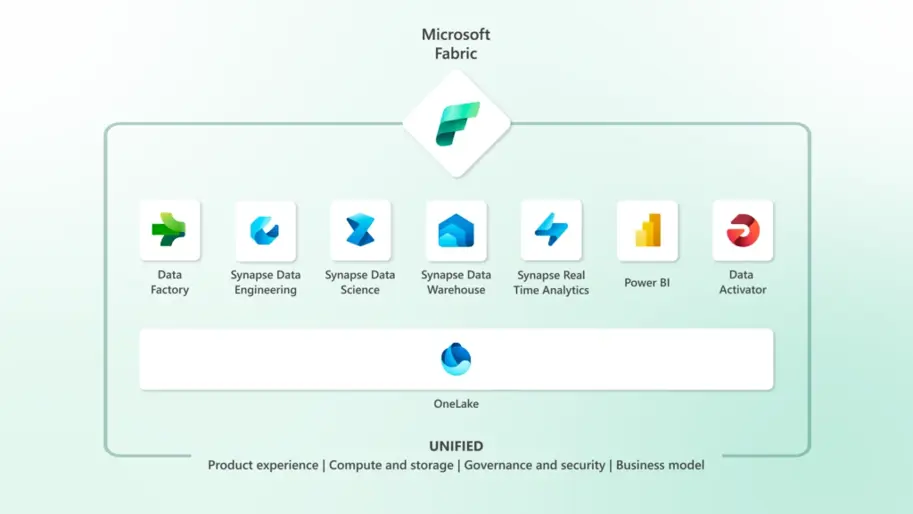
Microsoft Fabric is an end-to-end, software-as-a-service (SaaS) data and analytics platform that unifies data integration, engineering, warehousing, data science, real-time analytics, and business intelligence into a single, governed experience.
Launched in 2023, it brings every workload onto one foundation called OneLake, secured by Microsoft Entra ID and encrypted by default.
The point of Fabric is consolidation. Traditional architectures needed separate provisioning, security, and networking for each stage of the data lifecycle. Fabric puts all of it under a single tenant, a single storage layer, and a single governance model, which lowers total cost of ownership and shortens the path from raw data to AI-ready insight.
For a CIO or data leader, that shift matters for three reasons Power BI alone cannot address: scaling across growing data volumes, governing pipelines and models consistently, and building the unified data foundation that AI and Copilot actually require.
The Core Building Blocks of Fabric
Fabric is easier to understand as a few foundational ideas rather than a long feature list. Four building blocks do most of the work.
OneLake is the single data lake for your whole organization. Microsoft describes it as "the OneDrive for data," automatically provisioned with every Fabric tenant. Data lands once and every engine reads it in place, with no copying, duplication, or format conversion. Storage uses the open Delta-Parquet format, and Delta tables can now be read natively as Apache Iceberg, so you are not locked into a single vendor.
Shortcuts virtualize external data without moving it. A Shortcut creates a live link to storage that sits outside Fabric, such as Amazon S3, Google Cloud Storage, or Azure Data Lake Storage Gen2, and makes it appear as if it lives natively in your workspace. Recent releases extended Shortcuts to SharePoint and OneDrive, so business-critical documents can be queried in place.
Mirroring replicates operational databases with zero ETL. Mirroring continuously copies transactional data into OneLake as read-ready Delta tables, with no staging environments or incremental-load logic to maintain. Coverage now includes SAP and Snowflake among others.
Direct Lake gives Power BI import-class speed on live data. Historically you chose between importing data (fast but stale) or DirectQuery (fresh but slow). Direct Lake reads Delta-Parquet files straight from OneLake, helped by V-Order compression, so reports stay fast and current without a refresh cycle.
Together these support the medallion architecture (Bronze, Silver, Gold) that Microsoft recommends.
Fabric Real-World Examples
The clearest way to understand Fabric is to see what organizations build on it. Here are three HSO Fabric projects across very different sectors and use cases.
An asset management firm running billions in assets under management turned to Microsoft Fabric to predict and prevent customer churn. Facing tougher competition and a wave of retiring customers withdrawing their funds, the firm needed to understand who was likely to leave and why.
HSO built a churn prediction model on Fabric that analyzes customer data to flag at-risk investors, giving finance, marketing, and sales teams the insight to act before customers leave. The model also surfaced an unexpected pattern of younger customers pulling out their investments, which prompted the firm to rework its investor education programs.
Read the churn prediction case study
Amnesty International, the world's largest human rights nonprofit with more than 10 million supporters, migrated to Microsoft Fabric for a scalable and resilient data platform. The organization processes sensitive information from conflict zones and persecution cases worldwide, work that had outgrown spreadsheets.
As Head of IT Business Systems Mira Mistri put it, having data in a central place delivers "more accurate and better reporting, better data governance, and master data management." For a nonprofit, every pound saved through simpler technology is redirected to frontline work.
Read the Amnesty International case study
Spairliners, which provides aircraft component maintenance contracts, replaced pricing guesswork with machine learning models built in Microsoft Fabric. Contract prices had been estimated from flight hours and incomplete data, leaving no consistent pricing policy and disrupting planning and inventory management.
HSO assessed and cleaned the data, then built a Fabric solution that predicts expected maintenance and associated costs, stores the results in a data warehouse, and visualizes them in Power BI. In the words of Head of Innovation, Data & Quality Jonathan Mayer, "we are not kidding ourselves with prices that are too low, nor are we asking too much of our customers."
What You Can Do With Fabric
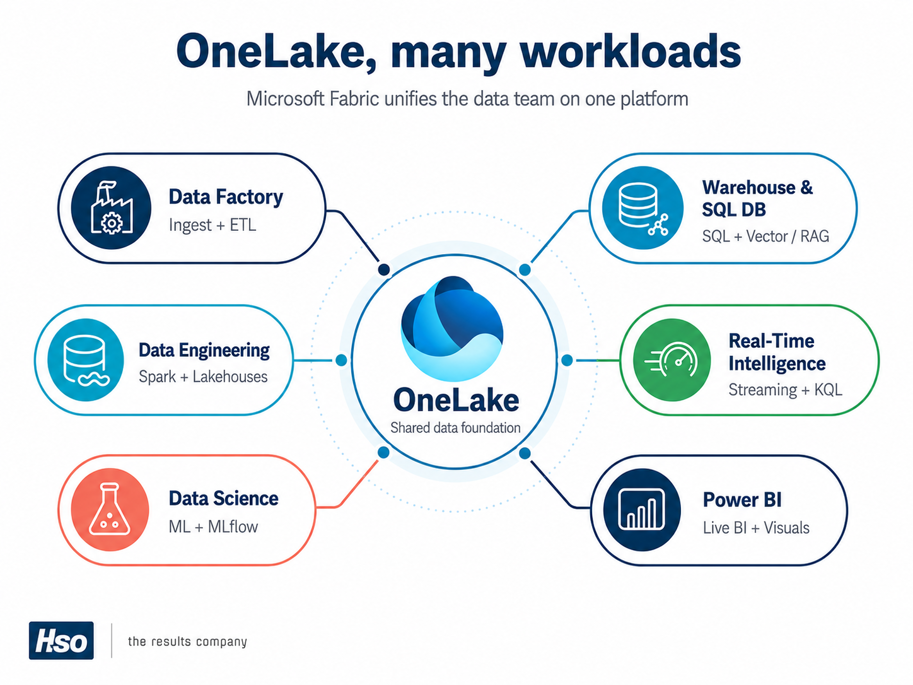
Fabric runs several distinct workloads over the same OneLake storage, each aimed at a different role. You can think of them as the jobs your data team already does, now sharing one platform instead of fighting across several.
Data Factory: Orchestrates ingestion and ETL across 140+ native connectors, now with human-in-the-loop approval steps routed through Teams or Outlook.
Data Engineering: Apache Spark notebooks and lakehouses for large-scale transformation, with declarative Materialized Lake Views replacing fragile hand-coded pipelines.
Data Science: The full machine learning lifecycle on data read directly from OneLake, with MLflow tracking and model deployment back into Power BI.
Data Warehouse and SQL Database: Enterprise SQL analytics plus a translytical database that natively supports vector types for retrieval-augmented generation (RAG) scenarios.
Real-Time Intelligence: The Eventhouse database and KQL for streaming telemetry, with Activator turning conditions in the data into automated business events.
Power BI: The familiar Microsoft Business intelligence tool reporting and visualization layer, now reading live from OneLake.
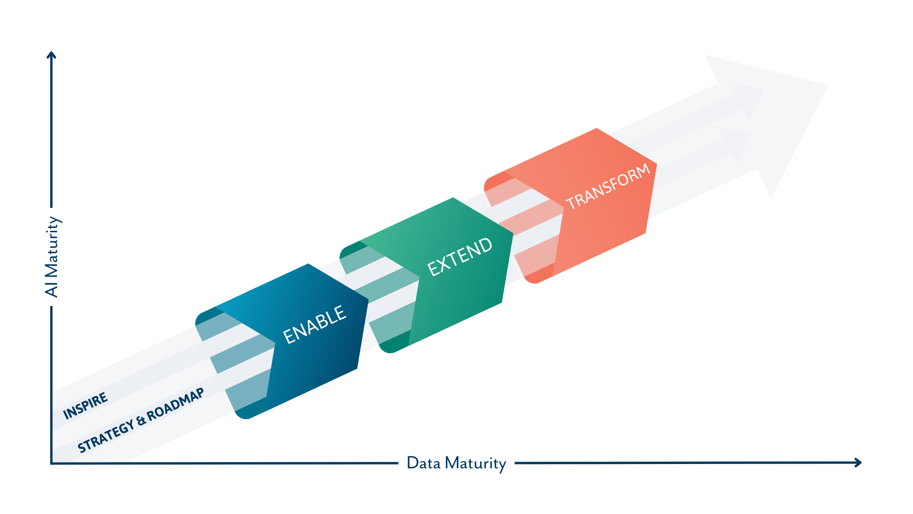
Fabric is best adopted incrementally, one subject area at a time, rather than as a single big-bang migration. A typical end-to-end data journey moves through three phases:
Months 1-3: Keep existing Power BI reports running, stand up OneLake as the central storage layer, and consolidate pipelines in Data Factory.
Months 4-8: Rebuild warehouse and semantic-model logic in Fabric incrementally, switching report creators to Direct Lake.
Months 9-18: Add Real-Time Intelligence, Data Science, and AI-powered insight as confidence grows.
Day-to-day work happens inside a tenant organized into workspaces, with separate development environments for safe promotion to production. Industry solutions for healthcare, sustainability, and more, the growing Fabric ISV partner ecosystem, and Microsoft Fabric certifications give teams accelerators, third-party tools, and the skills to run the platform. Training and customization, delivered as part of a structured rollout, are what turn a technical deployment into adopted, trusted data analytics solutions.
Fabric is one of the most open analytics platforms Microsoft has shipped, designed for multi-cloud and hybrid estates rather than Microsoft-only data. It connects outward in several ways:
Zero-copy access to Amazon S3, Azure Data Lake Storage Gen2, and Google Cloud Storage through OneLake Shortcuts.
Native connectors (140+) and Data Factory pipelines across databases, SaaS platforms, and file systems.
Cross-platform engines such as Snowflake and Databricks querying OneLake data directly, with Snowflake able to write Iceberg tables into OneLake.
Microsoft integration depth across Dynamics 365, Dataverse, Power Platform, the Microsoft 365 apps, and Power BI, plus open API access for custom integration.
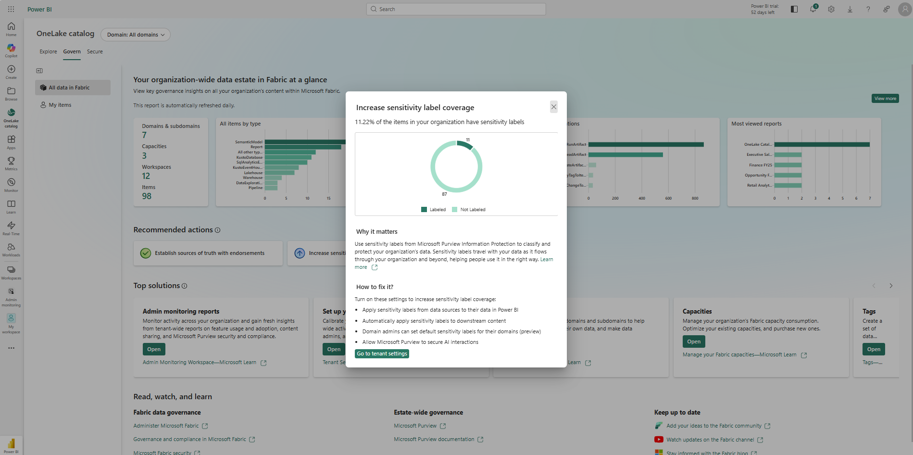
Governance in Fabric is built in through integration with Microsoft Purview. The OneLake Catalog gives data owners a single view of every item, its ownership information, endorsement and quality scores, and its sensitivity labels.
Practical controls include data sensitivity labels and classification tags, access policies enforced consistently from raw data through published reports, automated access requests, and automated governance workflows. Metadata management and data lineage run across all workloads, and federated governance lets central and domain teams share responsibility. The tooling makes good governance easier, but it does not replace clear ownership, naming standards, and certified datasets, which is where most HSO engagements focus.
The AI and Agentic Shift in Fabric
The biggest change in Fabric is its move from a passive analytics store to an active runtime for AI agents. Copilot is now embedded across every workload, from generating DAX measures to authoring Spark notebooks, lowering the barrier to advanced analytics.
Beyond Copilot, three developments signal the agentic direction. AI Functions run generative-AI calls (sentiment, classification, extraction, summarization, translation) natively inside T-SQL, so text analytics happen at the database layer. Data Agents answer natural-language questions across lakehouses, warehouses, and eventhouses, while the Operations Agent monitors data, diagnoses issues, and takes corrective action with human approval. Rayfin, announced at Build 2026, lets developers define and deploy full application backends that run on Fabric and share its security perimeter.
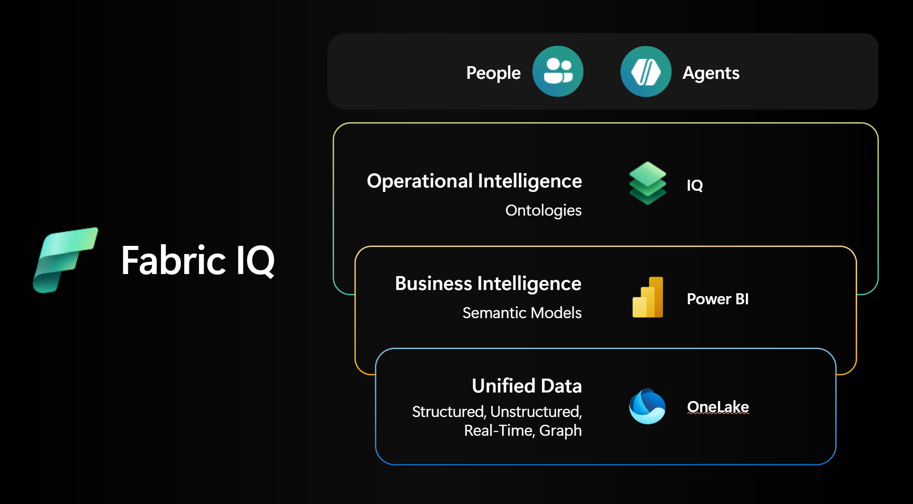
Microsoft has also introduced Fabric IQ, a semantic intelligence layer that lets teams and agents reason over shared business meaning rather than raw tables, using a no-code ontology and a graph engine. The common thread: AI is only as good as the governed data underneath it, which is what OneLake is built to provide.
Fabric Pricing and Licensing
Microsoft Fabric uses a single capacity-based model measured in Capacity Units (CUs), which covers every workload including Power BI. This replaces the retired Power BI Premium per-capacity (P-SKU) model; existing Premium customers transition to Fabric (F-SKU) capacity at renewal. A free trial is available for evaluation, and a capacity estimator helps you size your commitment.
Item | What you get | Indicative cost |
|---|---|---|
Fabric F2 capacity | Entry SKU, 2 Capacity Units, all workloads | $262 per month (or $0.36 per hour) |
Fabric F64 capacity | Common org-wide entry point; free licences can view reports. Scales up to F2048 | |
Power BI Pro | Per-user report creation, sharing, and collaboration | $14 per user per month |
Power BI Premium Per User | Per-user with advanced features | $24 per user per month |
Free trial | Time-limited evaluation of the full platform | No cost |
Pricing correct at the time of writing and subject to change. Verify current figures on the official Microsoft Fabric pricing page.
Cost note: Fabric can reduce spend by eliminating duplicate copies and consolidating licensing, but savings depend on discipline. Right-sizing your Fabric capacity, workspace strategy, and ingestion patterns is where a FinOps approach pays off, and where HSO helps clients avoid "copy-storm" overruns.
The independent business case is strong. A Forrester Total Economic Impact study of Fabric reported the following over three years.
379% ROI, with net present value of $9.79 million.
Payback in under six months, thanks to the SaaS model and the removal of legacy infrastructure.
$1.8 million in data engineering productivity from a 25% reduction in time spent searching, integrating, and debugging.
Fabric vs Databricks vs Snowflake
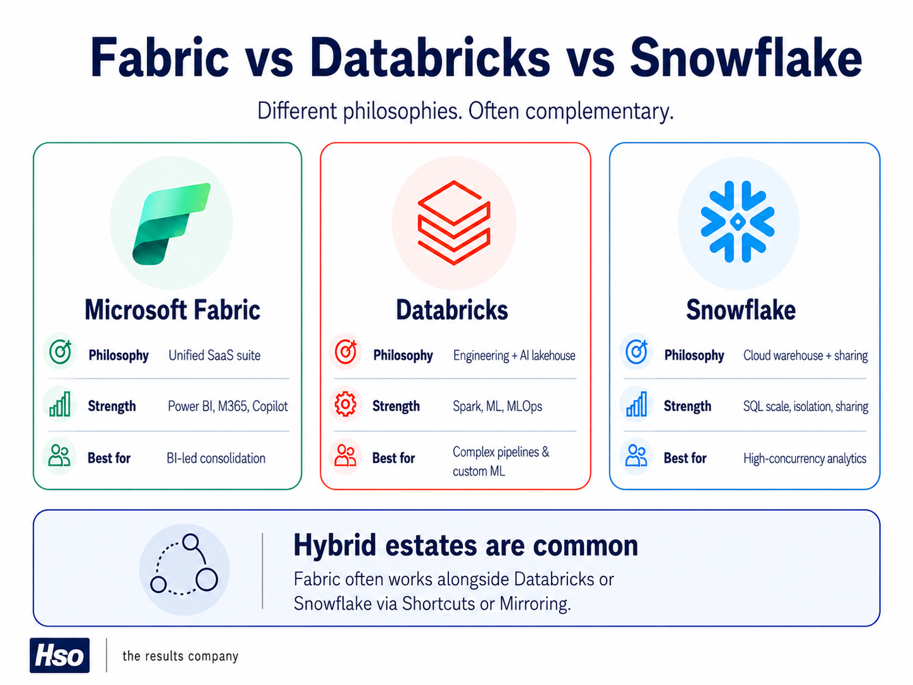
Fabric, Databricks, and Snowflake all compete for the enterprise data platform, but they start from different philosophies, and they frequently coexist. Fabric is not a universal replacement for every best-of-breed tool.
Platform Core philosophy Primary strengths Ideal for:
Microsoft Fabric Unified SaaS data estate Deep Microsoft 365, Power BI, and Copilot integration; low-code; unified OneLake governance BI-first organizations wanting a consolidated suite and broad data democratization.
Databricks Unified engineering and AI (lakehouse) Advanced Spark optimization; strong multi-cloud parity; frontier ML and MLOps Large-scale, complex engineering pipelines and custom ML development.
Snowflake Cloud warehouse and secure sharing Zero-management warehousing; workload isolation; cross-cloud data sharing Strictly isolated, high-concurrency SQL analytics and external data sharing.
In practice, many enterprises run a hybrid estate, keeping Snowflake or Databricks for specific workloads while using Fabric as the high-velocity analytics and AI engine, connected through Shortcuts or Mirroring. Microsoft was also named a Leader in the 2025 Gartner Magic Quadrant for Data Integration Tools. For a deeper Microsoft-specific comparison, see Microsoft Fabric vs Power BI and what Microsoft Fabric is not.
The HSO Fabric Approach
HSO treats Fabric as the unified data platform and the foundation for analytics and data-driven AI across Dynamics 365, Dataverse, Power Platform, and your other sources. As a Microsoft Solutions Partner for Data & AI, HSO helps organizations move toward Fabric-native models built on OneLake and medallion layers, standardize business concepts through a shared ontology, and enable agent and AI scenarios such as Business IQ and AI chat.
A suite of accelerators exists to shorten time-to-value, including the DnA Accelerator, Business IQ, the Fabric Environment Monitor, DP Migration Studio, AI Chat, and Data Masking. These reduce risk and compress timelines across migration, governance, and AI enablement.
Campaign - Microsoft Fabric Jumpstart: The best place to start is the Fabric Jumpstart, a four-day workshop where HSO co-develops your first data and analytics workload on Fabric. You leave with a working proof of value and a clear, costed action plan.
For a wider view, see HSO's full suite of Microsoft Fabric offerings and our enterprise-grade data governance services.
Microsoft Fabric Jumpstart FREE 4-day Workshop
Go live with your first Fabric workload in just 4 days with expert guidance from a top 1% Microsoft partner [eligibility criteria applies]