



Information Accelerator Demos
This demo series showcases the many features of HSOs Information Accelerator that makes it easier for Public Sector organisations to engage citizens and manage the information governance process

Guide to HSO Information Accelerator
HSO Information Accelerator transforms how councils handle information governance. By bringing FOIs, SARs, complaints, members' enquiries, gazetteer, and other day-to-day processes together in one Microsoft-based platform, it helps teams work faster, stay compliant and give residents a better experience.

It is designed to help councils bring information, requests, workflows, deadlines and resident interactions together in one place, reducing the need for staff to search across multiple systems, inboxes, spreadsheets and departmental records.
For councils, the aim is simple: make information easier to find, govern and use.
As councils begin adopting AI-powered tools and assistants, having accurate, governed and accessible information becomes increasingly important to ensure trusted outputs and responsible use of AI.
For residents, this results in a better experience when dealing with their council, built on timely responses and greater transparency.
Information Accelerator supports teams that need to manage information requests consistently, respond more efficiently, maintain auditability and improve visibility across the full request lifecycle.
Rather than starting from a blank sheet of paper, councils can use pre-configured modules designed around common local government processes. This reduces implementation effort, supports faster deployment and accelerates the point at which councils begin to see value.
Where Information Accelerator fits within Gov360
Information Accelerator is part of Gov360, HSO's local government solution built on Microsoft technology.
Gov360 helps councils create a connected view of each resident. A view that improves service visibility and supports more efficient resident support. Information Accelerator focuses on information governance, resident request management and the processes that sit behind FOIs, SARs, complaints and member enquiries.

Within Gov360, Information Accelerator helps councils connect:
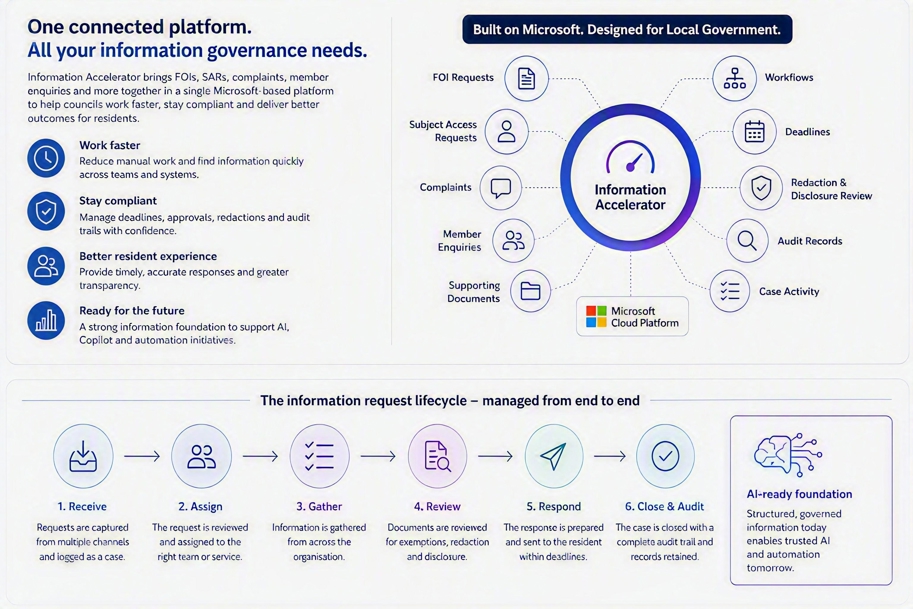
This gives teams a clearer view of what has been received, who is responsible, the information gathered, what needs to be reviewed, and where each request sits in the process.
What Information Accelerator does
Information Accelerator helps councils manage the end-to-end process for information-related requests.
In practice, that means supporting teams from the point a request is received through to response, closure and audit.
It helps councils move away from processes that rely heavily on shared inboxes, spreadsheets, manual chasing and disconnected systems.
By bringing information together in a structured and governed way, councils are also better positioned to take advantage of emerging AI capabilities without increasing information management risk.
Instead, requests are captured, assigned, tracked and managed through a structured workflow.
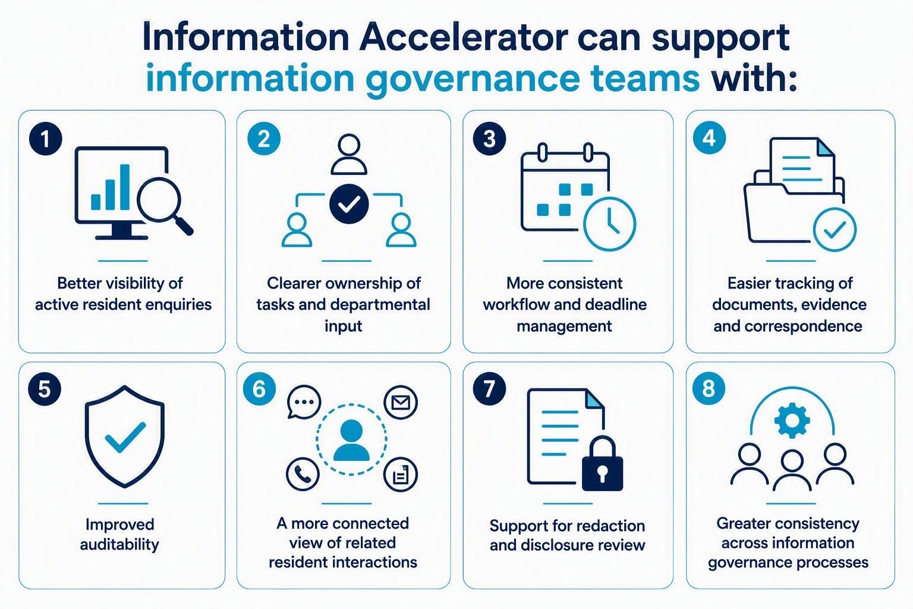
The value of Information Accelerator is not simply that it helps councils process requests faster. It is that it helps reduce the friction that often slows the process.
When information is easier to find, assign, review and govern, teams spend less time coordinating activity and more time supporting residents.
Information Accelerator use cases
Use Case 1: Managing a complex AI-generated Subject Access Request
A resident uses a public AI tool to draft a detailed Subject Access Request.
The request is broader than a traditional SAR. It asks the council to provide all personal data held about the resident across many services, including housing records, complaint history, contact centre interactions, internal emails, case notes and previous correspondence. The request also includes wording that indicates it was generated using AI, with a structured list of categories, date ranges and document types.
As AI tools make it easier for residents to generate comprehensive information requests, councils are likely to see increasing volume and complexity, making consistent case management and auditability even more important.
The request is submitted through the council website and received by the Information Governance team.
Without a connected process, the team may need to manually review the request, identify which services are involved, send separate emails to different departments, log updates in a spreadsheet and then chase each team for progress.
With Information Accelerator, the SAR is logged as a single case. The Information Governance Officer reviews the request and identifies that at least three areas of the council need to contribute: Housing, Customer Services and Legal Services.
Tasks are assigned to each team through a workflow. Each service area provides updates, uploads relevant documents and confirms whether information is held. The Information Governance Officer can see what has been received, what is outstanding and which actions need follow-up.
Once the information is gathered, the review process begins. Documents and records are checked for personal, sensitive or exempt information before disclosure. Redaction becomes an important part of the process, particularly where records include third-party data, internal notes or information that should not be released.
The full history of the request, including actions, decisions, documents and response activity, is retained in one place.
The council gains a single view of the SAR, clear ownership of departmental tasks and a complete audit trail. Instead of coordinating the response through separate inboxes and spreadsheets, the Information Governance team can manage the process through a structured case record.
Use Case 2: Managing a resident complaint through a single view
A resident submits a complaint about repeated missed waste collections.
At first, the complaint appears to relate to a single service issue. However, when the team begins reviewing the case, they find the resident contacted the council several times across different channels. There are previous service requests, contact centre notes, emails and a related councillor enquiry connected to the same issue.
Without a connected resident view, staff may need to search across different systems to piece together the full history. One team may be looking at the complaint, another at service request history, and another at previous correspondence.
With Information Accelerator, the complaint is managed alongside related resident information and supporting activity. The team can see the complaint, associated records, previous interactions and relevant documents in a more connected way.
The case is assigned to the appropriate service area, updates can be recorded, and progress can be monitored through to resolution. If the complaint later escalates, the full history is available to support review.
Staff spend less time searching for background information and more time resolving the issue. Managers gain better visibility of progress, and the resident receives a more informed and consistent response.
Use Case 3: Creating a single view of information across related processes
A resident has many open interactions with the council: a complaint, a recent FOI request, a previous SAR and several service enquiries.
Each interaction is submitted through a different route. One arrives through an online form. Another is received by email. Another is raised through customer services. A councillor may also have contacted the council on the resident's behalf.
Without a connected approach, each process is managed separately. Different teams hold different parts of the picture, and staff may not realise related activity exists elsewhere in the organisation.
Information Accelerator brings these processes together within a unified view. Teams can see related requests, interactions, documents and workflow activity, helping them understand the wider context before responding.
This does not mean every member of staff can see everything. Access and governance controls remain critical. However, it does mean the organisation can manage related information more effectively, rather than treating every request as an isolated event.
Councils improve visibility, reduce duplicated effort and support more joined-up resident services without requiring staff to search across disconnected systems.
Why choose HSO Information Accelerator
Councils recognise the need to improve how they manage FOIs, SARs, complaints and information requests. The challenge is how to make progress quickly without creating another lengthy transformation programme.
This is where HSO Information Accelerator is designed to help.
As a pre-built module within Gov360, Information Accelerator gives councils a faster route to implementation. Rather than spending months designing, developing and testing processes from scratch, councils can start with functionality already designed around common local government requirements.
Because Information Accelerator is a pre-built solution, councils move quickly from decision to delivery.
The module provides a starting point for FOIs, SARs, complaints and related information governance processes, allowing teams to focus on configuration, adoption and operational readiness rather than development.
For many councils, this means implementation can be achieved in weeks rather than months.

Next step: Explore HSO Gov360
Learn more about Information Accelerator and the wider Gov360 solution.
See it in action; view our short demo.Information Accelerator Demos
This demo series showcases the many features of HSOs Information Accelerator that makes it easier for Public Sector organisations to engage citizens and manage the information governance process