8 ERP Trends - 2026: What's Actually Changing (and What to Ignore)

Cloud migration and mobile access reshaped ERP a decade ago, and they’re now baseline expectation. The real shift in 2026 is what happens on top of that foundation: how AI, governance and industry-specific intelligence get built into the delivery model itself, not just the software.
This article breaks down the 8 trends reshaping ERP in 2026, backed by Forrester’s Q1 2026 ERP research and HSO’s delivery data across 1,200+ implementations in 60+ countries, so you can separate what genuinely changes your modernization roadmap and which are unlikely to materially change it.
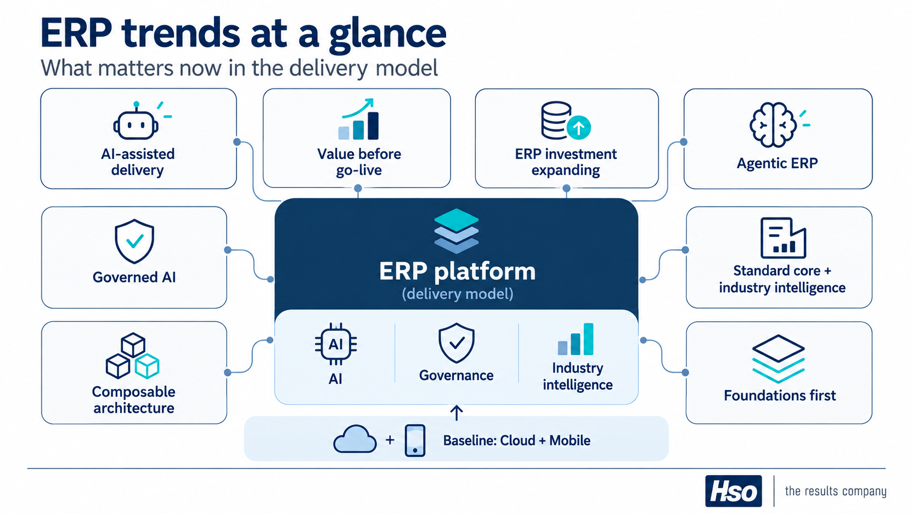
The ERP trends at a glance
AI-assisted delivery
Value starts before go-live
ERP investment is expanding
Agentic ERP
Governed AI by design
Standard core standard and industry intelligence
Composable architecture
Foundations first
Why ERP is changing in 2026: AI-readiness as the primary driver
AI-readiness, not cost or functionality, is now the main reason mid-market and enterprise organizations modernize ERP.
Forrester describes ERP as the central nervous system of the enterprise, and by early 2026 that system is under direct pressure to support AI-driven workflows.
Aging, on-premises, functionally fragmented ERP constrains agility and inflates total cost of ownership. It’s no longer just technical debt sitting quietly in the background. Three reasons show up consistently in why organizations modernize now:
Accelerating financial and operational performance, closing the gap between reporting and action.
Embedding AI-driven automation for resilience, so processes recover from disruption instead of just documenting it.
Enabling industry-specific agility at scale, without rebuilding the same customizations for every market or business unit.
This shift changes what “ERP trends” actually means in 2026. It’s less about which module ships next and more about whether the core system can support autonomous, AI-driven work at all.
1) AI-assisted delivery is compressing ERP timelines by 20% to 30%
AI now automates the repeatable work inside an ERP implementation, cutting timelines by 20% to 30% depending on scope and organizational readiness.
Requirements extraction, documentation, testing, project tracking and configuration used to take weeks. AI turns much of that around in days, allowing consultants to spend more time on human ingenuity.
AI is altering the mechanics of enterprise delivery. With the right partner, solutions can reach the business sooner, enabling organizations to realize value much earlier in the investment cycle.
This is the first of the four variables behind what HSO’s ERP Report calls the new ERP value equation, covered in full below. The practical effect: consultants spend less time drafting first-pass documentation and more time on the judgement calls, architecture decisions and change management that AI can’t do.
Nearly every implementation partner now claims to be faster with AI. That claim alone tells an IT Director nothing about whether the result is better.
"What’s the meaningful output of speed? If it’s just to re-implement what an organization has today, that’s not progress."

Speed only creates value if the time it frees up gets reinvested in architecture, process optimization or data quality. Speed spent re-implementing the same broken process, just faster, is wasted speed.
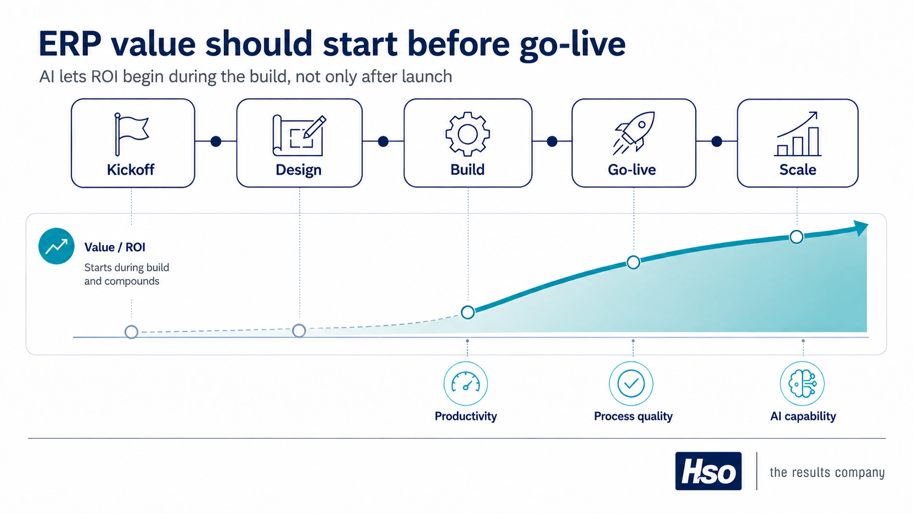
2) Value now starts before go-live, not at it
Go-live is no longer a reliable measure of ERP success. Value should start compounding during the build, not after it.
For three decades, program duration tracked human effort. AI breaks that link, and leaders no longer have to wait for go-live to see improvements in productivity, process quality or AI capability.
The clock on ROI starts during the build and never stops. That reframes how IT Directors should report progress to the board: not “we go live in month 14,” but “here’s what’s already improved in month 4.”
3) ERP investment is expanding, but complexity hasn’t gone away
ERP spend and adoption are both rising in 2026, and complexity is rising with them. For example, 77% of enterprise application decision-makers say their organization is adopting ERP, according to Forrester’s Enterprise Resource Planning Market Insights, May 2026.
Other research puts numbers behind what most IT Directors already feel day to day:
89% run multi-instance ERP estates—only 7% run a single instance.
50% rate customization, integrations and functional scope as complex, and are pursuing process standardization to address it.
Source: Forrester Research, Inc., The Top Trends Shaping ERP, July 2026
4 ) Agentic ERP: from systems of record to systems of action
Agentic ERP means the system takes action on data, not just stores it.
ERP is moving from a passive record-keeper to an active orchestrator, with AI agents embedded in the workflow from day one rather than added later as a chatbot layer.
At Venchi, a Microsoft-native agentic platform connects customer service, AI and ERP. A Purchase Order Entry Agent reads PDFs and other unstructured inputs, then validates pricing, availability and credit directly against ERP data. The result: order-to-cash now runs faster and more accurately.
“The new Dynamics 365 ERP MCP Server opens up hundreds of thousands of ERP functions for secure, real-time use by agents, developers, and applications. As organizations move from systems of record to systems of action, MCP becomes the connecting layer. It brings ERP data, analytics, and AI together under one trusted framework.”
If you want the mechanics of how this works inside Dynamics 365 specifically, HSO’s ERP AI chatbots article covers the agent architecture in more detail, including where agents sit relative to ERP data.
“In the next 18 months to 3 years, we’ll be seeing business commerce move significantly to AI as intelligent agents with permission.”
5) Governed AI by design replaces bolted-on compliance
Agents multiply whatever risk already exists in an ERP system, so governance has to be built in from the start, not added after the agents are live.
This is where HSO’s AI operating system, the governance, security and lifecycle management layer, that sits behind and controls how agents behave at scale.
Without a layer like this, every new agent is a new, ungoverned point of failure. With it, governance is a property of the architecture, not a checklist applied after deployment.
6) Keep the ERP core standard and accelerate with industry intelligence
The most successful ERP programs in 2026 are moving away from heavily customized ERP systems. Instead, organizations keep the ERP core as close to standard as possible and use industry-specific accelerators, AI agents, and low-code tools to add flexibility where they need it.
This approach reduces complexity, makes upgrades easier, and allows businesses to adapt faster without rebuilding core ERP functionality. According to Forrester, 50% of organizations already identify customization as a source of complexity in enterprise application environments.
Rather than starting every implementation from a blank page, leading organizations are increasingly adopting prebuilt industry processes, accelerators and AI agents that reflect how their sector already operates. This allows companies to deploy proven practices while still retaining the flexibility to extend and innovate around the edge using technologies such as Microsoft Power Platform.
“It's important that the core ERP business system stays as close to the standard product as possible. However, we still want the flexibility around the edge, and Microsoft Dynamics 365 gives us just that, with Power Apps, Power Automate and Power BI.”
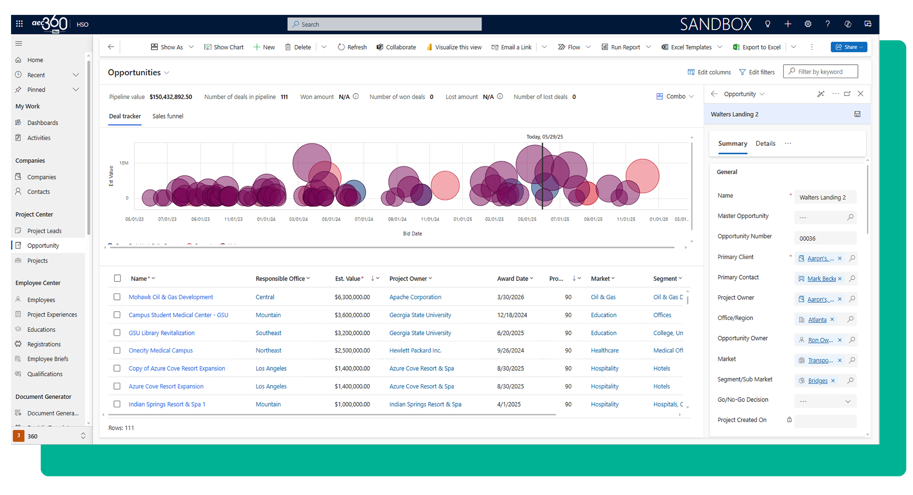
This is also where industry-specific ERP delivery increasingly differs from generic ERP implementation. Instead of redesigning common processes repeatedly, organizations can leverage prebuilt industry IP (Eg; aec360), agents and accelerators developed from previous implementations. HSO's portfolio of industry-focused AI agents and accelerators is designed to help customers adopt proven sector-specific patterns while maintaining a modern, upgradeable ERP foundation.
7) Composable, plug-and-play architecture replaces point-to-point
Composable ERP means reusable data models and components that let organizations grow without adding proportional complexity.
A global logistics company worked with HSO to build a Logical Data Platform on latest Microsoft cloud & data technologies, such as Microsoft Fabric, Power BI and Purview, that turn integration into a repeatable capability instead of a one-off project for every new system.
For organizations running multi-instance estates, this matters more than almost any other trend on this list. It’s the difference between every acquisition or new business unit adding integration debt and every new addition slotting into an existing pattern.
8) Foundations still come first: people, process, data, then architecture
The sequence that separates successful ERP programs from failed ones hasn’t changed: people, then process, then data, then architecture.
AI raises the cost of skipping this order rather than replacing it. An agent layered onto a broken process automates the breakage; it doesn’t fix it.
Start with the people who’ll actually use the system, redesign the process around what the business needs (not around what the old system did), build the data foundation so the process has something reliable to run on, then connect the architecture.
Watch AI in ERP: why data and process come before tech for a practical walkthrough of this sequence in action.
View HSO's Business Process Management Consulting Services.
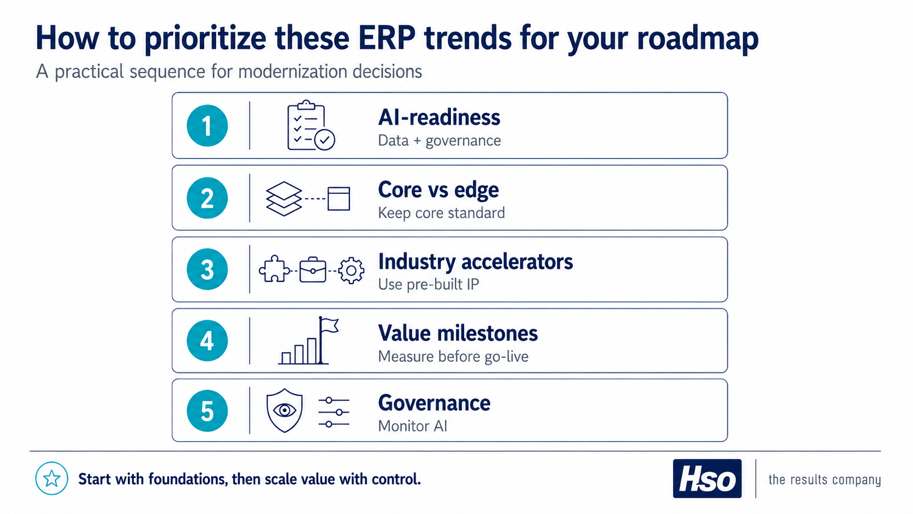
How to prioritize these ERP trends for your 2026 roadmap
Not every trend on this list deserves equal weight in a given roadmap. A practical starting sequence for IT Directors and Operations Directors evaluating modernization in 2026:
Audit AI-readiness first. Clean core, data quality and governance determine how much value any of the other trends can deliver. Skip this and agentic ERP just automates existing broken problems faster.
Decide what stays in the core and what moves to the edge. This single decision affects upgrade cost, customization risk and how quickly Power Platform can absorb future change requests.
Look for industry-specific accelerators before building from scratch. Ask any potential partner what pre-built IP exists for your sector, like AEC360. Blank-page design is the slowest and riskiest way to reach the same outcome.
Set value milestones before go-live, not just a go-live date. If a partner can’t show you what improves in month 3 or month 6, the delivery model probably isn’t AI-assisted in any meaningful sense.
Weight AI governance in the vendor evaluation, not as an afterthought. Ask specifically how agent behavior, cost and access are monitored, not just whether AI capabilities exist.