

Continuous Value Delivery and Elastic Capability
Closing the Value Gap after Go-Live

Most organisations invest significantly in Dynamics 365 and the wider Microsoft Platform to modernise operations, improve efficiency and unlock competitive advantage. Go-live marks an important milestone in that journey. But it is not the point at which value is secured. It is the point at which value must begin to compound.
Yet across many organisations, the operating model after go-live remains unchanged. Support replaces project delivery. Optimisation becomes occasional. Enhancements are reactive. The platform stabilises, but it does not accelerate.
This blog explores why that gap emerges and how an elastic capability model, combined with a structured continuous improvement cycle, can transform a stable platform into a continuously evolving asset.
The Value Gap Nobody Talks About
Go-live is often celebrated as the finish line. The project closes. The implementation team disbands. Support takes over.
On paper, the system is live, but something else happens quietly. Technology continues evolving. The business continues evolving. Customer expectations continue to rise.
Internal capability, however, often plateaus.
This creates what we call the Value Gap.
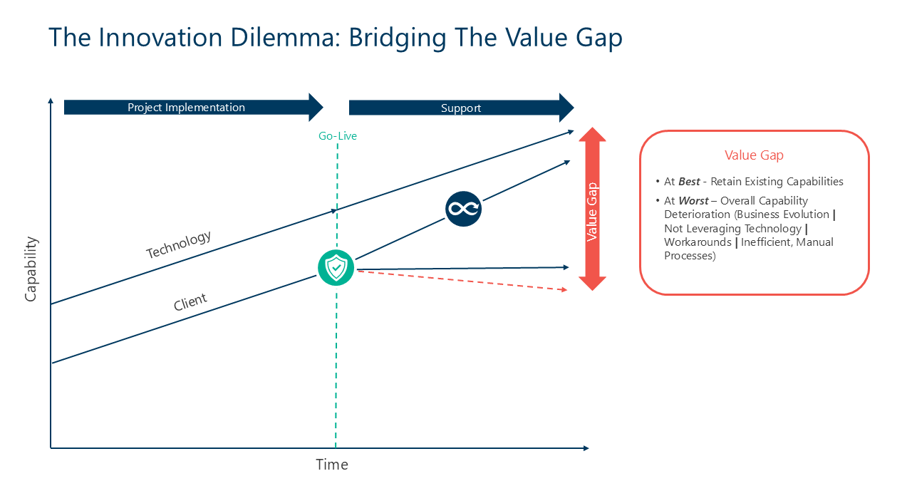
Fig.1a. Value Gap grows post-implementation without focused Realisation.
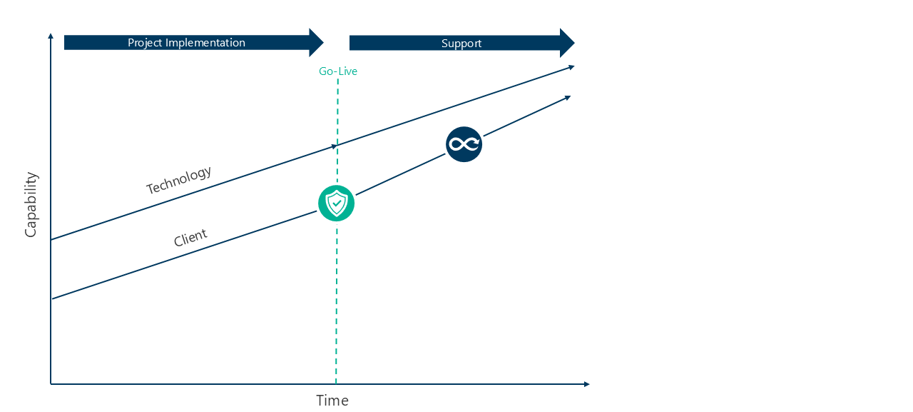
Fig.1b. Bridging the Value Gap through focused Continuous Improvement Cycles
At best, organisations retain existing capability. At worst, capability deteriorates.
Workarounds appear, and manual processes creep back in. Underused features sit dormant, and enhancements are delayed because they feel “too small” for a formal project and are not as critical as dealing with incidents being raised in BAU.
The platform runs, but it stops compounding in value.
Stability becomes the goal. Evolution becomes optional.
And in a platform designed for continuous evolution, standing still is not neutral. It is going backwards.
Why Traditional Delivery Models Break After Go-Live
Traditional project delivery models are optimised for one thing, completion. They have a defined scope, a fixed timeline, they adhere to strict budget, and finally we have a formal handover to BAU operations.
Success is measured by whether the system was delivered. A few organisations measure value six months later.
Continuous value delivery operates differently.
Ownership does not shift at go-live. Improvement does not stop at stabilisation. Feedback loops remain active. Success is measured by sustained business impact, not milestone completion.
If your operating model treats implementation and support as separate worlds, then a Value Gap is almost inevitable.
Elastic Capability: Designing for Continuous Evolution
If permanent headcount expansion is unrealistic and ad-hoc consultancy is ineffective, what is the alternative?
Elastic capability.
Elastic capability is access to the right depth of expertise, at the right time, without permanently inflating internal teams.
It allows organisations to:
Deliver targeted tactical improvements quickly.
Introduce specialist capability for complex enhancements.
Accelerate feature adoption without disrupting BAU.
Scale effort up or down as priorities shift.
Elasticity does not replace internal ownership - Strategic direction, architectural authority, business priorities, all remain internal. But execution expertise and depth flexes.
This is not staff augmentation; it is structured value acceleration.
The Continuous Value Delivery Cycle
Elastic capability becomes powerful when embedded within a disciplined improvement cycle.
We describe this as a Continuous Value Delivery model.
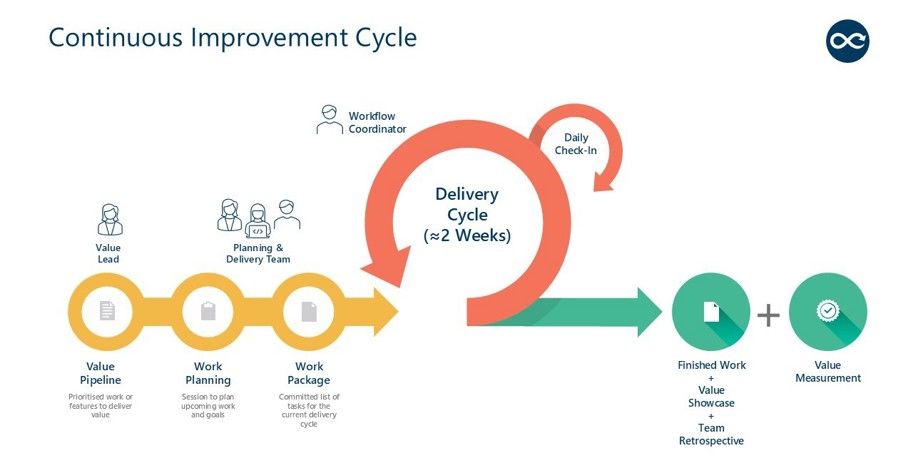
It begins with a Value Pipeline.
Business units and IT identify improvement opportunities, feature adoption candidates, bottlenecks or inefficiencies. These are captured not as tickets, but as value proposals.
Proposals are reviewed and prioritised based on business impact, feasibility and alignment with organisational objectives.
A committed work package is then defined for a short delivery cycle, typically two weeks, but adaptable.
Within that cycle:
Configuration, development and testing occur
Daily coordination ensures transparency
A dedicated delivery lead maintains momentum and alignment
At the end of the cycle:
Outcomes are demonstrated in a value showcase
Impact is measured
Lessons are captured in a retrospective
The cycle then repeats.
This model introduces rhythm, governance and measurement to optimisation. It shifts the change from reactive to intentional.
Governance That Protects Value
Continuous improvement without governance becomes chaos. At HSO, our model accounts for that and includes:
A Steering Committee
Providing strategic direction, approving priorities and ensuring alignment with broader business and IT goals.
A Working Group
Responsible for design, architecture, delivery and technical integrity.
A Product Owner
Aligning stakeholders, managing the backlog, prioritising work and owning acceptance of delivered value.
This structure ensures that even tactical enhancements contribute to strategic outcomes.
Why Continuous Value Delivery Accelerates ROI
Organisations adopting continuous value delivery methods report three consistent benefits.
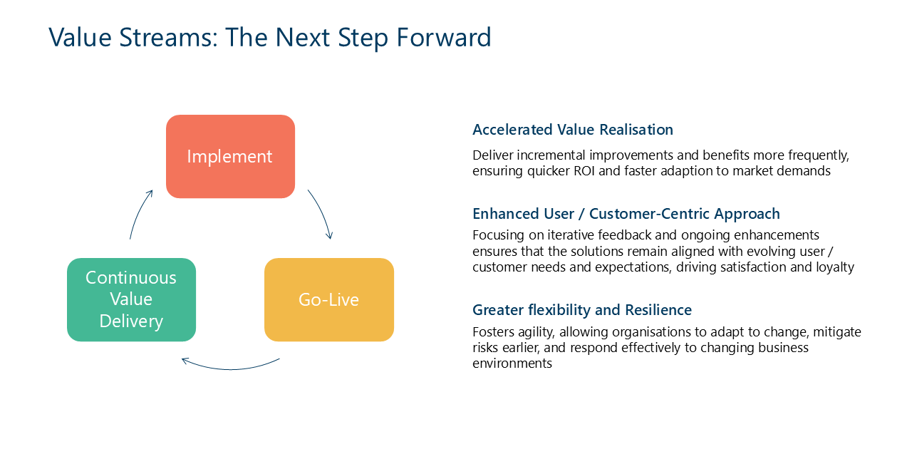
Accelerated Value Realisation
Incremental improvements are delivered more frequently, bringing forward ROI and enabling faster response to market shifts.
Enhanced User and Customer Alignment
Iterative feedback loops ensure that enhancements reflect evolving operational needs rather than outdated assumptions.
Greater Flexibility and Resilience
Structured cadence fosters agility, reduces accumulated risk and enables earlier course correction.
In contrast, static operating models often retain capability at best and erode it at worst.
A Practical Entry Point
Continuous value delivery does not require a major transformation programme to begin.
It can start with a single inefficiency. A single underutilised feature. A manual workaround that should not exist. A business request that has been sitting in the backlog for too long.
Whether you self-support, rely on an internal team, or work with an existing managed service provider, we are increasingly engaged to provide independent optimisation reviews and structured value acceleration support.
The objective is simple.
Introduce disciplined, measurable evolution into environments that are currently stable but not advancing.
Elastic capability allows organisations to address immediate tactical challenges while building a forward-looking value pipeline. Over time, incremental gains compound. Without structured evolution, they do not.
If you would value an external perspective on how your current model is performing, we are available to review, prioritise and help deliver meaningful improvements, one change at a time or as part of a structured continuous programme.