

Blog
Agentic AI Examples: 6 Enterprise Use Cases That Deliver ROI
View More Agentic AI Examples

Agentic AI vs AI Agents: Difference & Why It Matters (2026)

"Agent" is probably the most overused word in enterprise AI right now. Copilots embedded in Microsoft 365, chatbots fielding supplier queries, autonomous systems coordinating workflows, all of them are being labelled agents. They are not the same thing, and treating them as they are is a way to stall AI investments stall before they deliver.
The practical difference between an AI agent and agentic AI is the difference between a tool that completes a defined task and a system that can plan, reason across multiple steps, and adapt to reach a broader goal. For organizations building an AI strategy in 2026, that distinction has direct implications.
This article explains what each term means, how the autonomy spectrum works, where the real enterprise value sits, and what your organization needs in place before either will work.
An AI agent is an individual tool built to handle a specific, well-defined task. Agentic AI is a system, or an approach—characterized by autonomy, multi-step planning, and the ability to coordinate multiple agents to achieve a broader goal.
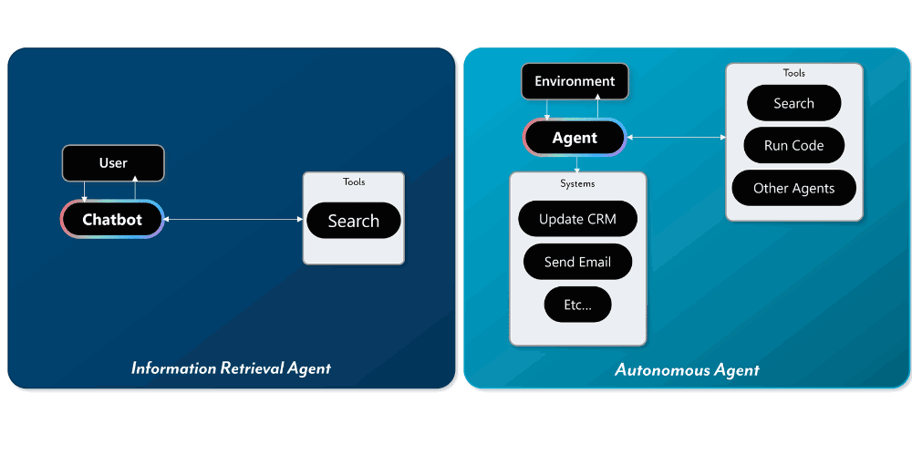
The relationship between the two is straightforward: agents are the building blocks. Agentic AI is what happens when those building blocks are given a goal, memory, and the capacity to decide how to use each other.
An AI agent is a software system that perceives inputs, makes decisions, and takes actions to complete a defined task, usually within explicit boundaries set by its design.
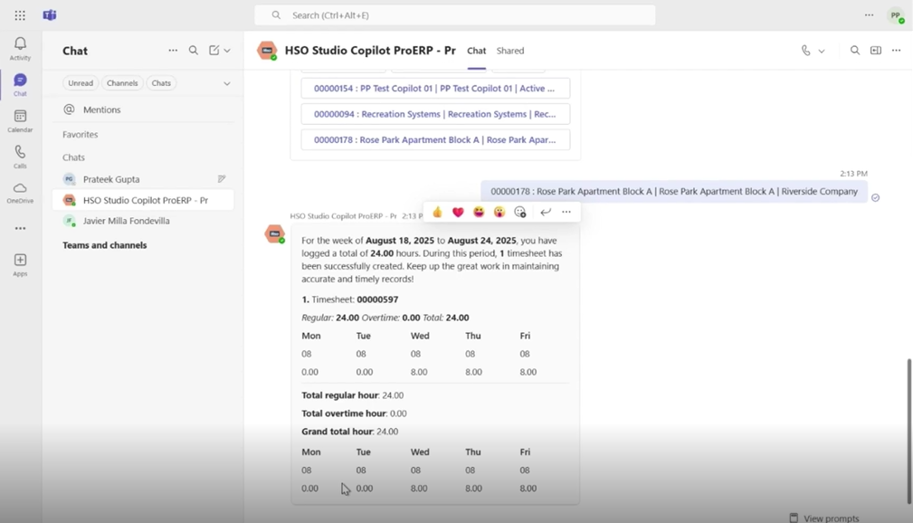
An agent is purpose-built for a specific function. It operates within a bounded scope, uses rules, machine learning, or a large language model to interpret inputs, and interacts with enterprise systems to carry out actions. It needs clear inputs and defined logic to work reliably.
HSO's own AI agents illustrate this clearly:
PayFlow Agent: A supplier emails asking about payment status. The agent reads the message, retrieves the relevant invoice from Dynamics 365 Finance, and sends an accurate response, no manual involvement required for routine queries. Built with Copilot Studio and Model Context Protocol (MCP).
Order Management Agent: Reads incoming orders from email, PDF, or other formats, extracts structured data, and creates the order in the ERP without manual entry.
Expense Agent: Processes employee expense submissions, fast, accurate, and consistently adopted because it removes a task nobody wants to do manually.
Each of these does one job, does it well, and stays within its defined scope.
One point worth being direct about: having multiple AI agents is not the same as having agentic AI. Without shared context and coordinated planning, a collection of individual agents still executes independently. They solve separate problems. They do not pursue a shared goal.
“Digital co-worker, the word that I prefer to use instead of 'agents', because it's probably the most overused word in the AI world right now.”

Agentic AI is a goal-directed system that reasons about what needs to happen, plans the steps required to get there, acts using whichever tools and agents are appropriate, and adjusts its approach when circumstances change.
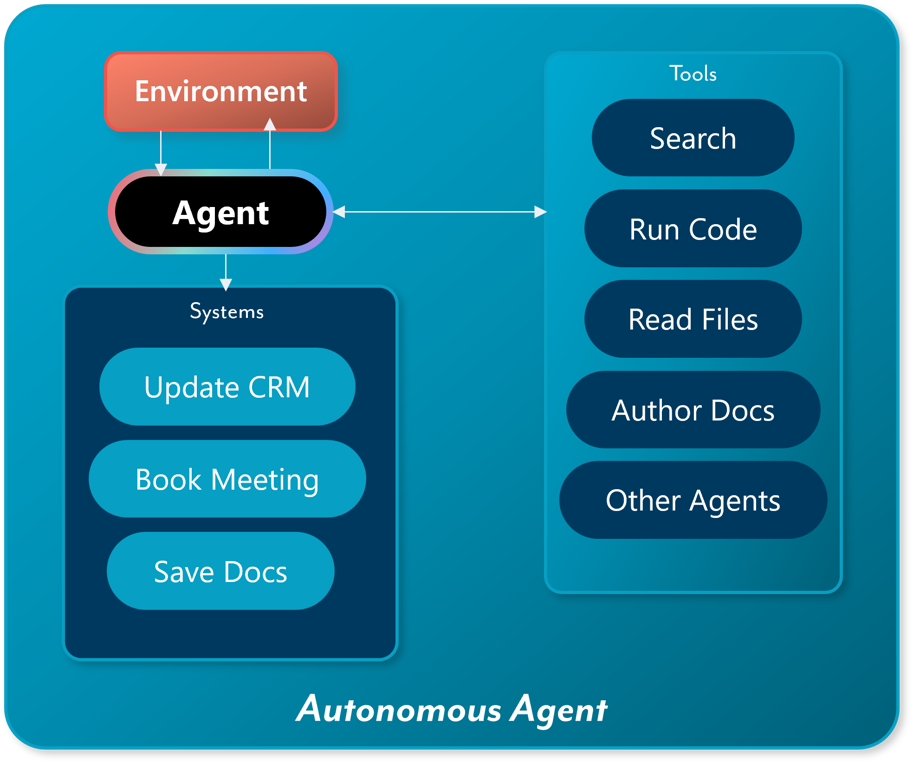
Where an individual agent executes a task, agentic AI pursues an objective. It maintains memory and context across steps. It selects which agents or tools to involve and in what order.
In theory an agentic AI system could notice a customer is approaching their credit limit, check outstanding invoices, evaluate payment history, flag the risk to the relevant account manager, and pause further orders until the situation is reviewed, all triggered by a single data event, without anyone asking it to.
Not every system calling itself "agentic" qualifies. True agentic AI operates at a meaningfully higher level of autonomy and requires specific foundations to work safely.
| Dimension | AI Agent | Agentic AI |
|---|---|---|
| Primary role | Execute a specific task | Coordinate and reason toward a broader goal |
| Scope | Single task or domain | Multi-step, cross-system workflows |
| Autonomy level | Low to moderate (reacts to inputs) | Moderate to high (proactive planning) |
| Memory | Typically stateless or short-context | Maintains context across steps |
| Adaptability | Follows predefined logic | Adjusts approach based on what it encounters |
| Orchestration | Executes independently | Coordinates multiple agents and tools |
| Typical use | Repeat a well-scoped operation reliably | Handle complex, variable workflows end-to-end |
| Analogy | A specialist doing one job | A project lead coordinating a team |
Is the task clearly defined with fixed steps? → AI agent
Does it span multiple systems or need to adapt mid-workflow? → Agentic AI (if your data and governance are ready) or start with an agent and build toward it
The Autonomy Spectrum: From Traditional AI to Agentic AI
AI systems sit on a spectrum from fully manual and human-controlled to highly autonomous and self-directed. Where a given system sits on that spectrum determines what it can do, what governance it requires, and what risk it carries.
Most enterprise AI tools today sit at the lower end. Agentic AI sits toward the higher end. Neither end is universally better, the right level depends on the maturity of your data, your processes, and your governance at the point of deployment.
A practical three-level framework, defined by how tasks, tools, and triggers are configured - shows where most enterprise AI sits today and where agentic AI operates.
| Level | Tasks | Tools | Triggers |
|---|---|---|---|
| Level 1 | Specific workflows or sequences defined by engineers with very few branching conditions | A defined set of interfaces that execute parameterized queries or actions | Timer-based, or responses to user requests in a chatbot or API |
| Level 2 | Defined by users, but make heavy use of agent-determined branching | Defined and documented by users, but parameters and usage are determined by the agent at runtime | Conditional, based on business system events - such as emails with certain context, or documents uploaded to a specific folder |
| Level 3 | Generated or selected by the agent based on trigger conditions, context, and goals | Dynamically discovered by the agent using API documentation, computer interfacing, and coding tools | Dynamic and determined by the agent as it monitors live feeds for activities related to its role |
Most deployed AI agents today operate at Level 1 or Level 2. They are scoped, reliable, and already delivering measurable value in the right processes. Level 3 is where true agentic AI operates, the system determines its own tasks, discovers its own tools, and monitors live environments to decide when and how to act.
HSO's PayFlow Agent and Time-Entry Agent are Level 1 or Level 2. They do their job consistently within defined boundaries. The agentic workflows HSO builds for end-to-end process orchestration push into Level 2 and Level 3 territory, where the system is reasoning across multiple inputs and adapting in real time.
“Companies may not necessarily know how the agent will behave once it's actually out there. If an agent runs, who's accountable for it? Who's responsible for its behavior—and what if it makes a mistake?”

Agentic AI Use Cases in the Enterprise
The strongest starting points for agentic AI are operational processes that are repetitive, high-volume, span multiple systems, or depend on consistent logic that currently relies on a specific person knowing how to execute them.
Vague productivity gains are hard to measure and harder to sustain. The use cases that generate real ROI are the ones where you can answer three questions before building:
If those numbers do not produce a clear positive, it is not the right place to start.
Deploying agentic AI on a properly built foundation realized $44.5 million in benefits over three years against $20.2 million in costs, producing an ROI of approximately 120%.
The HSO PayFlow Agent handles supplier payment queries end-to-end, reading incoming messages, retrieving the correct invoice from Dynamics 365 Finance, and responding with accurate payment status automatically.
Finance teams reduce chasing invoices manually. Reconciliation agents match payments and flag only the exceptions that need human review. Month-end close cycles shorten when processing runs in parallel across systems rather than sequentially.
The HSO Order Management Agent reads incoming purchase orders from email, PDF, WhatsApp or other formats, extracts the structured data, and creates the order in the ERP without manual entry.
Beyond order processing, agents can monitor equipment sensor data and trigger service scheduling before failure occurs, replacing reactive maintenance with scheduled intervention.
“HSO's sweet spot is optimizing business processes with fully integrated ERP, CRM and Analytics —making use of AI for those processes to become more autonomous, smarter, faster, and with less human effort.”


The same principle applies across knowledge work: document review, contract checking, timesheet validation. Agents handle the processing. People handle the judgment calls.
What You Actually Need Before Agentic AI Will Work
The technology is not what holds most organizations back. Weak data foundations, undefined processes, absent governance, and underestimated change management are the consistent failure points, regardless of which platform or agent type is being deployed.
Deloitte Research tells a clear story: 85% of organizations increased AI investment last year. Only 6% saw measurable return within 12 months. That gap is not a technology problem. It is a foundation problem. The organizations closing that gap are the ones that treated AI readiness as essential, not an afterthought.
“Everybody right now is like a kid in a candy shop when it comes to AI. Where's the strategy? Where's the plan? If you don't have data to support a use case—and if the fundamentals are broken, everything else is broken as well.”
An agent can only act on what it can see. Fragmented, stale, or inconsistently defined data produces fragmented, unreliable agent decisions, even when the agent itself is working exactly as designed.
The practical requirements: master data alignment, consistent entity definitions, and data that is available in near real time.
The risk of getting this wrong is not just inaccuracy. An agent operating on partial data can make logically coherent but commercially wrong decisions. Consider an agent that sees sales volume increasing and suggests to reduce the marketing budget accordingly, unaware that the spike came from a one-off discount applied three weeks earlier.
Agents execute documented processes. If the workflow exists only in someone's head, it cannot be reliably automated.
One of the most common mistake HSO sees in agentic AI implementations is that organizations try to automate poorly defined processes and then attribute the inconsistency to the agent. The agent is doing exactly what it was designed to do. The process was the problem.
What good looks like: the process is mapped, the rules are written down, the exceptions are known and handled. Before designing any agent, define the outcome it should achieve at the end - not just the steps it should follow. The goal is not a faster version of the current process. The goal is a process redesigned around the result.
“You don't go and hire an employee thinking let's hire them and then we will define what they will do. No. Digital coworkers (AI agents) are the same.”
With agents taking action in business systems, accountability must be explicitly assigned before deployment, not figured out after something goes wrong.
Traditional data governance operates on a simple model: a user initiates every action. Agents insert an autonomous layer that most existing governance frameworks were not designed to cover. Before any agent goes live, organizations need to answer: what decisions is this agent authorized to make, who is accountable for its behavior, and what happens when it acts on incomplete information?
“If we can't explain why an agent made a decision that it did or why it acted in a certain way, problems will surface downstream.”
If the people whose work an agent affects do not trust it, they will work around it, returning to old processes and making the investment redundant.
This is one of the most consistent failure patterns in artificial intelligence deployments. A technically sound agent goes live. Adoption drops off after the first few weeks. Teams revert to manual processes or start using unmanaged (Shadow AI) external tools to fill the gap. The agent sits unused, and the organization reports that "AI didn't work."
What reduces this risk: involving users in the design process, giving teams visibility into what the agent is doing and why, and building escalation paths that feel accessible rather than hidden. Treat agents like new digital workers. They need onboarding, performance monitoring, and periodic review. Deploying an agent is the beginning of a management relationship, not the end of an implementation project.
“If humans don't trust the system, they will quietly work around it. They'll either continue doing what they did before, or they'll find their own ways using commercially available tools.”
How HSO Approaches Agentic AI Implementations
HSO follows a prove-then-scale model, start with a defined, measurable process, demonstrate value quickly, then build the broader transformation on that foundation.
Forrester's Total Economic Impact study of Microsoft's agentic AI solutions found that organizations deploying on a properly built foundation realized $44.5 million in benefits over three years against $20.2 million in costs, producing an ROI of approximately 120%.
That is what good foundations and a structured approach produce. It is also why most organizations are not seeing those numbers yet.
Define outcomes before building. Before any agent is scoped, define the expected output, success criteria, ROI case, and the process the agent will sit inside. Define the role before you hire. View HSO's AI Strategy Services.
Choose the right starting point. High-volume, repetitive, measurable processes first. The first agent should produce a visible result in weeks.
Build on a data foundation. HSO integrates agent delivery with data platform readiness, not as a separate workstream, but as a prerequisite. No reliable agent on unreliable data. See HSO's DnA Accelerator.
Design governance in from day one. Audit trails, escalation paths, and accountability structures are part of the initial build, not added after problems emerge. View AI Governance Services.
Manage agents for the long term. HSO's managed services cover agent lifecycle management, performance monitoring, security, and continuous improvement. Agents are operational workloads. They need the same management discipline as any other business-critical system. View HSO's AI Managed Services.