AI Adoption Is Outpacing AI Security - And the Gap Is Growing
Most organizations have nowadopted AI in at least one business function, but only 63% of generative AI initiatives are properly secured. That gap creates real risk, not from external attackers, but from the AI itself.
Sensitive records surface to employees who should not see them. Autonomous AI agents take actions no one explicitly authorized. Staff turn to public AI tools that process enterprise data outside any IT oversight.
HSO's AI security consulting closes that gap, helping organizations deploy Microsoft AI that is powerful, productive, and provably safe.
How We Help
AI Security Consulting Services
HSO combines Microsoft's enterprise security stack with deep AI delivery experience to address the full spectrum of AI-specific risk. From assessing your current exposure to deploying secure AI architecture at scale, our consultants bring the technical depth and business context needed to protect your AI investments.
AI Security Risk Assessment
Evaluate your current AI environment for data exposure, access control gaps, and unsanctioned tool usage
Map all active AI systems - including shadow AI - against a defined risk taxonomy
Classify use cases by risk tier aligned to the NIST AI Risk Management Framework and EU AI Act categories
Identify "excessive agency" risks where AI agents hold more permissions than their function requires
Deliver a prioritized remediation roadmap with clear ownership and timelines
Establish a baseline AI security posture to track maturity over time
Shadow AI Discovery & Management
Detect unsanctioned AI tools in use across your organization using Microsoft Defender and SIEM tooling
Classify discovered tools by data-handling practices and security risk rating
Build a path to sanctioned AI - providing secure, enterprise-approved alternatives that meet employee productivity needs
HSO is a Microsoft Solutions Partner with decades of Partner of the Year Awards. Our AI security practice combines Microsoft's enterprise security tooling with consulting experience across financial services, professional services, healthcare, and the public sector, delivering AI that organizations can trust, at scale.
1
Microsoft Security Stack Expertise
Text: HSO deploys AI security controls using the tools organizations already trust: Microsoft Purview, Azure AI Content Safety, Microsoft Sentinel, Microsoft Defender, and Microsoft Entra ID. This is the same infrastructure underpinning Microsoft's own Secure Future Initiative - and HSO's consultants are certified to implement it across complex, regulated enterprise environments.
2
Security Built Into Every AI Engagement
HSO doesn't treat security as an afterthought. Every AI engagement - from an initial AI Briefing through to production deployment - applies security-by-design principles from the outset. That means AI systems are built to be safe at scale, not patched once problems emerge in production.
3
Responsible AI Aligned to Microsoft's Framework
HSO's AI security approach is grounded in Microsoft's six Responsible AI principles: fairness,reliability and safety, privacy and security, inclusiveness, transparency, andaccountability. This gives organizations a structured, auditable foundation for safe AI adoption that maps to international standards including the NIST AI RMF and ISO 42001.
4
Outcome-Focused AI Consulting
HSO delivers practical outcomes, not framework documents. Engagements are scoped to your organization's actual risk profile, starting with focused discovery and assessment, then moving to architecture, deployment, and ongoing assurance. For organizations taking their first step, HSO's AI Briefing provides an expert-led entry point to understand your current exposure and define a clear path forward.
Powered by Microsoft
Our AI Security Technology Stack
HSO secures AI environments using Microsoft's enterprise-grade security stack - tools that integrate natively with the AI platforms your organization is already deploying and extend naturally as your AI footprint grows.
HSO helps organizations across financial services, professional services, and the public sector deploy AI they can trust.
Common AI Security Challenges & Solutions
Most AI security risks don't arrive from the outside. They emerge from within, employees using unsanctioned tools, sensitive data surfacing in AI outputs, agents operating with unchecked access, or AI producing unreliable outputs that drive poor decisions. HSO addresses each of these systematically.
Employees Using Unsanctioned AI Tools
Challenge:38% of employees have shared sensitive data with AI tools without permission. When staff use public AI chatbots to draft emails, summarize contracts, or analyze financial data, that information may be processed externally, stored, or used for model training. Blanket bans rarely solve the problem - they push usage further underground, creating blind spots rather than eliminating risk.
Solution: HSO uses Microsoft Defender and SIEM tooling to surface AI tools in use across your environment, including developer-built tools and browser extensions. Rather than blocking without replacing, HSO builds a path to sanctioned AI: deploying Microsoft 365 Copilot services or Azure OpenAI within your organization's own secure tenant as enterprise-approved alternatives that meet employee productivity needs without the data risk.
Sensitive Data Surfacing in AI Outputs
Challenge: Without proper access controls, AI systems like Microsoft 365 Copilot can return information employees were never meant to see. A poorly configured deployment can surface confidential HR records, financial data, or client files in response to ordinary queries - creating significant data exposure at scale, often without any visible warning.
Solution: HSO uses Microsoft Purview to classify data across your Microsoft 365 environment and apply sensitivity labels that AI systems are required to respect. Before any Copilot deployment, HSO audits and remediates SharePoint permissions to ensure the AI operates within the same access boundaries as your people. The result is an AI that is as trustworthy as the policies it enforces.
Autonomous Agents Acting Without Oversight
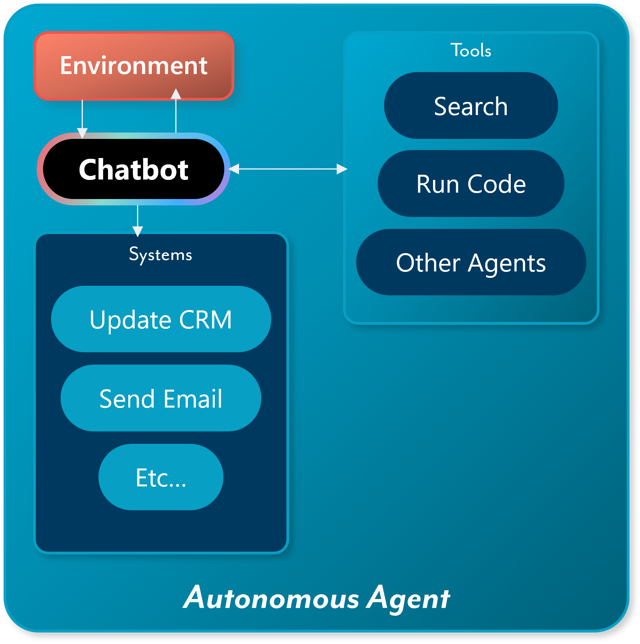
Challenge:Agentic AI moves from answering questions to taking actions - browsing the web, calling APIs, writing and executing code, sending emails. By 2028, 33% of enterprise software applications will include agentic AI, up from less than 1% in 2024. Without defined permission limits and human oversight built in, agents can take consequential actions no one explicitly authorized - and often no one is aware of until the damage is done.
Solution: HSO designs Microsoft AI solutions with least-privilege access, human-in-the-loop checkpoints for high-impact decisions, and documented override and shutdown protocols. Every agent is treated as a governed non-human identity - with scoped credentials, monitored activity logs, and defined escalation paths. Your teams retain full control over what the AI can do and when it requires human approval.
AI Producing Unreliable or Manipulated Outputs
Challenge: AI models can confidently generate incorrect information - known as hallucination - or be manipulated through prompt injection into ignoring their instructions and disclosing sensitive data. Prompt injection is the number one risk on the OWASP Top 10 for LLM Applications (2025). These risks are particularly acute for customer-facing deployments and any AI integrated with live business processes.
Solution: HSO implements Azure AI Content Safety to detect and block prompt injection attempts before they reach model inference. Groundedness detection is configured to ensure AI outputs are anchored in verified source materials rather than confabulated responses. For sensitive or customer-facing deployments, HSO conducts AI red teaming to stress-test models against real-world adversarial scenarios before go-live - and supports continuous testing as systems evolve.
AI Security Is an Executive Priority
According to Gartner, "the CFO must balance the risks and rewards of tools like generative AI" - ensuring that AI "creates value without introducing unacceptable risks." That responsibility doesn't sit with IT alone. It requires executive ownership, clear accountability, and a consulting partner who can turn that intent into a working security architecture.
HSO helps organizations build exactly that: a secure AI foundation grounded in Microsoft's enterprise AI tooling, aligned to international standards, and designed to scale alongside your AI ambitions.
AI Security Consulting FAQs
Frequently Asked Questions
Common questions about securing AI systems within the enterprise.
AI security consulting focuses on identifying and managing risk that arises from within AI systems themselves, covering data exposure, unsanctioned tool usage, autonomous agent behavior, and adversarial attacks on AI models.
It is distinct from traditional cybersecurity, which focuses on protecting networks and infrastructure from external threats. AI security addresses the risks that emerge when AI interacts with your organization's data, users, and workflows.
Traditional cybersecurity protects your perimeter from external attackers. AI security manages the risks created by the AI systems you are actively using, how they handle sensitive data, what permissions they hold, and how reliably they behave.
AI introduces new threat categories, prompt injection, model hallucinations, shadow AI, and excessive agent autonomy, that conventional security tools were not designed to address.
HSO applies a non-human identity governance model to AI agents, treating each agent as a privileged identity that requires scoped permissions, monitored activity, and defined escalation paths.
This includes enforcing least-privilege access, implementing human-in-the-loop checkpoints for sensitive decisions, and designing override and shutdown protocols. Agents are isolated across development, test, and production environments, with all interactions logged for audit purposes.
Connect With Our AI Security Experts
Ready to understand your AI risk exposure? Start with a conversation with HSO's AI security consultants.
Related Resources
Learn How We're Securing AI in the Enterprise
This website uses cookies
We, and third parties, use cookies on our website. We use cookies to keep statistics, to save your preferences, but also for marketing purposes (for example, tailoring advertisements). By clicking on 'Settings' you can read more about our cookies and adjust your preferences. By clicking 'Accept all', you agree to the use of all cookies as described in our privacy and cookie policy.
Required
Statistics
Marketing
Required Cookie preferences
Purpose This cookie is used to store your preferences regarding cookies. The history is stored in your local storage.
Cookies
PerplexCookieConsent
Location of Processing European Union
Technologies Used Cookies
Expiration date 1 year
Why required? Required web technologies and cookies make our website technically accessible to and usable for you. This applies to essential base functionalities such as navigation on the website, correct display in your internet browser or requesting your consent. Without these web technologies and cookies our website does not work.
Required Account & login
Purpose These cookies are stored to keep you logged into the website.
Cookies
SessionId
yourAuthCookie
Location of Processing European Union
Technologies Used Cookies
Expiration date 1 year
Why required? Required web technologies and cookies make our website technically accessible to and usable for you. This applies to essential base functionalities such as navigation on the website, correct display in your internet browser or requesting your consent. Without these web technologies and cookies our website does not work.
Required Safe form submissions
Purpose This cookie is used to submit forms to us in a safe way.
Cookies
__RequestVerificationToken
Location of Processing European Union
Technologies Used Cookies
Expiration date 1 year
Why required? Required web technologies and cookies make our website technically accessible to and usable for you. This applies to essential base functionalities such as navigation on the website, correct display in your internet browser or requesting your consent. Without these web technologies and cookies our website does not work.
Required Google Tag Manager
Purpose This service provided by Google is used to load specific tags (or trackers) based on your preferences and location.
Why required? This web technology enables us to insert tags based on your preferences. It is required but adheres to your settings and will not load any tags if you do not consent to them.
Required User Language
Purpose This cookie is used to store your preferences regarding language.
Cookies
perplex-user-language Stores your preferred website language. This cookie expires after 1 year.
Why required? We use your browser language to determine which language to show on our website. When you change the default language, this cookie makes sure your language preference is persistent.
Required Analytics
Purpose This service is used to track anonymized analytics on the HSO.com application. We find it very important that your privacy is protected. Therefore, all data is collected and stored on servers owned by HSO with no third-party dependencies. This cookie helps us collect data from HSO.com so that we can improve the website. Examples of this are: it allows us to track engagement by page, measuring various events like scroll-depth, time on page and clicks.
Cookie
uMarketingSuiteAnalyticsVisitorId This cookie is used to uniquely identify users. The cookie expires after 1 year.
Required A/B Testing
Purpose This cookie enables HSO to run A/B tests across the HSO.com application. A/B testing (also called split testing) is comparing two versions of a web page to learn how we can improve your experience. All data is collected and stored on servers owned by HSO with no third-party dependencies.
Statistics Google Analytics
Purpose With your consent, this website will load Google Analytics to track behavior across the site.
Cookies
_ga Used to uniquely identify users. The cookie expires after 2 years.
_ga_1D4MT58NBE Used to persist session state. The cookie expires after 2 years.
_gid Registers a unique ID that is used to generate statistical data on how the visitor uses the website. This cookie expires after 1 day.
Statistics Microsoft Clarity
Purpose With your consent, this website will load the Microsoft Clarity script, which helps us understand how people use the site. The cookies set by Clarity collect session-level data like how the visitor landed on the site, which pages they viewed, their language preference, and even their general location. This data powers Clarity’s features like heatmaps and session recordings, helping us see which parts of a page get attention and where users drop off. The goal isn’t to track individuals, but to understand patterns that can improve the user experience. Learn more about Microsoft Clarity cookies here.
Cookies
_clck Domain: hso.com Persists the Clarity User ID and preferences, which are unique to this website, and attributes them to the same user ID.
_clsk Domain: hso.com Connects multiple page views by a user into a single Clarity session recording.
clid Domain: clarity.ms Identifies the first-time Clarity saw this user on any site using Clarity.
ANONCHK Domain: clarity.ms This checks if a browser ID (MUID) is passed to another Microsoft cookie used for ads. For Clarity, this always returns a “no.”
MR Domain: clarity.ms Indicates whether to refresh the MUID cookie, which is used for analytics and advertising.
MUID Domain: clarity.ms Identifies unique web browsers visiting Microsoft sites. These cookies are used for advertising, site analytics, and other operational purposes.
SM Domain: c.clarity.ms Used in synchronizing the MUID across Microsoft domains.
Technologies Used Cookies
Marketing Google Advertising
Purpose With your consent, this website will load the Google Advertising tag which enables HSO to report user activity from HSO.com to Google. This enables HSO to track conversions and create remarketing lists based on user activity on HSO.com.
Possible cookies Please refer to the below page for an updated view of all possible cookies that the Google Ads tag may set.
Purpose With your consent, we use IPGeoLocation to retrieve a country code based on your IP address. We use this service to be able to trigger the right web technologies for the right people.
Marketing LeadFeeder
Purpose With your consent, we use Leadfeeder to identify companies by their IP-addresses. Leadfeeder automatically filters out all users visiting from residential IP addresses and ISPs. All visit data is aggregated on the company level.
Cookies
_lfa Used to set a unique identifier to separate different visitors. The cookie expires after 2 years.
Marketing LinkedIn
Purpose With your consent, this website will load the LinkedIn Insights tag which enables us to see analytical data on website performance, allows us to build audiences, and use retargeting as an advertising technique. Learn more about LinkedIn cookies here.
Cookies
li_mc Used as a temporary cache to avoid database lookups for a member's consent for use of non-essential cookies and used for having consent information on the client side to enforce consent on the client side. The cookie expires after 6 months.
lang Used to remember a user's language setting to ensure LinkedIn.com displays in the language selected by the user in their settings. The cookie expires after the session.
li_gc Used to store consent of guests regarding the use of cookies for non-essential purposes. This cookie expires after 6 months.
lidc To facilitate data center selection. This cookie expires after 24 hours.
bcookie Browser Identifier cookie to uniquely identify devices accessing LinkedIn to detect abuse on the platform. This cookie expires after 1 year.
liap Used to denote the logged-in status of a member. This cookie expires after 1 year.
Marketing Microsoft Advertising
Purpose With your consent, this website will load the Microsoft Advertising Universal Event Tracking tag which enables HSO to report user activity from HSO.com to Microsoft Advertising. HSO can then create conversion goals to specify which subset of user actions on the website qualify to be counted as conversions. Similarly, HSO can create remarketing lists based on user activity on HSO.com and Microsoft Advertising matches the list definitions with UET logged user activity to put users into those lists.
Cookies
MUID This is a Microsoft cookie that contains a GUID assigned to your browser. It gets set when you interact with a Microsoft property, including a UET beacon call or a visit to a Microsoft property through the browser.
_uetmsclkid This is the Microsoft Click ID, which is used to improve the accuracy of conversion tracking.
_uetsid This contains the session ID for a unique session on the site. It also contains some additional parameters like: insights_sessionId, timestamp, pagenumber, upgrade, upload.
_uetvid UET assigns this unique, anonymized visitor ID, representing a unique visitor. UET stores this data in a first-party cookie. It also contains some additional parameters like: insights_userId, cookieVersion, expiryTime, consent, cookie_creation_time.
Technologies Used Cookies
Marketing Microsoft Dynamics 365 Marketing
Purpose With your consent, this website will load the Microsoft Dynamics 365 Marketing tag which enables HSO to score leads based on your level of interaction with the website. The cookie contains no personal information, but does uniquely identify a specific browser on a specific machine. Learn more about Microsoft Dynamics 365 Marketing cookies here.
Cookies
msd365mkttr Identifies a website visitor/ end user (by browser). When a Microsoft Dynamics 365 form is submitted by a web visitor, a new contact/lead is created and we leverage the cookie available in the browser to associate previous visits with the newly generated contact/lead. This cookie expires after 2 years.
msd365mkttrs To find out how much time a website visitor spent on a certain page. The cookie is deleted when your session ends.
Technologies Used Cookies
Marketing Salesfeed
Marketing Spotler
Purpose With your consent, we use Spotler to measures more extensive recurring website visits based on IP address and draw up a profile of a visitor.
Cookies
wow.anonymousId Registers statistical data on users' behavior on the website. The cookie expires after 399 days.
Marketing Vimeo
Purpose With your consent, this website will show videos embedded from Vimeo.
Technologies Used Cookies
Marketing YouTube
Purpose With your consent, this website will show videos embedded from Youtube.
Cookies
VISITOR_INFO1_LIVE To provide bandwidth estimations. The cookie expires after 6 months.
YSC To ensure that requests within a browsing session are made by a real user, and not by other sites. This cookie prevents malicious sites from acting on behalf of a user without that user’s knowledge. The cookie is deleted when your session ends.
Technologies Used Cookies
Marketing Meta / Facebook
Purpose With your consent, this website will load the Meta-pixel tag which enables us to see analytical data on website performance, allows us to build audiences, and use retargeting as an advertising technique through platforms owned by Meta, like Facebook and Instagram. Learn more about Facebook cookies here. You can adjust how ads work for you on Facebook here.
Cookies
act This cookie helps to distinguish between two sessions for the same user, created at different times. This cookie expires at the end of the session.
c_user Contains the user ID of the currently logged-in user. This cookie expires after 3 months.
datr To identify the web browser being used to connect to Facebook independent of the logged-in user. This cookie expires after 2 years.
fr Contains an encrypted Facebook ID and Browser ID. This cookie expires after 1 month.
presence Used to contain the user’s chat state. This cookie expires at the end of the session.
sb This cookie is used by Meta/Facebook to improve friend suggestions. This cookie expires after 18 months.
wd Used to optimize the rendering of the page. This cookie expires after 1 week.
xs This cookie contains multiple pieces of information:
The first part of the value is an up to two-digit number representing the session number.
The second portion of the value is a session secret.
The third, optional component is a ‘secure’ flag if the user has enabled the secure browsing feature.
Marketing LeadInfo
Purpose With your consent, we use LeadInfo to identify companies by their IP-addresses. LeadInfo automatically filters out all users visiting from residential IP addresses and ISPs. These cookies are not shared with third parties under any circumstances.
Cookies
_li_id.xxxx A first-party cookie to determine if the visitor is a new visitor or a returning visitor. This cookie is only used in the current session.
_li_ses.xxxx A first-party cookie to determine which pages have been visited during their session. This cookie will be saved for two years.
Marketing TechTarget
Purpose With your consent, we use TechTarget to identify companies by their IP address(es).
Cookies
__cf_bm This cookie is used to distinguish between humans and bots. This is beneficial for the website, to make valid reports on the use of the website.
Marketing Personalization
Purpose This enables HSO to personalize pages across the HSO.com application. Personalization helps us to tailor the website to your specific needs, aiming to improve your experience on HSO.com. All data is collected and stored on servers owned by HSO with no third-party dependencies.
Marketing ZoomInfo
Purpose With your consent, we use ZoomInfo to identify companies by their IP addresses. The data collected helps us understand which companies are visiting our website, enabling us to target sales and marketing efforts more effectively.
Cookies
_wsLiteTok ZoomInfo Websights cookie for tracking domain information in form fills and matching against ZoomInfo database. This does not store personally identifiable information.
_zitok First-party cookie for maintaining a unique visitor identifier. It contains an opaque GUID to represent the current visitor.