

Table of Contents

Chapter 1
Headless Business Applications in Construction: How AI Moves Work from People to Systems
Building an Autonomous Construction Firm
1
Chapter 1 - Introduction
Introduction
2Chapter 2 - The Challenge with ERP and CRM in Construction
The Challenge with ERP and CRM in Construction
3Chapter 3 - Reframing the Project Lifecycle
Reframing the Project Lifecycle
4Chapter 4 - The shift toward an autonomous construction firm
The shift toward an autonomous construction firm
5Chapter 5 - Where to Start
Where to Start
6Chapter 6 - See What This Looks Like in Practice: Webinar
See What This Looks Like in Practice: Webinar
Most construction firms already have ERP and CRM systems in place. What they don’t have is confidence in the data that’s contained in them.
That’s because keeping those systems up to date still depends on manual input, which doesn’t align with how construction teams actually work.
Projects move fast. Conditions change. Teams focus on getting work done, not updating systems. The result is familiar: incomplete data, limited visibility, and decisions being made in the rear view mirror.
This is where a new model is starting to take hold – one that shifts work from people to systems.


Chapter 2
From Structured Systems to Autonomous Operations
From Structured Systems to Autonomous Operations
The idea behind an “autonomous construction firm” is straightforward. Instead of relying on people to continuously feed systems with data, systems begin to capture, update, and interpret that data on their own, only involving people when needed.
AI, machine learning, and automation are embedded directly into ERP and CRM systems, productivity tools like email, and mobile apps, allowing work to continue uninterrupted while systems stay up to date in the background.
This is the foundation of headless business applications, where ERP and CRM no longer depend on constant human interaction to stay accurate, but instead operate alongside the business, quietly supporting it.
Why Construction Has Always Struggled with ERP and CRM
Construction has long been one of the least digitized industries. Research from organizations like McKinsey has consistently pointed to lagging productivity, not because firms lack technology, but because data is fragmented and difficult to capture consistently.
The challenge is structural.
Data originates in the field, where systems are hardest to use. Marketing and business development rely on relationships and pursuit data that is rarely maintained in real time. And finance depends on timely data inputs from across the business.
When any part of that chain breaks, the entire system falls out of sync. Unfortunately, adding more process doesn’t fix this. It often makes adoption worse.


Chapter 3
Reframing the Project Lifecycle: From BD to Project Delivery to Finance
Reframing the Project Lifecycle: From BD to Project Delivery to Finance
To understand where this shift matters most, it helps to look at the full lifecycle of a project: from the first interaction with a client through project delivery and into financial management.
Marketing & Business Development (CRM)
For many firms, the breakdown starts before a project even begins.
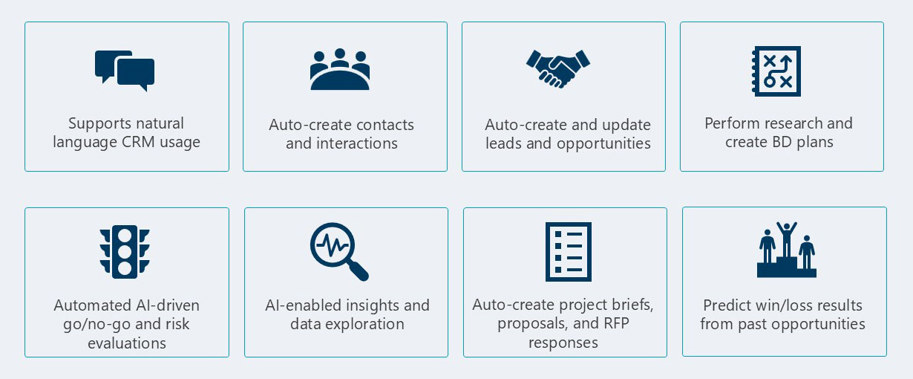
Business development and marketing teams are expected to maintain CRM systems with accurate contact data, activities, and pursuit tracking. In reality, conversations happen in email, Teams meetings, or in-person, relationships evolve across teams, and opportunities shift quickly. Very little of that makes it back into the system.
AI changes this by working inside tools like Microsoft Outlook and Dynamics 365 to capture interactions, update relationships, and keep opportunity data current without requiring manual input. CRM becomes less about maintenance and more about visibility and strategy.
Field & Operations (ERP)
As projects move into execution, the gap between the field and office becomes more pronounced.
Field teams don’t have time to navigate complex systems or enter structured data. As a result, critical information is delayed or missed entirely.
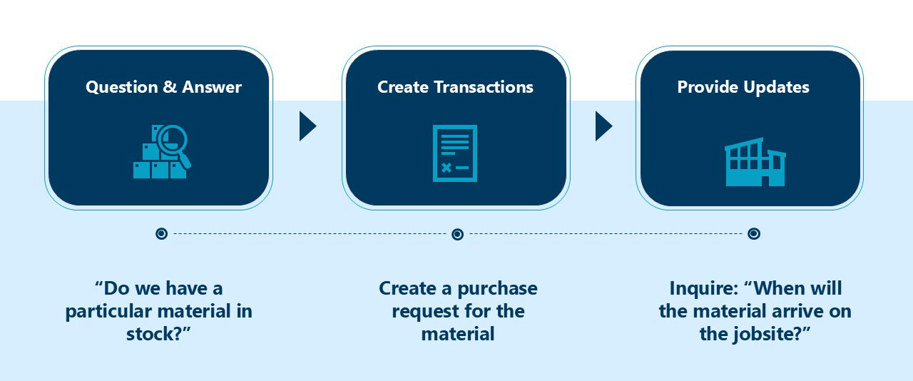
With AI embedded into ERP and mobile experiences, teams can interact with systems using voice or simple prompts: checking inventory, creating purchase orders, or confirming delivery timelines without breaking their workflow. Data is captured at the source, without slowing down the work.
Finance
Finance teams have traditionally carried the burden of incomplete and delayed data, combined with manual, repetitive processes that limit their ability to operate strategically.
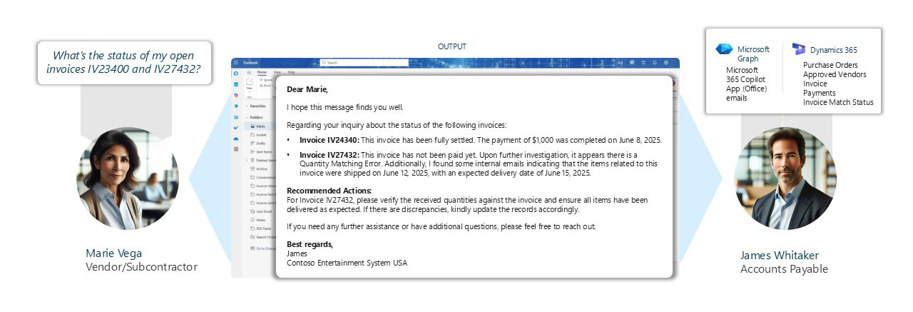
AI and autonomous processing are shifting this dynamic. AP invoices can be ingested and processed with minimal intervention. Vendor and subcontractor inquiries can be handled automatically. Account reconciliations can run continuously in the background, surfacing only the exceptions that require attention.
Instead of chasing transactions and reconciling data across disconnected systems, finance gains earlier visibility into performance and can focus on insights, forecasting, and risk management.
Leadership and Decision Making
When data is delayed or incomplete, decision-making becomes reactive.
AI enables a different approach, continuously analyzing data across CRM, projects, and finance to:
- Highlight risks and anomalies earlier
- Provide real-time visibility into performance
- Generate summaries and insights automatically
- Surface trends and patterns that would otherwise go unnoticed
Leaders spend less time validating data and more time acting on it.


Chapter 4
The shift toward an autonomous construction firm
The Multiplier Effect
What makes this shift meaningful isn’t any single use case, it’s how they connect.
As data improves at the source, it flows more consistently through the rest of the business. Marketing and business development gain a clearer view of relationships and pipeline. Project teams operate with more accurate, real-time information. Finance works from complete and timely data rather than reconciling gaps.
Over time, this creates a continuous loop where each function strengthens the others:
CRM → Project → Finance → Back to CRM
The result is not just better systems, but a more connected and responsive business.
The Foundation Still Matters: Data and Platform
AI doesn’t eliminate the need for ERP and CRM. It depends on them. Structured, reliable data remains the foundation for any AI-driven process. Without it, automation and insights quickly lose accuracy and value.
This is why platforms like Microsoft Dynamics 365 and Microsoft 365 are central to this shift, providing the underlying data model and integration points needed to embed AI into daily workflows.
At the same time, firms are investing in modern data strategies to unify ERP, CRM, and project data into a single, trusted foundation. HSO’s Data & AI offerings help construction firms build that foundation, enabling advanced analytics, AI-driven insights, and scalable data models that support this move toward autonomy.
What Holds Firms Back and Why It’s Changing
Many firms hesitate to move in this direction for understandable reasons. Past CRM initiatives may not have delivered value. Field teams may resist using structured systems. Poor data quality may already feel like a barrier.
There is also a growing sense of uncertainty around AI itself: what it actually means, how it works, and where it can be trusted.
And perhaps most importantly, there’s the challenge of change. Introducing new ways of working across field, office, and finance teams requires alignment, training, and a clear path forward.
These concerns are valid.
They are also exactly what this model addresses. By reducing reliance on manual input and embedding intelligence into existing workflows, firms can improve adoption and data quality at the same time, while introducing AI in a way that is practical and controlled.
With the right approach to change management, firms can guide teams through this shift without disruption and ensure these capabilities are actually used.
Explore HSO's Organizational Change Management Consulting Services


Chapter 5
Where to Start
This shift doesn’t begin with a full transformation. It starts with a different question.
Not “How do we get people to use our systems better?”
But “Where is friction slowing us down today?”
Leading firms begin by identifying where data breaks down across the lifecycle, where updates are delayed, where processes rely too heavily on manual effort, and where visibility is limited.
From there, they introduce AI into those moments, embedding it into the tools teams already use. Over time, those improvements connect into a more unified, real-time model across business development, project delivery, and finance.
This is where HSO works with firms, helping assess where friction exists, align the right Microsoft technologies to those challenges, and guide a practical path forward that delivers value early while building toward a broader transformation.
The Shift Is Already Underway
Across the industry, firms are already moving in this direction. Not through large, disruptive overhauls, but through targeted changes that reduce friction and improve visibility.
As more organizations adopt this model, the gap between those operating with real-time, connected data and those relying on manual processes continues to widen.
Firms that hesitate risk falling behind, not just in efficiency levels, but in their ability to make timely decisions, compete for the right work, and protect margins in an increasingly competitive market.


Chapter 6
See What This Looks Like in Practice: Webinar


See What This Looks Like in Practice | Webinar
We’re walking through real examples of this shift in the upcoming webinar.
From marketing and business development through field operations and finance, you’ll see how AI is being applied inside Microsoft Dynamics 365 and Microsoft 365 to reduce friction and improve performance across the entire project lifecycle.
Ready to Reduce Friction Across Your Business? Talk to HSO
Every construction firm is at a different point in this journey.
If you’re starting to explore how AI, Microsoft Dynamics 365, and connected data can improve visibility, adoption, and performance across your firm, we can help you identify where to begin and what will deliver the most impact.
Whether you’re looking to improve CRM adoption, streamline operations, or modernize finance, HSO works with construction firms to turn these concepts into practical, real-world outcomes.
Let’s start the conversation.