

This playbook will help you apply this sequence to your AI projects. In the chapters ahead, we will cover how to:

The Enterprise AI Playbook
How to move AI pilots into production and deliver real business impact.
A Note From Our CEO
There is no shortage of interest in AI right now. Boards are asking about it. Budgets are being allocated. Vendors are promising transformation. And yet, there is a gap between what AI is supposed to do and what it is actually delivering.
That tension — between the promise of AI and the reality of getting it to work — is the subject of this playbook.
At HSO, we have spent more than three decades helping organizations redesign how they operate. We have seen what happens when technology is deployed without the right foundations in place, and what becomes possible when it is.
Over the coming pages, we set out the foundations that give organizations the best chance of getting AI pilots into production: people, process, data and cloud architecture. In that order.
Every chapter draws on the experience of HSO practitioners who have seen programs scale, and on the clients who have made AI work in production.
— Peter J. ter Maaten, Founder and CEO, HSO
Table of Contents
Chapter 0 - Introduction and Executive Summary
Introduction and Executive Summary
Chapter 0 - Chapter 1: People FirstBring Your Organization’s Deepest Knowledge to Every AI Program
Chapter 1: People First
Bring Your Organization’s Deepest Knowledge to Every AI Program
Chapter 0 - Chapter 2: Redefine Processes NextGet to ROI Faster, with Fewer Agents
Chapter 2: Redefine Processes Next
Get to ROI Faster, with Fewer Agents
Chapter 0 - Chapter 3: Lay the Data FoundationMake Every System in Your Business AI-Ready
Chapter 3: Lay the Data Foundation
Make Every System in Your Business AI-Ready
Chapter 0 - Chapter 4: Connected Cloud Architecture Move AI from Isolated Wins to Enterprise-Wide Impact
Chapter 4: Connected Cloud Architecture
Move AI from Isolated Wins to Enterprise-Wide Impact
Chapter 0 - Chapter 5: The Case for Doing Less, Better
Chapter 5: The Case for Doing Less, Better
Chapter 1
I. AI Investment Is Outpacing Impact
At some point in the last two years, most business leaders have sat in a review of an AI proof of concept that met every technical benchmark — yet never made it into production.
MIT's research puts the share of AI pilot programs delivering measurable profit and loss impact at 5%. McKinsey data finds just 6% of organizations qualify as genuine AI high performers. Boston Consulting Group, after surveying a thousand executives, found only 26% of companies have developed production-ready AI capabilities. The remaining 74% are trapped in a cycle of failed experiments

26%
of companies have developed production-ready AI capabilities.
74%
of companies are trapped in a cycle of failed experiments.
In most of these cases, the technology worked. The problem was the order of operations.
Organizations are deploying AI without looking at the fundamentals first. They aren't redesigning processes, bringing end users into the conversation, or establishing whether their data can support what they're asking AI to do.
For AI agents to make it into production and change how businesses operate, organizations need to sequence transformation differently…
II. A Fresh Approach to AI Programs

More than three decades of transformation experience—and the lessons from our own agentic AI implementations—have shown us that organizations getting the best results from AI do not start with the technology.
Instead, they start with people. AI leaders identify where skilled team members are spending their days on tasks beneath their ability, where workflows are fragile, and where critical knowledge exists only in someone’s head. They talk to those doing the work, not just those directing it.
Then they redesign the process. Not a single task; the entire end-to-end flow, from input to outcome, reconsidering how day-to-day operations should function when intelligent agents are part of the team.
Then, and only then, they layer in the technology. A trusted data platform, cloud architecture, purpose-built agents, and the governance to hold them accountable.

Identify and redesign the end-to-end processes so AI delivers organization-wide returns.

Build a data and cloud foundation capable of supporting AI at enterprise scale.
Design AI solutions that people will adopt and use every day to work more effectively.

Steer clear of the most common mistakes that cause AI pilots to fail or stall.
III. The Perspective Behind This Playbook
Each chapter in this paper draws on the expertise of HSO’s global practitioners, who work at the intersection of AI technology and business operations, delivering projects and services to companies in more than 60 countries worldwide.
For the past 30 years, HSO has been at the frontline of complex business operations across retail, manufacturing, distribution, logistics, professional services and financial services.
We’ve supported over 1,200 digital transformation projects, designing change from start to finish and also being called in to solve problems when change has not gone to plan. Our measure of success is simple: whether the business performs better as a result.

Unlike most business solution providers, HSO holds every capability required for AI transformation in-house:
- 1
Technology
HSO is a full Microsoft stack partner, with end-to-end capability across Business Applications, Data and AI, Cloud Infrastructure, Security, and Modern Work. The Microsoft Azure platform underpins everything we do, including the data foundations and integration architecture that AI agents depend on to operate at scale.
- 2
Process
Our teams have spent decades redesigning how complex enterprises operate in some of the world’s most demanding industries. We spot roadblocks and uncover opportunities that many clients can’t see themselves, strategically analyzing their workflows alongside their technology stack.
- 3
People
We invest heavily in user-centered design and change management, which many organizations overlook. An AI solution that people do not trust, understand, or use is not a solution; it is an expensive proof of concept. Our practitioners bring together technology expertise and a deep understanding of human behavior.
- 4
Industry
Our teams are not generalist consultants who turn their hand to any sector. They are specialists who understand how revenue flows in a logistics business, how a manufacturing floor operates under pressure, or how a retail supply chain responds to disruption.
HSO’s starting point is always the same: successful transformation does not begin with software. It begins with strategy, people, and a clear understanding of the processes you are trying to improve.
Chapter 1


Chapter 1: People First
Bring Your Organization’s Deepest Knowledge to Every AI Program
Every AI program has two timelines: the project plan—model selection, integration, testing, deployment, and continuing improvements—and the time it takes for people to understand what is changing, why it affects them, and how they are supposed to work differently.
Most organizations focus their attention on the first timeline while underestimating the second. The gap between an agent going live and the workforce absorbing AI into their daily operations is where the majority of programs lose their return on investment.
I. Understand the User Before You Define the Use Case
AI and agents, at their most effective, solve human problems. But when people are not central to their design, adoption suffers.
Gallup's research finds that when leadership has communicated a clear plan for integrating AI, employees are three times more likely to feel prepared to work with it, and 2.6 times more likely to feel comfortable doing so.
User-centered design (UCD)—the discipline of building solutions around the needs, behaviors, and realities of the people who will use them—has been a cornerstone of good product development for decades. AI makes it even more critical because, unlike traditional deterministic software that provides fixed outcomes, AI and agents work probabilistically. Since AI and agents are affected by a user’s specific context, how an agent behaves cannot be fully anticipated before people start using it.

UCD begins with user pain points, wants, and needs, mapped through direct engagement with the people doing the work. It defines the current process as a journey, identifies points of friction, and uncovers current workarounds. This groundwork empowers teams to design and test agents that create a better version of that journey and positions AI as a tool for redeploying human talent toward higher-value work.
HSO's UCD approach covers five stages, based on the proven Double Diamond methodology and tailored specifically for AI agentic implementations:
Stage | What happens | What UCD prevents |
Inspire and Gain Insights (User research) | Map current workflow, identify friction, capture undocumented knowledge | A solution that nobody wants to use |
Ideate & Define (Co-creation) | Define what the AI solution needs to do, with the people who will use it | Adoption failure at launch |
Prototype & Test (Rapid prototyping) | Clickable prototype tested with end users before build begins | Expensive late-stage changes |
Build & Iterate | Feedback incorporated before technical development | Solutions that work in demos but not in live environment |
Human-in-the-loop design | Validation and feedback mechanisms built into the solution | AI programs that do not improve after deployment or degrade over time |
By the time a line of code is written, the solution has already been tested, refined and validated by its end users.
The result: the technical build is faster, late-stage changes are fewer, and the project is de-risked because the people who will determine its success are already bought into it.
II. Build a Center of Excellence to Drive AI Adoption

There are conversations happening in the corridors of every organization embarking on AI transformation. People are quietly calculating what new agents can do and wondering what it means for their role.
The fear of job displacement is real, widespread, and—if left unaddressed—a surefire way to ensure AI programs fail. People who believe a solution has been built to replace them will not embrace it. They will not share the operational knowledge that makes it function or flag the edge cases and exceptions. Instead, they will comply with the minimum requirements and wait.
Gartner's framing is useful reassurance here: the value of AI is not captured by reducing headcount. It is captured by redeploying capability. In successful AI implementations, employees move from executing processes to “managing” the agents that perform them.
Leading organizations build AI centers of excellence: cross-functional groups responsible for governance, literacy, and continuous learning. They create structured environments where employees can develop skills and build fluency at their own pace. When people understand what AI agents can do and discover that they can use them without a technical background, their fear recedes.
Before designing any agent, leaders also spend time tracking how work currently gets done — the volume, the time, the effort, the exceptions — to strengthen the business case for AI programs and create the baseline against which an agent's performance is measured.
Done well, an AI Center of Excellence turns the people most likely to undermine an AI program into the people most invested in making it succeed.
III. Transform Risky AI Enthusiasm into Safe Momentum
At the other end of the scale from fear, many employees are already using AI unregulated. Data from UpGuard reveals that more than 80% of workers use unapproved AI tools in their jobs, while research by CybSafe and the National Cybersecurity Alliance has found that 38% share confidential data with AI platforms without their employer's approval.
HSO has seen the consequences of this “shadow AI” firsthand. One company discovered that its employees had been using unvetted AI tools independently to overcome local challenges. However, this non-malicious “shadow AI” involved tasks using confidential data, leading to a preventable (and high-risk) security gap for the larger organization.
Organizations must not turn a blind eye to the reality and risks of shadow AI. These risks can transform into positive momentum when businesses quickly create a sanctioned alternative: a governed environment where employees can
experiment with AI tools within the defined boundaries of an AI playground or walled garden,
contribute to the development of internal policies,
and channel their enthusiasm into something the organization can benefit from.

The effect is twofold: it reduces the risk of ungoverned AI use, and it turns your organization’s most enthusiastic early adopters into advocates.
IV. Commit to Continuous Change
In traditional technology implementations, change happens once. The system goes live, people are trained, and the organization moves on.
AI does not work that way. Unlike traditional software, which stabilizes after deployment, agents require continuous evaluation, retraining and adjustment. Organizational culture must reflect this: weekly knowledge sessions, cross-functional feedback loops, and regular performance reviews of the agents running in production. Go-live is not the end of the change management process, but rather the beginning of a new phase of change management.

Mustad, the global manufacturing business, learned this through experience. An earlier digital transformation project had underestimated the impact on employees — in the words of Interim Group CFO Mayra Mouthaan at the time, “a lot of classic mistakes had been made.”
When HSO came on board for a subsequent program, adoption and change management were central from the outset. We established dedicated teams, involving and training end users from across the business. As Hans Mustad, seventh-generation CEO, puts it: “People really appreciate the time we invest in updating them and asking for feedback. When our employees are happy and benefit from the software every day, the project has been successful.”
Read Mustad's story in fullV. Summary: Your Framework for People-First Adoption
- 1
Build an AI Center of Excellence with cross-functional representation, not just technical expertise.
- 2
Address job displacement fears directly by involving end users from the beginning and demonstrating how AI empowers them instead of replacing them.
- 3
Set a human performance baseline before redesigning any process; without this, there is no meaningful way to evaluate whether an agent is delivering.
- 4
Apply user-centered design from the outset: map workflows, capture undocumented knowledge, and prototype agents with end users before the full technical build begins.
- 5
Create a controlled environment for AI experimentation and feedback, encouraging your most enthusiastic adopters to become governed agent advocates.
- 6
Continuously invest in people's AI fluency, giving them the skills, confidence, and guardrails needed to evolve their use at the same pace as the technology.
Chapter 2


Chapter 2: Redefine Processes Next
Get to ROI Faster, with Fewer Agents
When deploying AI, the instinct is to look for tasks to outsource to an agent. Which parts of the job are repetitive? Which decisions follow a predictable pattern? Which steps could AI complete faster than a human?
It’s a reasonable starting point, and one that will yield efficiencies. But the organizations generating the most impactful results start with inputs, outputs and desired outcomes — then redesign the process around those, with AI as part of the answer.
For many companies, the barrier to process improvement is legacy: systems built over decades, customized beyond recognition, and running on infrastructure that was never designed to be changed quickly. The temptation is to bolt AI onto what exists. But that is why pilots stay pilots.
McKinsey data confirm this: high-performing organizations are three times more likely to have redesigned their workflows before deploying AI into them.
I. Identify the Processes That Will Deliver the Greatest Returns
Not every process benefits from an AI agent. The ones worth prioritizing share a set of broad characteristics:
High Volume
The greater the frequency, the faster the return accumulates. An agent handling a hundred interactions a day delivers multiples of the value of an agent handling ten.
High Repeatability
The more consistent the process, the greater the cumulative time and cost savings, and the easier it is to prove ROI.
Clear, Measurable Outcome
Defining what the process should produce will allow you to evaluate performance and make the case for scaling AI use.
To identify the best starting point, HSO uses a value-effort matrix, which maps client processes against two axes: the business value of improving them, and the effort required to do so. The priority quadrant is high value, low effort: processes where the return justifies the investment and the complexity is manageable.
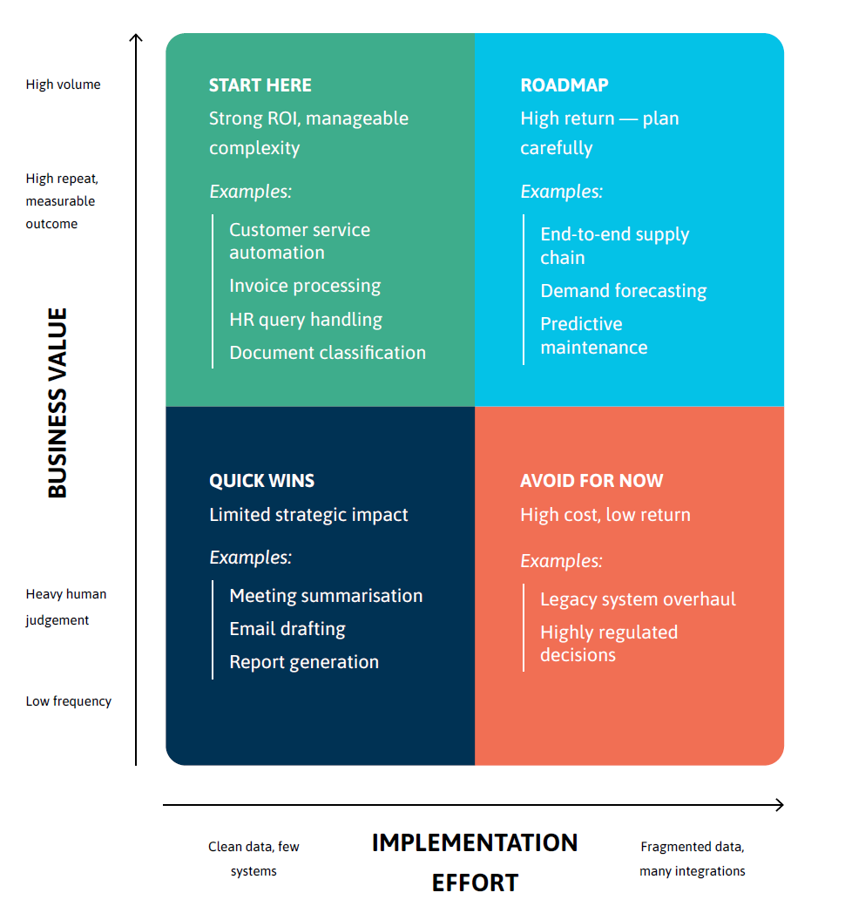
Examples of Ideal Processes to Optimize with AI
Industry | Process |
|---|---|
Retail |
|
Manufacturing |
|
Professional services |
|
Distribution and logistics |
|
II. Redesign End-to-End Processes with AI
a. Map the Current Process in Detail
Log what the process costs today: the volume, time, effort and exceptions. This baseline is both your business case and the most meaningful measure of whether a future agent is delivering.
Mapping the current process can reveal surprising insights. One HSO client discovered that a single team was fielding hundreds of queries a month within what was meant to be a straightforward customer service operation. The answers existed in the company handbook, but at that volume, the team did not have the capacity to retrieve and relay them efficiently. An agent connected to the same knowledge base could resolve most queries instantly.
b. Define the Outcome You Want to Achieve
When you’ve decided which process to redesign, your starting point is the result you need to produce. What does a completed interaction look like? What would the agent need to deliver for a human to approve it?
When HSO redesigned a customer service operation for an EnergyTech organization, we started with a single goal: every routine customer query answered accurately, instantly, without human involvement. That definition made the agent designable, evaluable and scalable.
Organizations that skip this step and move straight to building often find themselves with an agent that works with technical proficiency but delivers limited business value.

Your AI Center of Excellence will play a critical role in ensuring that these outcomes translate into meaningful operational change, and it is important to have both board-level leaders and operational experts in the room. Senior leaders commissioning AI programs tend to see the operation from a distance. They know which functions are expensive, which are slow, and which have been flagged in board meetings, but they do not always possess ground-level experience.
Team leaders understand each team’s volume of work, system workarounds, and the knowledge that exists only in people’s minds. Leveraging this combination of strategic perspective and ground-level expertise is key to identifying and achieving impactful outcomes.
c. Design the Agent Around That Outcome
With the outcome defined, the design work begins. From our experience across hundreds of agent deployments, there are four design principles that consistently determine whether an agent delivers in production:
- 1
Be specific about scope
The more precisely an agent’s scope is defined, the easier it is to evaluate, improve, and trust. Define exactly what it should handle and (equally importantly) what it should not.
- 2
Define inputs, outputs and escalation criteria.
What information does the agent need to function? What does a successful output look like? And at what point does it hand over to a human?
- 3
Build in evaluation.
Every agent needs reviewing to measure effectiveness and prevent degradation. Tools such as Microsoft Foundry allow agent outputs to be scored against the human baseline established during your process mapping.
- 4
Consider a maker-checker model for high-stakes outputs.
A second agent validating the first before the output reaches a human adds a layer of quality control that mirrors existing review processes.
We discuss the architecture of successful AI agents in greater detail in chapter four.
d. Monitor, Evaluate and Improve

Before any agent goes live, ask: what happens if it works? The organizations scaling AI successfully have already mapped the next two or three processes before the first one launches.
Deployment is not the end of the process redesign, either. Agent performance should be measured continuously against the human baseline, with owners responsible for acting on what the data shows.
III. Summary: Your Framework for Process-First AI
Redesign your processes before deploying AI into them; you cannot copy a broken process into a better system and expect a different result.
Choose processes to AI optimize on the basis of value and effort, not just what is easiest to automate.
Involve operational and frontline expertise in scoping suitable processes before the use case is fixed.
Define the outcome each AI-enabled process must produce before any design decisions are made.
Scope every agent narrowly, with defined inputs, outputs, and escalation criteria.
Build performance evaluation into the design and appoint clear ownership for ongoing monitoring before and after the agent goes live.
Chapter 3


Chapter 3: Lay the Data Foundation
Make Every System in Your Business AI-Ready
Data is the engine of AI transformation. Its quality, completeness and accessibility determine not just what agents can do at launch, but how far they can scale. But that does not mean organizations should wait for a perfect enterprise-wide data estate before starting. The strongest AI programs improve the data foundation while delivering value in parallel.
When AI or agents underperform in a live environment, the instinct is to question the model, the architecture or the vendor. But often, the issue lies in the data. AI amplifies whatever foundation it runs on — and if that foundation is poor, your agent will produce confident, plausible, but ultimately incorrect answers.

In 2026, Gartner predicts that organizations will abandon 60% of AI projects due to insufficient data quality. The conclusion is not that AI should wait until every issue is fixed. It is that the data constraints around the first high-value use case should be addressed early, while the wider estate is improved over time.

Enterprise AI operating in transactional systems is also held to a higher data standard than consumer applications. Outputs must be accurate, repeatable and explainable, particularly in heavily regulated industries where data non-compliance carries legal and financial consequences.
I. Get Full Visibility of Your Data Estate
Before designing any AI solution, the most valuable thing your organization can do is understand exactly what your data estate looks like.
Think of data quality as an iceberg. Most organizations currently see around 10% of the factors that influence it: the duplicate records, the missing fields, the failed reports. The remaining 90% has been absorbed so completely into operations that it no longer registers as a data issue.
Data management shortcomings often result in detailed records being aggregated into summary figures, but this eliminates the detail AI and agents need most. For example, a retailer that retains total annual spend per customer but discards the underlying transactions cannot deeply analyze what the customer bought, when they bought it, how often, at what price point, through which channel. And as a result, they cannot identify spending patterns, predict behavior, or personalize interactions to increase customer value.
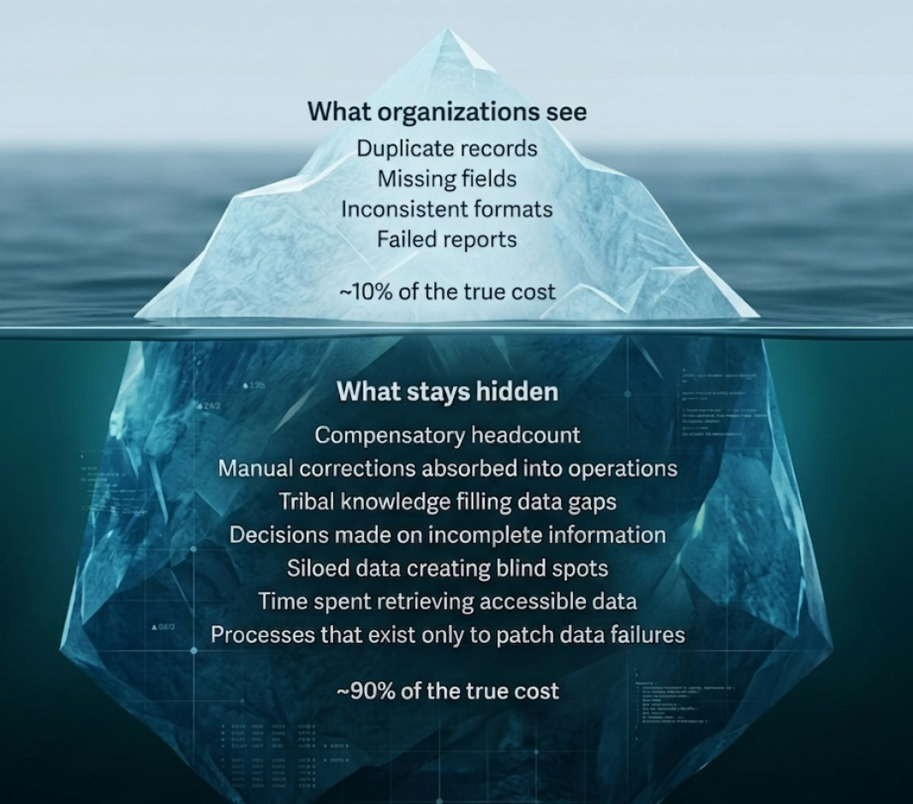
Getting beneath the surface of your estate — tracking the manual interventions, the workarounds, the time spent compensating for what your systems cannot do — will tell you which processes your data can support, and which it cannot.
II. Target the Insights That Drive Your Core Processes
A multi-year data remediation program would cost more than it delivers, take longer than anyone budgets for, and be partially out of date before it ends. A targeted approach is far more productive: identify what data a specific process requires, assess its reliability, and establish continuous controls to maintain it. In most organizations, this starts with a flagship initiative — a use case capable of delivering visible value early, while being sufficiently contained to manage data risk. That early success builds trust in the program, creates momentum, and gives the business confidence to improve the broader data estate in parallel.
When HSO worked with stichd, part of the PUMA Group, its IT landscape had grown complex across multiple brands, systems and markets. Rather than attempting to rationalize it wholesale, HSO built a single integration layer that decoupled the data component from the application architecture, making all data across all systems accessible from one place.

With all data now visible and accessible through a single layer, stichd can extract value from every system in its estate, and the business can innovate without waiting for IT to catch up.
Reach stichd's story in full“The easier it is to integrate with stichd from outside, the more quickly we can bring brands, businesses, consumers and suppliers into our value chain.”
III. Build an AI-Ready Modern Data Platform
As AI applications become more sophisticated, the importance of their data estate grows accordingly. While a single-purpose agent can run on a well-maintained knowledge base, enterprise-wide AI operating across functions, systems, and geographies requires every data source to be connected, governed, and accessible from one environment.
HSO's approach to building that foundation starts with one principle: a unified view of the truth. Achieve this and your data platform becomes an asset that grows in value with every agent built on top of it.
We define an AI-ready data platform across five capabilities:

At HSO, we recommend Microsoft Fabric as the unified data platform for the era of AI and agents. Rather than stitching multiple tools together, Fabric unifies analytics, data engineering, data science and BI in a single platform, with both structured and unstructured data consolidated and governed. It gives enterprise AI a single governed environment to operate from, with quality, compliance and access controls embedded.
There are faster and slower routes to AI value — and the sequence you choose determines the speed of return. Organizations that strengthen their data platform and launch carefully chosen use cases in parallel tend to reach AI-readiness fastest. The goal is not to boil the ocean, but to create enough trusted, governed data around priority workflows to deliver value now while expanding the foundation over time.
Logicall, a European logistics provider operating across thirty-five offices in twelve countries, is one company taking this approach. Logicall partnered with HSO and Microsoft to put its data platform first. Built on Microsoft Fabric, integration services, Purview, and Power BI, the platform will consolidate all Logicall divisions, delivering unified real-time insight across the entire operation.
The result will be a single source of truth across all divisions, real-time operational insight, and a data foundation from which AI agents can operate across planning, operations and customer service.
Read Logicall's vision
IV. Govern Data with Continuous Discipline
Unlike SaaS technology, an AI agent in production is never truly finished. The data it depends on changes continuously: consumer behavior evolves, supplier formats update, upstream systems change. Without ongoing management, agents will continue to operate on outdated assumptions.
At HSO, we’ve experienced this first-hand. Our own expense entry agent stopped functioning correctly one December without anyone having touched it. The culprit was a model update made by a third-party provider. Continuous monitoring meant we were able to spot the problem quickly, communicate clearly with all affected users, and resolve the issue confidently.
Like us, most organizations are reminded of the importance of data governance when an agent produces rogue results. The companies that show consistent benefits over time from their AI implementations treat their agents the way they treat their people: with defined expectations and regular performance reviews.
V. Summary: Your Framework for a Data-First AI Foundation

Map your data estate in full before designing anything: every source, every gap, and every manual workaround that currently exists.
Focus your initial data quality investment on the processes identified in your value-effort matrix, while broader governance work continues in parallel.
Bring all relevant data sources into a single, unified environment before asking AI to draw on them.
Build your data platform before the applications so that when you launch new agents, they have a connected foundation to operate from.
Assign clear ownership of data governance, with regular performance reviews of agents against the baseline they were trained on.
Use a proven reference architecture. Microsoft's Fabric is the data platform for the era of enterprise AI and agents.
Chapter 4


Chapter 4: Connected Cloud Architecture
Move AI from Isolated Wins to Enterprise-Wide Impact
There is a pattern HSO sees in organizations that deploy AI pilots successfully but cannot scale them. The first agent works, but the second requires a new integration. By the time the third and fourth agents are in scope, teams are spending as much time maintaining connections as building capability. Their AI program slows because the architecture was never designed to support more than one agent at a time.
The integration layer — the infrastructure that governs how applications connect to enterprise systems and to each other — is where AI initiatives either scale or stall. Most organizations make this decision by default, deploying agents one at a time and solving the integration problem as it arises. The result is a collection of point-to-point connections whose maintenance cost grows with every agent added.
I. Your Integration Architecture Determines What AI and Agents Can Do
An AI agent’s capability is bound by what it can reach. For an agent to change how your business operates—initiate transactions, update records, and route decisions across ERP, CRM, supply-chain, and finance systems—it needs access to those systems through a governed, secure, and consistent integration layer. Without that layer, every new agent inherits a different set of connections, controls, and maintenance requirements.

Enterprise integration landscapes are almost always more complex than they first appear. When HSO worked with a commercial bank to automate its consumer credit processing, the bank believed it had a manageable integration challenge: six dominant banking institutions covering 90% of statements. What nobody had mapped was that the remaining 10%, spread across 11,000 payment processors. An integration architecture scoped around the majority would have failed on contact with the rest.
Moving to the cloud makes enterprise AI architecture feasible, as on-premises infrastructure was not designed for the connectivity that agentic AI requires. It also frees up capital previously tied up in physical infrastructure — capital that can be redirected into the AI program itself — and removes the structural constraints that limit how agents connect and scale.

For example, a European horticultural cooperative built its entire growth strategy around getting the integration layer right first. With HSO’s support, they established an API-first, event-driven architecture that connects every system — growers, packers, logistics partners, retail customers — through a single platform. New markets, new partners and new systems connect without a new IT project each time.
An AI model running on this connected data foundation now optimizes packaging, reducing waste and improving margins. The algorithm delivered a 5% improvement in its first trial week alone.
HSO recommends a platform-neutral architecture capable of connecting any large language model, from any vendor. AI's business case evolves quickly, and so do the models that best serve it. What you are running today may not be the right choice in twelve months, and the integration layer should enable future innovation, not limit growth.
II. MCP: The Standard That Makes Agentic AI Scalable
Historically, every AI application that needed to connect to an external system required a custom integration, maintained separately, of little or no use to the next agent. In an organization running a handful of agents, this was manageable. But at enterprise scale, across dozens of use cases and scores of systems, it constrains AI programs.
Model Context Protocol (MCP) is the architectural response to this problem. An open standard that defines a consistent interface between AI applications and the tools, data sources and systems they need to connect to, MCP means that an agent built on a compatible architecture can access multiple operational systems through the same interface. A new system can be added without rewriting the agent. A new agent can be deployed without rebuilding the connections.

MCP also enables agent-to-agent communication. Value-driving enterprise AI is not one agent working alone; it is a chain of specialized agents, each handling a defined scope, passing context between them. Without MCP, that handoff requires its own bespoke integration. With it, the entire architecture operates through a single governed interface.
| Without MCP | With MCP |
|---|---|---|
Agent-to-system connections | Custom integration per system | Single standardized interface |
Agent-to-agent communication | Custom logic per interaction | Governed, standardized handoffs |
New use cases | New integrations required | Leverage existing connections |
Maintenance burden | Scales with agent count | Scales independently of agent count |
Vendor flexibility | Lock-in at the integration layer | Platform-neutral, model-agnostic |
HSO has made MCP central to our agentic AI architecture. Clients are not building a new connection every time a system changes or a use case is added. Instead, they are operating from a governed, extensible layer that any agent, from any vendor, running on any model, can connect to.
III. Agentic AI Introduces a New Category of Risk
Most AI security conversations currently focus on data: what the agent can access, where it is stored, and risk of exposure. These are legitimate concerns; the Cloud Security Alliance has found that 34% of organizations with AI workloads have already experienced a security breach. Insecure identities and misconfigured permissions are the most common cause of data security failures.
As agents move from retrieval to execution — from reading and presenting data to taking actions that change the state of connected systems — a different challenge emerges: managing the impact of autonomous decisions made with no humans in the loop.
MCP architecture gives agents access to data and the ability to trigger direct actions in connected systems. An agent connected to your ERP can place a purchase order if stock levels are running low, for example. But if that action was never authorized, or it was triggered by an upstream error in an agent chain, your business could find itself committed to inventory it doesn't need, with a supplier obligation you cannot easily unwind.
To retain control as agents move from retrieval to execution, there are three security questions every organization needs to ask before deployment:
- 1
Who authorized this agent's access, and when was it last reviewed?
Agent permissions need to be defined, documented and reviewed with the same rigor as any other access control in the organization. The answer to who authorized them should never be “whoever built the agent.”
- 2
What controls stand between an agent's decision and its execution?
Before any agent triggers a material action, a maker-checker control should be in place. One agent proposes. A second validates. Nothing consequential executes without that second check, whether automated or human.
- 3
Can you explain what the agent did, and why?
Every agent action should be logged, traceable and reproducible. When something goes wrong, the ability to account for what an agent did separates a recoverable incident from one that cannot be easily resolved or defended.
HSO's reference architecture for enterprise AI deployment is Microsoft's Azure AI Landing Zone, which builds governance, compliance and observability into the platform from day one.
IV. Summary: Your Framework for a Cloud-First AI Foundation

Design your integration architecture before your second agent; every new use case should build on the same governed layer.
Upgrade to a centralized, global cloud infrastructure to give your agents the connectivity and scalability that enterprise AI requires.
Adopt MCP as your integration standard: one consistent interface for every agent, every system, and every handoff.
Keep your architecture platform-neutral so the integration layer supports change rather than constraining it.
Put a maker-checker control between every agent and consequential action; autonomous decisions should be validated before execution.
Chapter 5


Chapter 5: The Case for Doing Less, Better
Let us return to that meeting about the AI proof of concept that never made it into production. The question in the room was almost certainly, What went wrong with the technology? when it should have been, What should have happened before we built anything?
The organizations generating significant returns from early AI projects have not found better tools. They have done the groundwork — and in most cases, that groundwork has led them to build fewer agents than originally planned. However, the agents they are building frequently make it to production and deliver measurable, sustainable ROI.
Repeating this groundwork at enterprise scale takes structure and meaningful collaboration within the organization and with external partners. At HSO, we have seen firsthand the multifaceted benefits of developing an AI center of excellence. By bringing people, process, data, architecture, and delivery together in one team, organizations set themselves up for success from the very beginning.
Run well, an AI Center of Excellence turns each deployment into a foundation for the next — so agents are faster to build, cheaper to run, and more likely to deliver rapid ROI.
Build Your Roadmap to Production-Ready AI
It is natural to feel excited about AI’s potential. The pace of development makes almost anything seem possible. But at its best, AI should be boring: trusted agents running quietly in the background, doing invisible work while people focus on managing relationships, exercising judgment, and solving problems that require human experience.
The DNA of successful projects is always the same: AI is treated as an operational discipline before agents are built and deployed. That is the throughline of every practitioner voice and client story in this playbook, and the pattern behind every program, including HSO’s own, that has made it from pilot to production.
No playbook can be the final word, though. The models, tools and techniques dominating the conversation in six, twelve or eighteen months will not be the ones dominating it now, and no one can say yet which of the current assumptions will hold.
In that kind of uncertainty, an experienced partner is invaluable: insight and guidance from someone who has redesigned operations across industries, successfully launched and scaled enterprise AI programs, and runs those same programs inside its own business.
That is the work HSO does. If you are thinking through your own AI roadmap, we would welcome the conversation.